|
PDBsum entry 6bpp

|
|
|
|
|
|

|

|

|

|
|

|
|

|
|

|
|

|
|

|
|

|
|
|
 |

|

|
|
|
|
|
|
|
|
|
|
|
|
|
|
|
|
|
|
|
|
|
|
|
|
|
|
|
|
|
|
|
|
|
|
|
Lipid transport
|
PDB id
|
|
|
|
6bpp
|
|
|
|
|
|
|
|
|
|
|
|
|
|
|

|

|

|
|
|
|
|
|
|
|
|
Enzyme class:
|
|
E.C.7.5.2.6
- ABC-type lipid A-core oligosaccharide transporter.
|
|
|
|
|
|
|
Reaction:
|
|
ATP + H2O + lipid A-core oligosaccharideSide 1 = ADP + phosphate + lipid A-core oligosaccharideSide 2
|
|
|
|
|
|
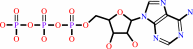 ATP
ATP
|
+
|
H2O
|
+
|
lipid A-core oligosaccharideSide 1
|
=
|
 ADP
ADP
|
+
|
phosphate
Bound ligand (Het Group name = )
matches with 50.00% similarity
|
+
|
lipid A-core oligosaccharideSide 2
|
|
|
|
|
|
|
|
|
|
|
|
|
Molecule diagrams generated from .mol files obtained from the
KEGG ftp site
|
|
|
|
|
|
|
|
|
|
|
|
|
|
 |
|
|
|
|
|
|
| |
|
|
| |
|
DOI no:
|
Nature
557:196-201
(2018)
|
|
PubMed id:
|
|
|
|
|
|
| |
|
Structural basis for dual-mode inhibition of the ABC transporter MsbA.
|
|
H.Ho,
A.Miu,
M.K.Alexander,
N.K.Garcia,
A.Oh,
I.Zilberleyb,
M.Reichelt,
C.D.Austin,
C.Tam,
S.Shriver,
H.Hu,
S.S.Labadie,
J.Liang,
L.Wang,
J.Wang,
Y.Lu,
H.E.Purkey,
J.Quinn,
Y.Franke,
K.Clark,
M.H.Beresini,
M.W.Tan,
B.D.Sellers,
T.Maurer,
M.F.T.Koehler,
A.T.Wecksler,
J.R.Kiefer,
V.Verma,
Y.Xu,
M.Nishiyama,
J.Payandeh,
C.M.Koth.
|
|
|
|
|
| |
ABSTRACT
|
|
|
|
| |
|
|
The movement of core-lipopolysaccharide across the inner membrane of
Gram-negative bacteria is catalysed by an essential ATP-binding cassette
transporter, MsbA. Recent structures of MsbA and related transporters have
provided insights into the molecular basis of active lipid transport; however,
structural information about their pharmacological modulation remains limited.
Here we report the 2.9 Å resolution structure of MsbA in complex with G907, a
selective small-molecule antagonist with bactericidal activity, revealing an
unprecedented mechanism of ABC transporter inhibition. G907 traps MsbA in an
inward-facing, lipopolysaccharide-bound conformation by wedging into an
architecturally conserved transmembrane pocket. A second allosteric mechanism of
antagonism occurs through structural and functional uncoupling of the
nucleotide-binding domains. This study establishes a framework for the selective
modulation of ABC transporters and provides rational avenues for the design of
new antibiotics and other therapeutics targeting this protein family.
|
|
|
|
|
|
|
|
|
|
|
|
|
|
|
|
|
|
 |
 |
 |
|


 Links
Links