 |
PDBsum entry 3dr4

|
|
|
|
|
 |
Contents |
 |
|
|
|
|
|
|
|
|
|
|
|
|
* Residue conservation analysis
|
|
|
|
|
|
|
|
|
|
|
Enzyme class:
|
|
E.C.2.6.1.102
- GDP-perosamine synthase.
|
|
|
|
|
|
|
Reaction:
|
|
GDP-alpha-D-perosamine + 2-oxoglutarate = GDP-4-dehydro-alpha-D-rhamnose + L-glutamate
|
|
|
|
|
|
GDP-alpha-D-perosamine
Bound ligand (Het Group name = )
matches with 40.00% similarity
|
+
|
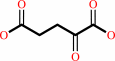 2-oxoglutarate
|
=
|
GDP-4-dehydro-alpha-D-rhamnose
|
+
|
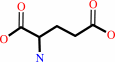 L-glutamate
|
|
|
|
|
|
|
|
|
|
Cofactor:
|
|
Pyridoxal 5'-phosphate
|
|
|
|
|
|
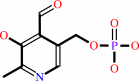 Pyridoxal 5'-phosphate
|
|
|
|
|
|
|
Molecule diagrams generated from .mol files obtained from the
KEGG ftp site
|
|
|
|
|
|
|
|
|
|
|
|
|
|
 |
|
|
|
|
|
|
| |
|
|
| |
|
|
Biochemistry
47:10685-10693
(2008)
|
|
PubMed id:
|
|
|
|
|
|
| |
|
Accommodation of GDP-linked sugars in the active site of GDP-perosamine synthase.
|
|
P.D.Cook,
A.E.Carney,
H.M.Holden.
|
|
|
|
|
| |
ABSTRACT
|
|
|
|
| |
|
|
Perosamine (4-amino-4,6-dideoxy- d-mannose), or its N-acetylated form, is one of
several dideoxy sugars found in the O-antigens of such infamous Gram-negative
bacteria as Vibrio cholerae O1 and Escherichia coli O157:H7. It is added to the
bacterial O-antigen via a nucleotide-linked version, namely GDP-perosamine.
Three enzymes are required for the biosynthesis of GDP-perosamine starting from
mannose 1-phosphate. The focus of this investigation is GDP-perosamine synthase
from Caulobacter crescentus, which catalyzes the final step in GDP-perosamine
synthesis, the conversion of GDP-4-keto-6-deoxymannose to GDP-perosamine. The
enzyme is PLP-dependent and belongs to the aspartate aminotransferase
superfamily. It contains the typically conserved active site lysine residue,
which forms a Schiff base with the PLP cofactor. Two crystal structures were
determined for this investigation: a site-directed mutant protein (K186A)
complexed with GDP-perosamine and the wild-type enzyme complexed with an
unnatural ligand, GDP-3-deoxyperosamine. These structures, determined to 1.6 and
1.7 A resolution, respectively, revealed the manner in which products, and
presumably substrates, are accommodated within the active site pocket of
GDP-perosamine synthase. Additional kinetic analyses using both the natural and
unnatural substrates revealed that the K m for the unnatural substrate was
unperturbed relative to that of the natural substrate, but the k cat was lowered
by a factor of approximately 200. Taken together, these studies shed light on
why GDP-perosamine synthase functions as an aminotransferase whereas another
very similar PLP-dependent enzyme, GDP-4-keto-6-deoxy- d-mannose 3-dehydratase
or ColD, catalyzes a dehydration reaction using the same substrate.
|
|
|
|
|
|
|
|
|
|
|
|
|
|
|
|
|
|
 |
 |
 |
|
Literature references that cite this PDB file's key reference
|
|
|
| |
PubMed id
|
|
Reference
|
|
|
|
|
|
E.Hutchinson,
B.Murphy,
T.Dunne,
C.Breen,
B.Rawlings,
and
P.Caffrey
(2010).
Redesign of polyene macrolide glycosylation: engineered biosynthesis of 19-(O)-perosaminyl-amphoteronolide B.
|
| |
Chem Biol,
17,
174-182.
|
|
|
|
|
|
|
H.M.Holden,
P.D.Cook,
and
J.B.Thoden
(2010).
Biosynthetic enzymes of unusual microbial sugars.
|
| |
Curr Opin Struct Biol,
20,
543-550.
|
|
|
|
|
|
|
P.D.Cook,
R.L.Kubiak,
D.P.Toomey,
and
H.M.Holden
(2009).
Two site-directed mutations are required for the conversion of a sugar dehydratase into an aminotransferase.
|
| |
Biochemistry,
48,
5246-5253.
|
|
|
PDB code:
|
|
|
|
|
|
|
The most recent references are shown first.
Citation data come partly from CiteXplore and partly
from an automated harvesting procedure. Note that this is likely to be
only a partial list as not all journals are covered by
either method. However, we are continually building up the citation data
so more and more references will be included with time.
Where a reference describes a PDB structure, the PDB
code is
shown on the right.
|
|


 Links
Links


