 |
PDBsum entry 2w1h

|
|
|
|
|
 |
Contents |
 |
|
|
|
|
|
|
|
|
|
|
|
|
* Residue conservation analysis
|
|
|
|
|
|
PDB id:
|
|
|
|
| Name: |
|
Transferase
|
|
|
Title:
|
|
Fragment-based discovery of the pyrazol-4-yl urea (at9283), a multi- targeted kinase inhibitor with potent aurora kinase activity
|
|
Structure:
|
|
Cell division protein kinase 2. Chain: a. Synonym: p33 protein kinase, cdk2. Engineered: yes
|
|
Source:
|
|
Homo sapiens. Human. Organism_taxid: 9606. Expressed in: spodoptera frugiperda. Expression_system_taxid: 7108. Expression_system_cell_line: sf9.
|
|
Resolution:
|
|
|
2.15Å
|
R-factor:
|
0.263
|
R-free:
|
0.308
|
|
|
Authors:
|
|
S.Howard,V.Berdini,J.A.Boulstridge,M.G.Carr,D.M.Cross,J.Curry, L.A.Devine,T.R.Early,L.Fazal,A.L.Gill,M.Heathcote,S.Maman, J.E.Matthews,R.L.Mcmenamin,E.F.Navarro,M.A.O'Brien,M.O'Reilly, D.C.Rees,M.Reule,D.Tisi,G.Williams,M.Vinkovic,P.G.Wyatt
|
|
Key ref:
|
|
S.Howard
et al.
(2009).
Fragment-based discovery of the pyrazol-4-yl urea (AT9283), a multitargeted kinase inhibitor with potent aurora kinase activity.
J Med Chem,
52,
379-388.
PubMed id:
|
|
|
Date:
|
|
|
17-Oct-08
|
Release date:
|
27-Jan-09
|
|
|
|
|
|
|
PROCHECK
|

|
|
|
|
|
Headers
|
|
|
|
References
|
|
|
|
|
|

|
|
P24941
(CDK2_HUMAN) -
Cyclin-dependent kinase 2 from Homo sapiens
|
|
|
|
Seq:
Struc:
|
|
|
|
298 a.a.
283 a.a.
|
|

|

|

|
|
|
|
|
|
|
|
|
|
|
Key: |
 |
PfamA domain |
|
|
 |
Secondary structure |
|
 |
CATH domain |
|
|
|
|
|
|
|
|
|
|
|
|
|
Enzyme class:
|
|
E.C.2.7.11.22
- cyclin-dependent kinase.
|
|
|
|
|
|
|
Reaction:
|
|
|
1.
|
L-seryl-[protein] + ATP = O-phospho-L-seryl-[protein] + ADP + H+
|
|
2.
|
L-threonyl-[protein] + ATP = O-phospho-L-threonyl-[protein] + ADP + H+
|
|
|
|
|
|
|
L-seryl-[protein]
|
+
|
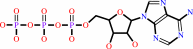 ATP
ATP
|
=
|
O-phospho-L-seryl-[protein]
|
+
|
 ADP
ADP
|
+
|
H(+)
|
|
|
|
|
|
|
L-threonyl-[protein]
|
+
|
ATP
|
=
|
O-phospho-L-threonyl-[protein]
|
+
|
ADP
|
+
|
H(+)
|
|
|
|
|
|
|
|
|
|
|
|
|
Molecule diagrams generated from .mol files obtained from the
KEGG ftp site
|
|
|
|
|
|
|
|
|
|
|
|
|
|
 |
|
|
|
|
|
|
| |
|
|
| |
|
|
J Med Chem
52:379-388
(2009)
|
|
PubMed id:
|
|
|
|
|
|
| |
|
Fragment-based discovery of the pyrazol-4-yl urea (AT9283), a multitargeted kinase inhibitor with potent aurora kinase activity.
|
|
S.Howard,
V.Berdini,
J.A.Boulstridge,
M.G.Carr,
D.M.Cross,
J.Curry,
L.A.Devine,
T.R.Early,
L.Fazal,
A.L.Gill,
M.Heathcote,
S.Maman,
J.E.Matthews,
R.L.McMenamin,
E.F.Navarro,
M.A.O'Brien,
M.O'Reilly,
D.C.Rees,
M.Reule,
D.Tisi,
G.Williams,
M.Vinković,
P.G.Wyatt.
|
|
|
|
|
| |
ABSTRACT
|
|
|
|
| |
|
|
Here, we describe the identification of a clinical candidate via structure-based
optimization of a ligand efficient pyrazole-benzimidazole fragment. Aurora
kinases play a key role in the regulation of mitosis and in recent years have
become attractive targets for the treatment of cancer. X-ray crystallographic
structures were generated using a novel soakable form of Aurora A and were used
to drive the optimization toward potent (IC(50) approximately 3 nM) dual Aurora
A/Aurora B inhibitors. These compounds inhibited growth and survival of HCT116
cells and produced the polyploid cellular phenotype typically associated with
Aurora B kinase inhibition. Optimization of cellular activity and
physicochemical properties ultimately led to the identification of compound 16
(AT9283). In addition to Aurora A and Aurora B, compound 16 was also found to
inhibit a number of other kinases including JAK2 and Abl (T315I). This compound
demonstrated in vivo efficacy in mouse xenograft models and is currently under
evaluation in phase I clinical trials.
|
|
|
|
|
|
|
|
|
|
|
|
|
|
|
|
|
|
 |
 |
 |
|
Literature references that cite this PDB file's key reference
|
|
|
| |
PubMed id
|
|
Reference
|
|
|
|
|
|
A.Yan,
L.Wang,
S.Xu,
and
J.Xu
(2011).
Aurora-A kinase inhibitor scaffolds and binding modes.
|
| |
Drug Discov Today,
16,
260-269.
|
|
|
|
|
|
|
A.Yan,
Y.Chong,
L.Wang,
X.Hu,
and
K.Wang
(2011).
Prediction of biological activity of Aurora-A kinase inhibitors by multilinear regression analysis and support vector machine.
|
| |
Bioorg Med Chem Lett,
21,
2238-2243.
|
|
|
|
|
|
|
D.Bixby,
and
M.Talpaz
(2011).
Seeking the causes and solutions to imatinib-resistance in chronic myeloid leukemia.
|
| |
Leukemia,
25,
7.
|
|
|
|
|
|
|
F.P.Santos,
and
A.Quintás-Cardama
(2011).
New drugs for chronic myelogenous leukemia.
|
| |
Curr Hematol Malig Rep,
6,
96.
|
|
|
|
|
|
|
J.Lee,
S.M.Paek,
and
S.Y.Han
(2011).
FMS-like tyrosine kinase 3 inhibitors: a patent review.
|
| |
Expert Opin Ther Pat,
21,
483-503.
|
|
|
|
|
|
|
P.D.Leeson,
and
S.A.St-Gallay
(2011).
The influence of the 'organizational factor' on compound quality in drug discovery.
|
| |
Nat Rev Drug Discov,
10,
749-765.
|
|
|
|
|
|
|
R.E.Hubbard
(2011).
Structure-based drug discovery and protein targets in the CNS.
|
| |
Neuropharmacology,
60,
7.
|
|
|
|
|
|
|
S.Schenone,
O.Bruno,
M.Radi,
and
M.Botta
(2011).
New insights into small-molecule inhibitors of Bcr-Abl.
|
| |
Med Res Rev,
31,
1.
|
|
|
|
|
|
|
Y.Cheng,
W.Cui,
Q.Chen,
C.H.Tung,
M.Ji,
and
F.Zhang
(2011).
The molecular mechanism studies of chirality effect of PHA-739358 on Aurora kinase A by molecular dynamics simulation and free energy calculations.
|
| |
J Comput Aided Mol Des,
25,
171-180.
|
|
|
|
|
|
|
C.A.Dodson,
M.Kosmopoulou,
M.W.Richards,
B.Atrash,
V.Bavetsias,
J.Blagg,
and
R.Bayliss
(2010).
Crystal structure of an Aurora-A mutant that mimics Aurora-B bound to MLN8054: insights into selectivity and drug design.
|
| |
Biochem J,
427,
19-28.
|
|
|
PDB codes:
|
|
|
|
|
|
|
|
C.W.Murray,
and
T.L.Blundell
(2010).
Structural biology in fragment-based drug design.
|
| |
Curr Opin Struct Biol,
20,
497-507.
|
|
|
|
|
|
|
E.J.Ashforth,
C.Fu,
X.Liu,
H.Dai,
F.Song,
H.Guo,
and
L.Zhang
(2010).
Bioprospecting for antituberculosis leads from microbial metabolites.
|
| |
Nat Prod Rep,
27,
1709-1719.
|
|
|
|
|
|
|
J.Qin,
L.Xi,
J.Du,
H.Liu,
and
X.Yao
(2010).
QSAR studies on aminothiazole derivatives as aurora a kinase inhibitors.
|
| |
Chem Biol Drug Des,
76,
527-537.
|
|
|
|
|
|
|
K.L.Whalen,
K.L.Pankow,
S.R.Blanke,
and
M.A.Spies
(2010).
Exploiting Enzyme Plasticity in Virtual Screening: High Efficiency Inhibitors of Glutamate Racemase.
|
| |
ACS Med Chem Lett,
1,
9.
|
|
|
|
|
|
|
M.S.Coumar,
M.T.Tsai,
C.Y.Chu,
B.J.Uang,
W.H.Lin,
C.Y.Chang,
T.Y.Chang,
J.S.Leou,
C.H.Teng,
J.S.Wu,
M.Y.Fang,
C.H.Chen,
J.T.Hsu,
S.Y.Wu,
Y.S.Chao,
and
H.P.Hsieh
(2010).
Identification, SAR studies, and X-ray co-crystallographic analysis of a novel furanopyrimidine aurora kinase A inhibitor.
|
| |
ChemMedChem,
5,
255-267.
|
|
|
PDB code:
|
|
|
|
|
|
|
|
R.Tanaka,
M.S.Squires,
S.Kimura,
A.Yokota,
R.Nagao,
T.Yamauchi,
M.Takeuchi,
H.Yao,
M.Reule,
T.Smyth,
J.F.Lyons,
N.T.Thompson,
E.Ashihara,
O.G.Ottmann,
and
T.Maekawa
(2010).
Activity of the multitargeted kinase inhibitor, AT9283, in imatinib-resistant BCR-ABL-positive leukemic cells.
|
| |
Blood,
116,
2089-2095.
|
|
|
|
|
|
|
P.J.Scutt,
M.L.Chu,
D.A.Sloane,
M.Cherry,
C.R.Bignell,
D.H.Williams,
and
P.A.Eyers
(2009).
Discovery and exploitation of inhibitor-resistant aurora and polo kinase mutants for the analysis of mitotic networks.
|
| |
J Biol Chem,
284,
15880-15893.
|
|
|
|
|
|
|
S.Lapenna,
and
A.Giordano
(2009).
Cell cycle kinases as therapeutic targets for cancer.
|
| |
Nat Rev Drug Discov,
8,
547-566.
|
|
|
|
|
|
|
X.Tao,
H.S.Chon,
S.Fu,
J.J.Kavanagh,
and
W.Hu
(2008).
Update on aurora kinase inhibitors in gynecologic malignancies.
|
| |
Recent Pat Anticancer Drug Discov,
3,
162-177.
|
|
|
|
|
|
The most recent references are shown first.
Citation data come partly from CiteXplore and partly
from an automated harvesting procedure. Note that this is likely to be
only a partial list as not all journals are covered by
either method. However, we are continually building up the citation data
so more and more references will be included with time.
Where a reference describes a PDB structure, the PDB
codes are
shown on the right.
|
|


 Links
Links


