|
PDBsum entry 2kod

|
|
|
|
|
|

|

|

|

|
|

|
|

|
|

|
|
|
 |

|

|
|
|
|
|
|
|
|
|
|
|
|
|
|
|
|
|
|
|
|
|
|
|
|
|
|
|
|
|
|
|
|
Viral protein
|
PDB id
|
|
|
|
2kod
|
|
|
|
|
|
|
|
|
|
|
|
|
|
|

|

|

|
|
|
|
|
|
|
|
|
Enzyme class 1:
|
|
E.C.2.7.7.-
- ?????
|
|
|
|
|
|
|
Enzyme class 2:
|
|
E.C.2.7.7.49
- RNA-directed Dna polymerase.
|
|
|
|
|
|
|
Reaction:
|
|
DNA(n) + a 2'-deoxyribonucleoside 5'-triphosphate = DNA(n+1) + diphosphate
|
|
|
|
|
|
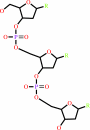 DNA(n)
|
+
|
2'-deoxyribonucleoside 5'-triphosphate
|
=
|
DNA(n+1)
|
+
|
 diphosphate
|
|
|
|
|
|
|
|
|
|
Enzyme class 3:
|
|
E.C.2.7.7.7
- DNA-directed Dna polymerase.
|
|
|
|
|
|
|
Reaction:
|
|
DNA(n) + a 2'-deoxyribonucleoside 5'-triphosphate = DNA(n+1) + diphosphate
|
|
|
|
|
|
DNA(n)
|
+
|
2'-deoxyribonucleoside 5'-triphosphate
|
=
|
DNA(n+1)
|
+
|
diphosphate
|
|
|
|
|
|
|
|
|
|
Enzyme class 4:
|
|
E.C.3.1.-.-
|
|
|
|
|
|
|
Enzyme class 5:
|
|
E.C.3.1.13.2
- exoribonuclease H.
|
|
|
|
|
|
|
Reaction:
|
|
Exonucleolytic cleavage to 5'-phosphomonoester oligonucleotides in both 5'- to 3'- and 3'- to 5'-directions.
|
|
|
|
|
|
Enzyme class 6:
|
|
E.C.3.1.26.13
- retroviral ribonuclease H.
|
|
|
|
|
|
|
Enzyme class 7:
|
|
E.C.3.4.23.16
- HIV-1 retropepsin.
|
|
|
|
|
|
|
Reaction:
|
|
Specific for a P1 residue that is hydrophobic, and P1' variable, but often Pro.
|
|
|
|
|
|
|
|
|
Note, where more than one E.C. class is given (as above), each may
correspond to a different protein domain or, in the case of polyprotein
precursors, to a different mature protein.
|
|
|
|
Molecule diagrams generated from .mol files obtained from the
KEGG ftp site
|
|
|
|
|
|
|
|
|
|
|
|
|
|
 |
|
|
|
|
|
|
| |
|
|
| |
|
|
Cell
139:780-790
(2009)
|
|
PubMed id:
|
|
|
|
|
|
| |
|
Structural convergence between Cryo-EM and NMR reveals intersubunit interactions critical for HIV-1 capsid function.
|
|
I.J.Byeon,
X.Meng,
J.Jung,
G.Zhao,
R.Yang,
J.Ahn,
J.Shi,
J.Concel,
C.Aiken,
P.Zhang,
A.M.Gronenborn.
|
|
|
|
|
| |
ABSTRACT
|
|
|
|
| |
|
|
Mature HIV-1 particles contain conical-shaped capsids that enclose the viral RNA
genome and perform essential functions in the virus life cycle. Previous
structural analysis of two- and three-dimensional arrays of the capsid protein
(CA) hexamer revealed three interfaces. Here, we present a cryoEM study of a
tubular assembly of CA and a high-resolution NMR structure of the CA C-terminal
domain (CTD) dimer. In the solution dimer structure, the monomers exhibit
different relative orientations compared to previous X-ray structures. The
solution structure fits well into the EM density map, suggesting that the dimer
interface is retained in the assembled CA. We also identified a CTD-CTD
interface at the local three-fold axis in the cryoEM map and confirmed its
functional importance by mutagenesis. In the tubular assembly, CA intermolecular
interfaces vary slightly, accommodating the asymmetry present in tubes. This
provides the necessary plasticity to allow for controlled virus capsid
dis/assembly.
|
|
|
|
|
|
|
|
|
|
|
|
|
|
|
|
|
|
 |
 |
 |
|
Literature references that cite this PDB file's key reference
|
|
|
| |
PubMed id
|
|
Reference
|
|
|
|
|
|
A.Engelman,
and
P.Cherepanov
(2012).
The structural biology of HIV-1: mechanistic and therapeutic insights.
|
| |
Nat Rev Microbiol,
10,
279-290.
|
|
|
|
|
|
|
C.J.Tsai,
and
R.Nussinov
(2011).
A unified convention for biological assemblies with helical symmetry.
|
| |
Acta Crystallogr D Biol Crystallogr,
67,
716-728.
|
|
|
|
|
|
|
O.Pornillos,
B.K.Ganser-Pornillos,
and
M.Yeager
(2011).
Atomic-level modelling of the HIV capsid.
|
| |
Nature,
469,
424-427.
|
|
|
PDB codes:
|
|
|
|
|
|
|
The most recent references are shown first.
Citation data come partly from CiteXplore and partly
from an automated harvesting procedure. Note that this is likely to be
only a partial list as not all journals are covered by
either method. However, we are continually building up the citation data
so more and more references will be included with time.
Where a reference describes a PDB structure, the PDB
codes are
shown on the right.
|
|


 Links
Links