 |
PDBsum entry 2cmc

|
|
|
|
|
 |
Contents |
 |
|
|
|
|
|
|
|
|
|
|
|
|
* Residue conservation analysis
|
|
|
|
|
|
PDB id:
|
|
|
|
| Name: |
|
Hydrolase
|
|
|
Title:
|
|
Structural basis for inhibition of protein tyrosine phosphatase 1b by isothiazolidinone heterocyclic phosphonate mimetics
|
|
Structure:
|
|
Tyrosine-protein phosphatase non-receptor type 1. Chain: a. Fragment: catalytic domain, residues 1-298. Synonym: protein tyrosine phosphatase 1b. Engineered: yes
|
|
Source:
|
|
Homo sapiens. Human. Organism_taxid: 9606. Expressed in: escherichia coli. Expression_system_taxid: 469008.
|
|
Resolution:
|
|
|
2.20Å
|
R-factor:
|
0.209
|
R-free:
|
0.263
|
|
|
Authors:
|
|
P.J.Ala,L.Gonneville,M.C.Hillman,M.Becker-Pasha,M.Wei,B.G.Reid, R.Klabe,E.W.Yue,B.Wayland,B.Douty,A.P.Combs,P.Polam,Z.Wasserman, M.Bower,T.C.Burn,G.F.Hollis,R.Wynn
|
Key ref:

|
|
P.J.Ala
et al.
(2006).
Structural basis for inhibition of protein-tyrosine phosphatase 1B by isothiazolidinone heterocyclic phosphonate mimetics.
J Biol Chem,
281,
32784-32795.
PubMed id:
DOI:

|
|
|
Date:
|
|
|
04-May-06
|
Release date:
|
17-Aug-06
|
|
|
|
|
|
|
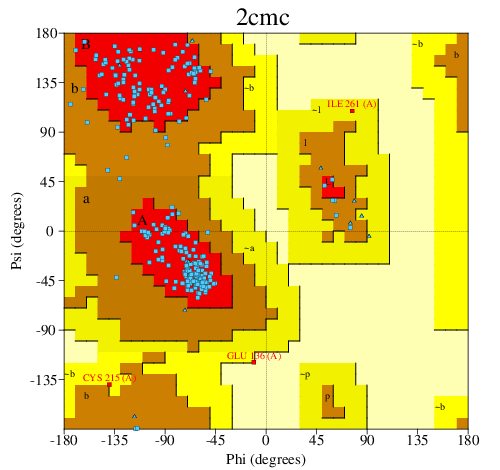
PROCHECK
|
|
|
|
|
|
Headers
|
|
|
|
References
|
|
|
|
|
|

|
|
P18031
(PTN1_HUMAN) -
Tyrosine-protein phosphatase non-receptor type 1 from Homo sapiens
|
|
|
|
Seq:
Struc:
|
|
|
|
435 a.a.
286 a.a.*
|
|

|

|

|
|
|
|
|
|
|
|
|
|
|
Key: |
 |
PfamA domain |
|
|
 |
Secondary structure |
|
 |
CATH domain |
|
|
*
PDB and UniProt seqs differ
at 1 residue position (black
cross)
|
|
|
|
|
|
|
|
|
|
|
|
|
Enzyme class:
|
|
E.C.3.1.3.48
- protein-tyrosine-phosphatase.
|
|
|
|
|
|
|
Reaction:
|
|
O-phospho-L-tyrosyl-[protein] + H2O = L-tyrosyl-[protein] + phosphate
|
|
|
|
|
|
O-phospho-L-tyrosyl-[protein]
|
+
|
H2O
|
=
|
L-tyrosyl-[protein]
|
+
|
 phosphate
|
|
|
|
|
|
|
|
|
|
|
|
|
Molecule diagrams generated from .mol files obtained from the
KEGG ftp site
|
|
|
|
|
|
|
|
|
|
|
|
|
|
 |
|
|
|
|
|
|
| |
|
|
| |
|
DOI no:
|
J Biol Chem
281:32784-32795
(2006)
|
|
PubMed id:
|
|
|
|
|
|
| |
|
Structural basis for inhibition of protein-tyrosine phosphatase 1B by isothiazolidinone heterocyclic phosphonate mimetics.
|
|
P.J.Ala,
L.Gonneville,
M.C.Hillman,
M.Becker-Pasha,
M.Wei,
B.G.Reid,
R.Klabe,
E.W.Yue,
B.Wayland,
B.Douty,
P.Polam,
Z.Wasserman,
M.Bower,
A.P.Combs,
T.C.Burn,
G.F.Hollis,
R.Wynn.
|
|
|
|
|
| |
ABSTRACT
|
|
|
|
| |
|
|
Crystal structures of protein-tyrosine phosphatase 1B in complex with compounds
bearing a novel isothiazolidinone (IZD) heterocyclic phosphonate mimetic reveal
that the heterocycle is highly complementary to the catalytic pocket of the
protein. The heterocycle participates in an extensive network of hydrogen bonds
with the backbone of the phosphate-binding loop, Phe(182) of the flap, and the
side chain of Arg(221). When substituted with a phenol, the small inhibitor
induces the closed conformation of the protein and displaces all waters in the
catalytic pocket. Saturated IZD-containing peptides are more potent inhibitors
than unsaturated analogs because the IZD heterocycle and phenyl ring directly
attached to it bind in a nearly orthogonal orientation with respect to each
other, a conformation that is close to the energy minimum of the saturated
IZD-phenyl moiety. These results explain why the heterocycle is a potent
phosphonate mimetic and an ideal starting point for designing small nonpeptidic
inhibitors.
|
|
|
|
|
|
| |
Selected figure(s)
|
|
|
|
| |
|
|

|
|

|
|
Figure 2.
FIGURE 2. Crystal structure of PTP1B/1. a, superposition of
the bound conformations of the phosphonate mimetics of compounds
1, 5, and 1G7G. Note the IZD heterocycle of 1 mimics the
interactions of DFMP and CMBA, and it displaces four waters. b,
stereo view of the 2F[o] - F[c] simulated annealed omit map
(contoured at 1  ) and atomic model for
PTP1B/1. The inhibitor was omitted from the model prior to a
cycle of simulated annealing and was not used in the calculation
of phases. c, stereo view of 1 (ball-and-stick) bound in the A
site. Dashed lines indicate 10 potential hydrogen bonds between
the inhibitor and residues in the active site. ) and atomic model for
PTP1B/1. The inhibitor was omitted from the model prior to a
cycle of simulated annealing and was not used in the calculation
of phases. c, stereo view of 1 (ball-and-stick) bound in the A
site. Dashed lines indicate 10 potential hydrogen bonds between
the inhibitor and residues in the active site.
|
|
Figure 6.
FIGURE 6. Bound conformations of saturated and unsaturated
IZD-phenyl moieties. a, the relative angle between the
unsaturated IZD and phenyl rings of 1 is  70-75°. b,
superposition of the unsaturated IZD 1 (stick bonds) and the
saturated (S)-IZD-phenyl moiety of 2 (ball-and-stick). Note the
phenyl ring and heteroatoms of IZD bind in the same position
whether or not the heterocycle is reduced. 70-75°. b,
superposition of the unsaturated IZD 1 (stick bonds) and the
saturated (S)-IZD-phenyl moiety of 2 (ball-and-stick). Note the
phenyl ring and heteroatoms of IZD bind in the same position
whether or not the heterocycle is reduced.
|
|
|
|
|
|
| |
The above figures are
reprinted
by permission from the ASBMB:
J Biol Chem
(2006,
281,
32784-32795)
copyright 2006.
|
|
| |
Figures were
selected
by the author.
|
|
|
|
|
|
|
|
|
|
|
|
|
|
|
|
 |
 |
 |
|
Literature references that cite this PDB file's key reference
|
|
|
| |
PubMed id
|
|
Reference
|
|
|
|
|
|
C.Abad-Zapatero,
O.Perišić,
J.Wass,
A.P.Bento,
J.Overington,
B.Al-Lazikani,
and
M.E.Johnson
(2010).
Ligand efficiency indices for an effective mapping of chemico-biological space: the concept of an atlas-like representation.
|
| |
Drug Discov Today,
15,
804-811.
|
|
|
|
|
|
|
K.A.Rawls,
C.Grundner,
and
J.A.Ellman
(2010).
Design and synthesis of nonpeptidic, small molecule inhibitors for the Mycobacterium tuberculosis protein tyrosine phosphatase PtpB.
|
| |
Org Biomol Chem,
8,
4066-4070.
|
|
|
|
|
|
|
T.A.Brandão,
A.C.Hengge,
and
S.J.Johnson
(2010).
Insights into the reaction of protein-tyrosine phosphatase 1B: crystal structures for transition state analogs of both catalytic steps.
|
| |
J Biol Chem,
285,
15874-15883.
|
|
|
PDB codes:
|
|
|
|
|
|
|
|
D.Vidović,
and
S.C.Schürer
(2009).
Knowledge-based characterization of similarity relationships in the human protein-tyrosine phosphatase family for rational inhibitor design.
|
| |
J Med Chem,
52,
6649-6659.
|
|
|
|
|
|
The most recent references are shown first.
Citation data come partly from CiteXplore and partly
from an automated harvesting procedure. Note that this is likely to be
only a partial list as not all journals are covered by
either method. However, we are continually building up the citation data
so more and more references will be included with time.
Where a reference describes a PDB structure, the PDB
codes are
shown on the right.
|
|


 Links
Links


