 |
PDBsum entry 1s9f

|
|
|
|
|
|

|

|

|

|
|

|
|

|
|

|
|

|
|

|
|

|
|

|
|

|
|
|
 |

|

|
|
|
|
|
|
|
|
|
|
|
|
|
|
|
|
|
|
|
|
|
|
|
|
|
|
|
|
|
|
|
|
|
|
|
|
|
Transferase/DNA
|
PDB id
|
|
|
|
1s9f
|
|
|
|
|
|
|
|
|
|
|
|
|
|
|

|

|

|
|
|
|
|
|
|
|
 |
Contents |
 |
|
|
|
|
|
|
|
|
|
|
|
|
|
|
|
|
* Residue conservation analysis
|
|
|
|
|
|
PDB id:
|
|
|
|
| Name: |
|
Transferase/DNA
|
|
|
Title:
|
|
Dpo with at matched
|
|
Structure:
|
|
5'-d( Gp Gp Gp Gp Gp Ap Ap Gp Gp Ap Cp Tp A)-3'. Chain: e, f, g, h. Engineered: yes. 5'-d( T Tp Cp Ap Gp Tp Ap Gp Tp Cp Cp Tp Tp Cp Cp Cp Cp C)- 3'. Chain: i, j, k, l. Engineered: yes. DNA polymerase iv. Chain: a, b, c, d.
|
|
Source:
|
|
Synthetic: yes. Sulfolobus solfataricus. Organism_taxid: 2287. Gene: dbh, dpo4, sso2448. Expressed in: escherichia coli. Expression_system_taxid: 562
|
|
Biol. unit:
|
|
 Trimer (from
)
Trimer (from
)
|
|
Resolution:
|
|
|
2.00Å
|
R-factor:
|
0.205
|
R-free:
|
0.239
|
|
|
Authors:
|
|
J.Trincao,R.E.Johnson,W.T.Wolfle,C.R.Escalante,S.Prakash,L.Prakash, A.K.Aggarwal
|
Key ref:

|
|
J.Trincao
et al.
(2004).
Dpo4 is hindered in extending a G.T mismatch by a reverse wobble.
Nat Struct Mol Biol,
11,
457-462.
PubMed id:
DOI:

|
|
|
Date:
|
|
|
04-Feb-04
|
Release date:
|
15-Feb-05
|
|
|
|
|
|
|
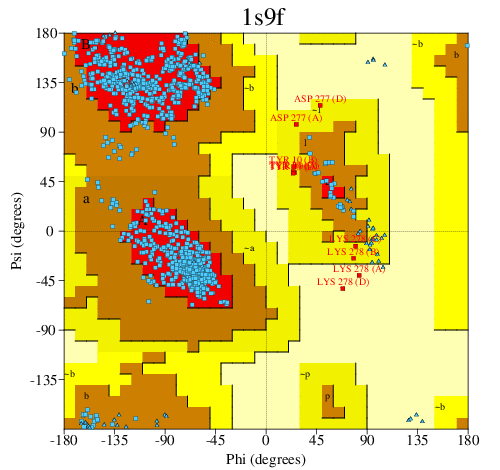
PROCHECK
|
|
|
|
|
|
Headers
|
|
|
|
References
|
|
|
|
|
|

|
|
Q97W02
(DPO4_SULSO) -
DNA polymerase IV from Saccharolobus solfataricus (strain ATCC 35092 / DSM 1617 / JCM 11322 / P2)
|
|
|
|
Seq:
Struc:
|
|
|
|
352 a.a.
341 a.a.
|
|

|

|

|
|
|
|
|
|
|
|
|
|
|
Key: |
 |
PfamA domain |
|
|
 |
Secondary structure |
|
 |
CATH domain |
|
|
|
|
|
|
|
|

|
|
|
|
G-G-G-G-G-A-A-G-G-A-C-T-A
13 bases
|
|
|
|
T-C-A-G-T-A-G-T-C-C-T-T-C-C-C-C-C
17 bases
|
|
|
|
G-G-G-G-G-A-A-G-G-A-C-T-A
13 bases
|
|
|
|
T-C-A-G-T-A-G-T-C-C-T-T-C-C-C-C-C
17 bases
|
|
|
|
G-G-G-G-G-A-A-G-G-A-C-T-A
13 bases
|
|
|
|
T-C-A-G-T-A-G-T-C-C-T-T-C-C-C-C-C
17 bases
|
|
|
|
G-G-G-G-G-A-A-G-G-A-C-T-A
13 bases
|
|
|
|
T-C-A-G-T-A-G-T-C-C-T-T-C-C-C-C-C
17 bases
|
|
|
|
|
|
|
|
|
|
|
|
|
|
Enzyme class:
|
|
E.C.2.7.7.7
- DNA-directed Dna polymerase.
|
|
|
|
|
|
|
Reaction:
|
|
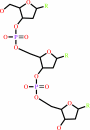
DNA(n) + a 2'-deoxyribonucleoside 5'-triphosphate = DNA(n+1) + diphosphate
|
|
|
|
|
|
 DNA(n)
|
+
|
2'-deoxyribonucleoside 5'-triphosphate
|
=
|
DNA(n+1)
|
+
|
 diphosphate
|
|
|
|
|
|
|
|
|
|
|
|
|
Molecule diagrams generated from .mol files obtained from the
KEGG ftp site
|
|
|
|
|
|
|
|
|
|
|
|
|
|
 |
|
|
|
|
|
|
| |
|
|
| |
|
DOI no:
|
Nat Struct Mol Biol
11:457-462
(2004)
|
|
PubMed id:
|
|
|
|
|
|
| |
|
Dpo4 is hindered in extending a G.T mismatch by a reverse wobble.
|
|
J.Trincao,
R.E.Johnson,
W.T.Wolfle,
C.R.Escalante,
S.Prakash,
L.Prakash,
A.K.Aggarwal.
|
|
|
|
|
| |
ABSTRACT
|
|
|
|
| |
|
|
The ability or inability of a DNA polymerase to extend a mispair directly
affects the establishment of genomic mutations. We report here kinetic analyses
of the ability of Dpo4, a Y-family polymerase from Sulfolobus solfataricus, to
extend from all mispairs opposite a template G or T. Dpo4 is equally inefficient
at extending these mispairs, which include, surprisingly, a G.T mispair expected
to conform closely to Watson-Crick geometry. To elucidate the basis of this, we
solved the structure of Dpo4 bound to G.T-mispaired primer template in the
presence of an incoming nucleotide. As a control, we also determined the
structure of Dpo4 bound to a matched A-T base pair at the primer terminus. The
structures offer a basis for the low efficiency of Dpo4 in extending a G.T
mispair: a reverse wobble that deflects the primer 3'-OH away from the incoming
nucleotide.
|
|
|
|
|
|
| |
Selected figure(s)
|
|
|
|
| |
|
|

|
|

|
|
Figure 1.
Figure 1. Dpo4-catalyzed extension of a G  T
primer -terminal mispair. (a) The incorporation of dGTP
opposite C following an A-T primer -terminal base pair (left) is
500-fold more efficient when compared to the incorporation of
dGTP opposite C following a G T
primer -terminal mispair (right). The incorporation of dGTP (200 T
primer -terminal mispair. (a) The incorporation of dGTP
opposite C following an A-T primer -terminal base pair (left) is
500-fold more efficient when compared to the incorporation of
dGTP opposite C following a G T
primer -terminal mispair (right). The incorporation of dGTP (200
 M)
was examined for the indicated time periods for each substrate.
The enzyme concentrations for the A-T base-paired and the G T
mispaired primer termini were 0.2 nM and 1.2 nM, respectively.
(b) The rate of dGTP incorporation opposite a template C
following an A-T primer -terminal base pair (left) or following
a G T
primer -terminal mispair (right) was graphed as a function of
dGTP concentration. The solid line represents the best fit to
the Michaelis-Menten equation. The steady-state parameters, k
[cat] and K [m], are listed in Table 1. M)
was examined for the indicated time periods for each substrate.
The enzyme concentrations for the A-T base-paired and the G T
mispaired primer termini were 0.2 nM and 1.2 nM, respectively.
(b) The rate of dGTP incorporation opposite a template C
following an A-T primer -terminal base pair (left) or following
a G T
primer -terminal mispair (right) was graphed as a function of
dGTP concentration. The solid line represents the best fit to
the Michaelis-Menten equation. The steady-state parameters, k
[cat] and K [m], are listed in Table 1.
|
|
Figure 2.
Figure 2. Dpo4 in complex with matched and mismatched primer
termini. (a) An overall view of different Dpo4 -DNA
complexes: the type I structure determined by Yang and
colleagues, and the structures reported here of Dpo4 bound to a
mismatched (G T)
and the matched (A-T) primer template. Dpo4 in each complex is
colored by palm (blue), fingers (yellow) and thumb (orange)
domains, as well as PAD (green). The terminal base pair of the
DNA in each complex is red. (b) Close-up view of the
template-primer terminus in each complex, highlighting the
terminal base pair (red), the incoming nucleotide, the active
site residues (Asp7, Asp105 and Glu106) coordinating a metal ion
(yellow ball, refined as Ca^2+), residues (Tyr48, Arg51 and
Lys159) bonding to the di- or triphosphate moiety of the
incoming nucleotide, as well as residues (Val32, Ala42 and
Gly58) from the fingers domain that impinge on the templating
base. Also in red is the C3' atom at the primer terminus. The
figure was generated with MolMol32 and PovRay
(http://www.povray.org). (c) 2F [o] - F [c] electron density for
a portion of the primer and the incoming nucleotide in the G
T
complex. The map was computed with the terminal guanine (ddG)
and the incoming nucleotide (ddCTP) omitted (and followed by
simulated annealing). The terminal guanine inverts to form a
reverse wobble. Also in red is the hypothetical position for the
guanine in a standard wobble configuration (which is completely
out of density).
|
|
|
|
|
|
| |
The above figures are
reprinted
by permission from Macmillan Publishers Ltd:
Nat Struct Mol Biol
(2004,
11,
457-462)
copyright 2004.
|
|
| |
Figures were
selected
by an automated process.
|
|
|
|
|
|
|
|
|
|
|
|
|
|
|
|
 |
 |
 |
|
Literature references that cite this PDB file's key reference
|
|
|
| |
PubMed id
|
|
Reference
|
|
|
|
|
|
J.D.Pata
(2010).
Structural diversity of the Y-family DNA polymerases.
|
| |
Biochim Biophys Acta,
1804,
1124-1135.
|
|
|
|
|
|
|
H.Zhang,
R.L.Eoff,
I.D.Kozekov,
C.J.Rizzo,
M.Egli,
and
F.P.Guengerich
(2009).
Versatility of Y-family Sulfolobus solfataricus DNA Polymerase Dpo4 in Translesion Synthesis Past Bulky N2-Alkylguanine Adducts.
|
| |
J Biol Chem,
284,
3563-3576.
|
|
|
PDB codes:
|
|
|
|
|
|
|
|
H.Zhang,
R.L.Eoff,
I.D.Kozekov,
C.J.Rizzo,
M.Egli,
and
F.P.Guengerich
(2009).
Structure-function relationships in miscoding by Sulfolobus solfataricus DNA polymerase Dpo4: guanine N2,N2-dimethyl substitution produces inactive and miscoding polymerase complexes.
|
| |
J Biol Chem,
284,
17687-17699.
|
|
|
PDB codes:
|
|
|
|
|
|
|
|
H.Zhang,
U.Bren,
I.D.Kozekov,
C.J.Rizzo,
D.F.Stec,
and
F.P.Guengerich
(2009).
Steric and electrostatic effects at the C2 atom substituent influence replication and miscoding of the DNA deamination product deoxyxanthosine and analogs by DNA polymerases.
|
| |
J Mol Biol,
392,
251-269.
|
|
|
|
|
|
|
O.Rechkoblit,
L.Malinina,
Y.Cheng,
N.E.Geacintov,
S.Broyde,
and
D.J.Patel
(2009).
Impact of conformational heterogeneity of OxoG lesions and their pairing partners on bypass fidelity by Y family polymerases.
|
| |
Structure,
17,
725-736.
|
|
|
PDB codes:
|
|
|
|
|
|
|
|
P.Xu,
L.Oum,
Y.C.Lee,
N.E.Geacintov,
and
S.Broyde
(2009).
Visualizing sequence-governed nucleotide selectivities and mutagenic consequences through a replicative cycle: processing of a bulky carcinogen N2-dG lesion in a Y-family DNA polymerase.
|
| |
Biochemistry,
48,
4677-4690.
|
|
|
|
|
|
|
R.Jain,
D.T.Nair,
R.E.Johnson,
L.Prakash,
S.Prakash,
and
A.K.Aggarwal
(2009).
Replication across template T/U by human DNA polymerase-iota.
|
| |
Structure,
17,
974-980.
|
|
|
PDB codes:
|
|
|
|
|
|
|
|
K.H.Tang,
M.Niebuhr,
C.S.Tung,
H.C.Chan,
C.C.Chou,
and
M.D.Tsai
(2008).
Mismatched dNTP incorporation by DNA polymerase beta does not proceed via globally different conformational pathways.
|
| |
Nucleic Acids Res,
36,
2948-2957.
|
|
|
PDB code:
|
|
|
|
|
|
|
|
L.DeCarlo,
A.S.Gowda,
Z.Suo,
and
T.E.Spratt
(2008).
Formation of purine-purine mispairs by Sulfolobus solfataricus DNA polymerase IV.
|
| |
Biochemistry,
47,
8157-8164.
|
|
|
|
|
|
|
M.P.Roettger,
M.Bakhtina,
and
M.D.Tsai
(2008).
Mismatched and matched dNTP incorporation by DNA polymerase beta proceed via analogous kinetic pathways.
|
| |
Biochemistry,
47,
9718-9727.
|
|
|
|
|
|
|
S.Broyde,
L.Wang,
O.Rechkoblit,
N.E.Geacintov,
and
D.J.Patel
(2008).
Lesion processing: high-fidelity versus lesion-bypass DNA polymerases.
|
| |
Trends Biochem Sci,
33,
209-219.
|
|
|
|
|
|
|
A.Irimia,
R.L.Eoff,
P.S.Pallan,
F.P.Guengerich,
and
M.Egli
(2007).
Structure and activity of Y-class DNA polymerase DPO4 from Sulfolobus solfataricus with templates containing the hydrophobic thymine analog 2,4-difluorotoluene.
|
| |
J Biol Chem,
282,
36421-36433.
|
|
|
PDB codes:
|
|
|
|
|
|
|
|
K.A.Fiala,
J.A.Brown,
H.Ling,
A.K.Kshetry,
J.Zhang,
J.S.Taylor,
W.Yang,
and
Z.Suo
(2007).
Mechanism of template-independent nucleotide incorporation catalyzed by a template-dependent DNA polymerase.
|
| |
J Mol Biol,
365,
590-602.
|
|
|
PDB code:
|
|
|
|
|
|
|
|
S.Lone,
S.A.Townson,
S.N.Uljon,
R.E.Johnson,
A.Brahma,
D.T.Nair,
S.Prakash,
L.Prakash,
and
A.K.Aggarwal
(2007).
Human DNA polymerase kappa encircles DNA: implications for mismatch extension and lesion bypass.
|
| |
Mol Cell,
25,
601-614.
|
|
|
|
|
|
|
L.Zhang,
O.Rechkoblit,
L.Wang,
D.J.Patel,
R.Shapiro,
and
S.Broyde
(2006).
Mutagenic nucleotide incorporation and hindered translocation by a food carcinogen C8-dG adduct in Sulfolobus solfataricus P2 DNA polymerase IV (Dpo4): modeling and dynamics studies.
|
| |
Nucleic Acids Res,
34,
3326-3337.
|
|
|
|
|
|
|
O.Rechkoblit,
L.Malinina,
Y.Cheng,
V.Kuryavyi,
S.Broyde,
N.E.Geacintov,
and
D.J.Patel
(2006).
Stepwise translocation of Dpo4 polymerase during error-free bypass of an oxoG lesion.
|
| |
PLoS Biol,
4,
e11.
|
|
|
PDB codes:
|
|
|
|
|
|
|
|
A.Vaisman,
H.Ling,
R.Woodgate,
and
W.Yang
(2005).
Fidelity of Dpo4: effect of metal ions, nucleotide selection and pyrophosphorolysis.
|
| |
EMBO J,
24,
2957-2967.
|
|
|
PDB codes:
|
|
|
|
|
|
|
|
H.Zang,
A.K.Goodenough,
J.Y.Choi,
A.Irimia,
L.V.Loukachevitch,
I.D.Kozekov,
K.C.Angel,
C.J.Rizzo,
M.Egli,
and
F.P.Guengerich
(2005).
DNA adduct bypass polymerization by Sulfolobus solfataricus DNA polymerase Dpo4: analysis and crystal structures of multiple base pair substitution and frameshift products with the adduct 1,N2-ethenoguanine.
|
| |
J Biol Chem,
280,
29750-29764.
|
|
|
PDB codes:
|
|
|
|
|
|
|
|
R.E.Johnson,
L.Prakash,
and
S.Prakash
(2005).
Distinct mechanisms of cis-syn thymine dimer bypass by Dpo4 and DNA polymerase eta.
|
| |
Proc Natl Acad Sci U S A,
102,
12359-12364.
|
|
|
|
|
|
|
S.Prakash,
R.E.Johnson,
and
L.Prakash
(2005).
Eukaryotic translesion synthesis DNA polymerases: specificity of structure and function.
|
| |
Annu Rev Biochem,
74,
317-353.
|
|
|
|
|
|
|
V.K.Batra,
W.A.Beard,
D.D.Shock,
L.C.Pedersen,
and
S.H.Wilson
(2005).
Nucleotide-induced DNA polymerase active site motions accommodating a mutagenic DNA intermediate.
|
| |
Structure,
13,
1225-1233.
|
|
|
PDB codes:
|
|
|
|
|
|
|
|
S.N.Uljon,
R.E.Johnson,
T.A.Edwards,
S.Prakash,
L.Prakash,
and
A.K.Aggarwal
(2004).
Crystal structure of the catalytic core of human DNA polymerase kappa.
|
| |
Structure,
12,
1395-1404.
|
|
|
PDB code:
|
|
|
|
|
|
|
The most recent references are shown first.
Citation data come partly from CiteXplore and partly
from an automated harvesting procedure. Note that this is likely to be
only a partial list as not all journals are covered by
either method. However, we are continually building up the citation data
so more and more references will be included with time.
Where a reference describes a PDB structure, the PDB
codes are
shown on the right.
|
|


 Links
Links


