Antithrombin is activated as an inhibitor of the coagulation proteases through
its specific interaction with a heparin pentasaccharide. The binding of heparin
induces a global conformational change in antithrombin which results in the
freeing of its reactive center loop for interaction with target proteases and a
1000-fold increase in heparin affinity. The allosteric mechanism by which the
properties of antithrombin are altered by its interactions with the specific
pentasaccharide sequence of heparin is of great interest to the medical and
protein biochemistry communities. Heparin binding has previously been
characterized as a two-step, three-state mechanism where, after an initial weak
interaction, antithrombin undergoes a conformational change to its high-affinity
state. Although the native and heparin-activated states have been determined
through protein crystallography, the number and magnitude of conformational
changes render problematic the task of determining which account for the
improved heparin affinity and how the heparin binding region is linked to the
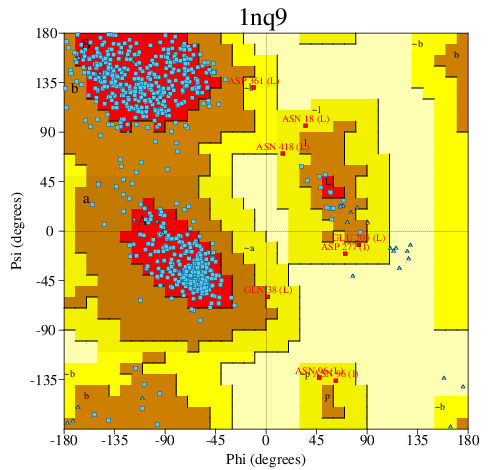
expulsion of the reactive center loop. Here we present the structure of an
intermediate pentasaccharide-bound conformation of antithrombin which has
undergone all of the conformational changes associated with activation except
loop expulsion and helix D elongation. We conclude that the basis of the
high-affinity state is not improved interaction with the pentasaccharide but a
lowering of the global free energy due to conformational changes elsewhere in
antithrombin. We suggest a mechanism in which the role of helix D elongation is
to lock antithrombin in the five-stranded fully activated conformation.