 |
PDBsum entry 1nkt

|
|
|
|
|
|

|

|

|

|
|

|
|

|
|

|
|

|
|

|
|

|
|

|
|
|
 |

|

|
|
|
|
|
|
|
|
|
|
|
|
|
|
|
|
|
|
|
|
|
|
|
|
|
|
|
|
|
|
|
|
|
|
|
|
Protein transport
|
PDB id
|
|
|
|
1nkt
|
|
|
|
|
|
|
|
|
|
|
|
|
|
|

|

|

|
|
|
|
|
|
|
|
 |
Contents |
 |
|
|
|
|
|
|
|
|
|
|
|
|
|
|
* Residue conservation analysis
|
|
|
|
|
|
PDB id:
|
|
|
|
| Name: |
|
Protein transport
|
|
|
Title:
|
|
Crystal structure of the seca protein translocation atpase from mycobacterium tuberculosis complex with adpbs
|
|
Structure:
|
|
Preprotein translocase seca 1 subunit. Chain: a, b. Engineered: yes
|
|
Source:
|
|
Mycobacterium tuberculosis. Organism_taxid: 1773. Gene: seca1 or seca or rv3240c. Expressed in: escherichia coli bl21(de3). Expression_system_taxid: 469008.
|
|
Biol. unit:
|
|
Dimer (from
)
|
|
Resolution:
|
|
|
2.60Å
|
R-factor:
|
0.216
|
R-free:
|
0.265
|
|
|
Authors:
|
|
V.Sharma,A.Arockiasamy,D.R.Ronning,C.G.Savva,A.Holzenburg, M.Braunstein,W.R.Jacobs Jr.,J.C.Sacchettini,Tb Structural Genomics Consortium (Tbsgc)
|
Key ref:

|
|
V.Sharma
et al.
(2003).
Crystal structure of Mycobacterium tuberculosis SecA, a preprotein translocating ATPase.
Proc Natl Acad Sci U S A,
100,
2243-2248.
PubMed id:
DOI:

|
|
|
Date:
|
|
|
03-Jan-03
|
Release date:
|
04-Mar-03
|
|
|
|
|
|
|
PROCHECK
|

|
|
|
|
|
Headers
|
|
|
|
References
|
|
|
|
|
|

|
|
P9WGP5
(SECA1_MYCTU) -
Protein translocase subunit SecA 1 from Mycobacterium tuberculosis (strain ATCC 25618 / H37Rv)
|
|
|
|
Seq:
Struc:
|
|
|
|
949 a.a.
836 a.a.*
|
|

|

|

|
|
|
|
|
|
|
|
|
|
|
Key: |
 |
PfamA domain |
|
|
 |
Secondary structure |
|
 |
CATH domain |
|
|
*
PDB and UniProt seqs differ
at 1 residue position (black
cross)
|
|
|
|
|
|
|
|
|
|
|
|
|
Enzyme class:
|
|
E.C.7.4.2.8
- protein-secreting ATPase.
|
|
|
|
|
|
|
Reaction:
|
|
ATP + H2O + cellular proteinSide 1 = ADP + phosphate + cellular proteinSide 2
|
|
|
|
|
|
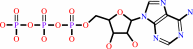 ATP
ATP
|
+
|
H2O
|
+
|
cellular proteinSide 1
|
=
|
ADP
Bound ligand (Het Group name = )
corresponds exactly
|
+
|
 phosphate
|
+
|
cellular proteinSide 2
|
|
|
|
|
|
|
|
|
|
|
|
|
Molecule diagrams generated from .mol files obtained from the
KEGG ftp site
|
|
|
|
|
|
|
|
|
|
|
|
|
|
 |
|
|
|
|
|
|
| |
|
|
| |
|
DOI no:
|
Proc Natl Acad Sci U S A
100:2243-2248
(2003)
|
|
PubMed id:
|
|
|
|
|
|
| |
|
Crystal structure of Mycobacterium tuberculosis SecA, a preprotein translocating ATPase.
|
|
V.Sharma,
A.Arockiasamy,
D.R.Ronning,
C.G.Savva,
A.Holzenburg,
M.Braunstein,
W.R.Jacobs,
J.C.Sacchettini.
|
|
|
|
|
| |
ABSTRACT
|
|
|
|
| |
|
|
In bacteria, the majority of exported proteins are translocated by the Sec
system, which recognizes the signal sequence of a preprotein and uses ATP and
the proton motive force to mediate protein translocation across the cytoplasmic
membrane. SecA is an essential protein component of this system, containing the
molecular motor that facilitates translocation. Here we report the
three-dimensional structure of the SecA protein of Mycobacterium tuberculosis.
Each subunit of the homodimer contains a "motor" domain and a
translocation domain. The structure predicts that SecA can interact with the
SecYEG pore and function as a molecular ratchet that uses ATP hydrolysis for
physical movement of the preprotein. Knowledge of this structure provides a
framework for further elucidation of the translocation process.
|
|
|
|
|
|
| |
Selected figure(s)
|
|
|
|
| |
|
|

|
|

|
|
Figure 4.
Fig. 4. Comparison of the binding site of tbSecA:ADP-
 -S (a) with
PcrA:ATP (b). (a) Stereo diagram of a stick representation of
the binding site of tbSecA:ADP- -S shows the
residues involved in the ADP binding. Most of the contacts from
NBD1 are from Walker A (cyan), Walker B (purple), and adenine
binding (green) loops. (b) Similar representation of binding of
ATP analog ADPNP to PcrA helicase (42). The side chains that
make contact with the -S (a) with
PcrA:ATP (b). (a) Stereo diagram of a stick representation of
the binding site of tbSecA:ADP- -S shows the
residues involved in the ADP binding. Most of the contacts from
NBD1 are from Walker A (cyan), Walker B (purple), and adenine
binding (green) loops. (b) Similar representation of binding of
ATP analog ADPNP to PcrA helicase (42). The side chains that
make contact with the  -phosphate
are Q254, R287, and R610 and have counterparts in SecA (Q566,
R490, and R570). -phosphate
are Q254, R287, and R610 and have counterparts in SecA (Q566,
R490, and R570).
|
|
Figure 5.
Fig. 5. A mechanical drawing depicting our model of the
motor movements associated with the ADP and ATP bound states of
SecA. (a) The red tubes represent the regions of the connecting
structure of SecA observed in the ADP bound state. (b) In
transparent violet are the corresponding regions of our model of
the protein with ATP bound. The movements of the motor domain as
described in the text are transmitted to the translation domain
via the long  25-helix
and the two connecting -strands
shown atop the silver pipe, which is the conserved pore found in
the SSD. In dark blue is the pivot arm groove from the adjacent
subunit of the dimer. 25-helix
and the two connecting -strands
shown atop the silver pipe, which is the conserved pore found in
the SSD. In dark blue is the pivot arm groove from the adjacent
subunit of the dimer.
|
|
|
|
| |
Figures were
selected
by an automated process.
|
|
|
|
|
|
|
|
|
|
|
|
|
|
|
|
 |
 |
 |
|
Literature references that cite this PDB file's key reference
|
|
|
| |
PubMed id
|
|
Reference
|
|
|
|
|
|
M.E.Feltcher,
and
M.Braunstein
(2012).
Emerging themes in SecA2-mediated protein export.
|
| |
Nat Rev Microbiol,
10,
779-789.
|
|
|
|
|
|
|
A.J.Wowor,
D.Yu,
D.A.Kendall,
and
J.L.Cole
(2011).
Energetics of SecA dimerization.
|
| |
J Mol Biol,
408,
87-98.
|
|
|
|
|
|
|
I.Kusters,
G.van den Bogaart,
A.Kedrov,
V.Krasnikov,
F.Fulyani,
B.Poolman,
and
A.J.Driessen
(2011).
Quaternary structure of SecA in solution and bound to SecYEG probed at the single molecule level.
|
| |
Structure,
19,
430-439.
|
|
|
|
|
|
|
M.E.Feltcher,
J.T.Sullivan,
and
M.Braunstein
(2010).
Protein export systems of Mycobacterium tuberculosis: novel targets for drug development?
|
| |
Future Microbiol,
5,
1581-1597.
|
|
|
|
|
|
|
S.M.Auclair,
J.P.Moses,
M.Musial-Siwek,
D.A.Kendall,
D.B.Oliver,
and
I.Mukerji
(2010).
Mapping of the signal peptide-binding domain of Escherichia coli SecA using Förster resonance energy transfer.
|
| |
Biochemistry,
49,
782-792.
|
|
|
|
|
|
|
B.W.Bauer,
and
T.A.Rapoport
(2009).
Mapping polypeptide interactions of the SecA ATPase during translocation.
|
| |
Proc Natl Acad Sci U S A,
106,
20800-20805.
|
|
|
|
|
|
|
C.Mao,
S.J.Hardy,
and
L.L.Randall
(2009).
Maximal efficiency of coupling between ATP hydrolysis and translocation of polypeptides mediated by SecB requires two protomers of SecA.
|
| |
J Bacteriol,
191,
978-984.
|
|
|
|
|
|
|
A.J.Driessen,
and
N.Nouwen
(2008).
Protein translocation across the bacterial cytoplasmic membrane.
|
| |
Annu Rev Biochem,
77,
643-667.
|
|
|
|
|
|
|
D.B.Cooper,
V.F.Smith,
J.M.Crane,
H.C.Roth,
A.A.Lilly,
and
L.L.Randall
(2008).
SecA, the motor of the secretion machine, binds diverse partners on one interactive surface.
|
| |
J Mol Biol,
382,
74-87.
|
|
|
|
|
|
|
E.M.Clérico,
J.L.Maki,
and
L.M.Gierasch
(2008).
Use of synthetic signal sequences to explore the protein export machinery.
|
| |
Biopolymers,
90,
307-319.
|
|
|
|
|
|
|
J.M.Hou,
N.G.D'Lima,
N.W.Rigel,
H.S.Gibbons,
J.R.McCann,
M.Braunstein,
and
C.M.Teschke
(2008).
ATPase activity of Mycobacterium tuberculosis SecA1 and SecA2 proteins and its importance for SecA2 function in macrophages.
|
| |
J Bacteriol,
190,
4880-4887.
|
|
|
|
|
|
|
Y.Chen,
X.Pan,
Y.Tang,
S.Quan,
P.C.Tai,
and
S.F.Sui
(2008).
Full-length Escherichia coli SecA dimerizes in a closed conformation in solution as determined by cryo-electron microscopy.
|
| |
J Biol Chem,
283,
28783-28787.
|
|
|
|
|
|
|
A.R.Osborne,
and
T.A.Rapoport
(2007).
Protein translocation is mediated by oligomers of the SecY complex with one SecY copy forming the channel.
|
| |
Cell,
129,
97.
|
|
|
|
|
|
|
E.Muraille,
E.Narni-Mancinelli,
P.Gounon,
D.Bassand,
N.Glaichenhaus,
L.L.Lenz,
and
G.Lauvau
(2007).
Cytosolic expression of SecA2 is a prerequisite for long-term protective immunity.
|
| |
Cell Microbiol,
9,
1445-1454.
|
|
|
|
|
|
|
E.Papanikou,
S.Karamanou,
and
A.Economou
(2007).
Bacterial protein secretion through the translocase nanomachine.
|
| |
Nat Rev Microbiol,
5,
839-851.
|
|
|
|
|
|
|
H.J.Hu,
J.Holley,
J.He,
R.W.Harrison,
H.Yang,
P.C.Tai,
and
Y.Pan
(2007).
To be or not to be: predicting soluble SecAs as membrane proteins.
|
| |
IEEE Trans Nanobioscience,
6,
168-179.
|
|
|
|
|
|
|
I.Gelis,
A.M.Bonvin,
D.Keramisanou,
M.Koukaki,
G.Gouridis,
S.Karamanou,
A.Economou,
and
C.G.Kalodimos
(2007).
Structural basis for signal-sequence recognition by the translocase motor SecA as determined by NMR.
|
| |
Cell,
131,
756-769.
|
|
|
PDB code:
|
|
|
|
|
|
|
|
M.Alami,
K.Dalal,
B.Lelj-Garolla,
S.G.Sligar,
and
F.Duong
(2007).
Nanodiscs unravel the interaction between the SecYEG channel and its cytosolic partner SecA.
|
| |
EMBO J,
26,
1995-2004.
|
|
|
|
|
|
|
M.Musial-Siwek,
S.L.Rusch,
and
D.A.Kendall
(2007).
Selective photoaffinity labeling identifies the signal peptide binding domain on SecA.
|
| |
J Mol Biol,
365,
637-648.
|
|
|
|
|
|
|
S.Karamanou,
G.Gouridis,
E.Papanikou,
G.Sianidis,
I.Gelis,
D.Keramisanou,
E.Vrontou,
C.G.Kalodimos,
and
A.Economou
(2007).
Preprotein-controlled catalysis in the helicase motor of SecA.
|
| |
EMBO J,
26,
2904-2914.
|
|
|
|
|
|
|
S.L.Rusch,
and
D.A.Kendall
(2007).
Oligomeric states of the SecA and SecYEG core components of the bacterial Sec translocon.
|
| |
Biochim Biophys Acta,
1768,
5.
|
|
|
|
|
|
|
S.L.Rusch,
and
D.A.Kendall
(2007).
Interactions that drive Sec-dependent bacterial protein transport.
|
| |
Biochemistry,
46,
9665-9673.
|
|
|
|
|
|
|
X.V.Guo,
M.Monteleone,
M.Klotzsche,
A.Kamionka,
W.Hillen,
M.Braunstein,
S.Ehrt,
and
D.Schnappinger
(2007).
Silencing Mycobacterium smegmatis by using tetracycline repressors.
|
| |
J Bacteriol,
189,
4614-4623.
|
|
|
|
|
|
|
Y.Chen,
P.C.Tai,
and
S.F.Sui
(2007).
The active ring-like structure of SecA revealed by electron crystallography: conformational change upon interaction with SecB.
|
| |
J Struct Biol,
159,
149-153.
|
|
|
|
|
|
|
A.Economou,
P.J.Christie,
R.C.Fernandez,
T.Palmer,
G.V.Plano,
and
A.P.Pugsley
(2006).
Secretion by numbers: Protein traffic in prokaryotes.
|
| |
Mol Microbiol,
62,
308-319.
|
|
|
|
|
|
|
D.Keramisanou,
N.Biris,
I.Gelis,
G.Sianidis,
S.Karamanou,
A.Economou,
and
C.G.Kalodimos
(2006).
Disorder-order folding transitions underlie catalysis in the helicase motor of SecA.
|
| |
Nat Struct Mol Biol,
13,
594-602.
|
|
|
|
|
|
|
K.Mitra,
J.Frank,
and
A.Driessen
(2006).
Co- and post-translational translocation through the protein-conducting channel: analogous mechanisms at work?
|
| |
Nat Struct Mol Biol,
13,
957-964.
|
|
|
|
|
|
|
L.B.Jilaveanu,
and
D.Oliver
(2006).
SecA dimer cross-linked at its subunit interface is functional for protein translocation.
|
| |
J Bacteriol,
188,
335-338.
|
|
|
|
|
|
|
M.N.Vassylyeva,
H.Mori,
T.Tsukazaki,
S.Yokoyama,
T.H.Tahirov,
K.Ito,
and
D.G.Vassylyev
(2006).
Cloning, expression, purification, crystallization and initial crystallographic analysis of the preprotein translocation ATPase SecA from Thermus thermophilus.
|
| |
Acta Crystallogr Sect F Struct Biol Cryst Commun,
62,
909-912.
|
|
|
|
|
|
|
Q.Chen,
H.Wu,
R.Kumar,
Z.Peng,
and
P.M.Fives-Taylor
(2006).
SecA2 is distinct from SecA in immunogenic specificity, subcellular distribution and requirement for membrane anchoring in Streptococcus parasanguis.
|
| |
FEMS Microbiol Lett,
264,
174-181.
|
|
|
|
|
|
|
W.Meining,
J.Scheuring,
M.Fischer,
and
S.Weinkauf
(2006).
Cloning, purification, crystallization and preliminary crystallographic analysis of SecA from Enterococcus faecalis.
|
| |
Acta Crystallogr Sect F Struct Biol Cryst Commun,
62,
583-585.
|
|
|
|
|
|
|
A.M.Zelazny,
L.B.Calhoun,
L.Li,
Y.R.Shea,
and
S.H.Fischer
(2005).
Identification of Mycobacterium species by secA1 sequences.
|
| |
J Clin Microbiol,
43,
1051-1058.
|
|
|
|
|
|
|
A.R.Osborne,
T.A.Rapoport,
and
B.van den Berg
(2005).
Protein translocation by the Sec61/SecY channel.
|
| |
Annu Rev Cell Dev Biol,
21,
529-550.
|
|
|
|
|
|
|
H.Nakatogawa,
A.Murakami,
H.Mori,
and
K.Ito
(2005).
SecM facilitates translocase function of SecA by localizing its biosynthesis.
|
| |
Genes Dev,
19,
436-444.
|
|
|
|
|
|
|
J.P.Murry,
and
E.J.Rubin
(2005).
New genetic approaches shed light on TB virulence.
|
| |
Trends Microbiol,
13,
366-372.
|
|
|
|
|
|
|
J.Zhou,
and
Z.Xu
(2005).
The structural view of bacterial translocation-specific chaperone SecB: implications for function.
|
| |
Mol Microbiol,
58,
349-357.
|
|
|
|
|
|
|
L.B.Jilaveanu,
C.R.Zito,
and
D.Oliver
(2005).
Dimeric SecA is essential for protein translocation.
|
| |
Proc Natl Acad Sci U S A,
102,
7511-7516.
|
|
|
|
|
|
|
M.G.Pretz,
H.Remigy,
J.Swaving,
S.V.Albers,
V.G.Garrido,
M.Chami,
A.Engel,
and
A.J.Driessen
(2005).
Functional and structural characterization of the minimal Sec translocase of the hyperthermophile Thermotoga maritima.
|
| |
Extremophiles,
9,
307-316.
|
|
|
|
|
|
|
M.Musial-Siwek,
S.L.Rusch,
and
D.A.Kendall
(2005).
Probing the affinity of SecA for signal peptide in different environments.
|
| |
Biochemistry,
44,
13987-13996.
|
|
|
|
|
|
|
A.R.Osborne,
W.M.Clemons,
and
T.A.Rapoport
(2004).
A large conformational change of the translocation ATPase SecA.
|
| |
Proc Natl Acad Sci U S A,
101,
10937-10942.
|
|
|
PDB codes:
|
|
|
|
|
|
|
|
E.Papanikou,
S.Karamanou,
C.Baud,
G.Sianidis,
M.Frank,
and
A.Economou
(2004).
Helicase Motif III in SecA is essential for coupling preprotein binding to translocation ATPase.
|
| |
EMBO Rep,
5,
807-811.
|
|
|
|
|
|
|
A.Gauthier,
and
B.B.Finlay
(2003).
Translocated intimin receptor and its chaperone interact with ATPase of the type III secretion apparatus of enteropathogenic Escherichia coli.
|
| |
J Bacteriol,
185,
6747-6755.
|
|
|
|
|
|
|
C.V.Smith,
and
J.C.Sacchettini
(2003).
Mycobacterium tuberculosis: a model system for structural genomics.
|
| |
Curr Opin Struct Biol,
13,
658-664.
|
|
|
|
|
|
|
F.Duong
(2003).
Binding, activation and dissociation of the dimeric SecA ATPase at the dimeric SecYEG translocase.
|
| |
EMBO J,
22,
4375-4384.
|
|
|
|
|
|
|
J.Zhou,
and
Z.Xu
(2003).
Structural determinants of SecB recognition by SecA in bacterial protein translocation.
|
| |
Nat Struct Biol,
10,
942-947.
|
|
|
PDB code:
|
|
|
|
|
|
|
|
M.Bellinzoni,
and
G.Riccardi
(2003).
Techniques and applications: The heterologous expression of Mycobacterium tuberculosis genes is an uphill road.
|
| |
Trends Microbiol,
11,
351-358.
|
|
|
|
|
|
|
M.Eser,
and
M.Ehrmann
(2003).
SecA-dependent quality control of intracellular protein localization.
|
| |
Proc Natl Acad Sci U S A,
100,
13231-13234.
|
|
|
|
|
|
|
N.N.Alder,
and
S.M.Theg
(2003).
Energy use by biological protein transport pathways.
|
| |
Trends Biochem Sci,
28,
442-451.
|
|
|
|
|
|
|
Z.Bu,
L.Wang,
and
D.A.Kendall
(2003).
Nucleotide binding induces changes in the oligomeric state and conformation of Sec A in a lipid environment: a small-angle neutron-scattering study.
|
| |
J Mol Biol,
332,
23-30.
|
|
|
|
|
|
The most recent references are shown first.
Citation data come partly from CiteXplore and partly
from an automated harvesting procedure. Note that this is likely to be
only a partial list as not all journals are covered by
either method. However, we are continually building up the citation data
so more and more references will be included with time.
Where a reference describes a PDB structure, the PDB
code is
shown on the right.
|
|


 Links
Links


