 |
PDBsum entry 1id0

|
|
|
|
|
 |
Contents |
 |
|
|
|
|
|
|
|
|
|
|
|
|
|
|
* Residue conservation analysis
|
|
|
|
|
|
|
|
|
|
|
Enzyme class 1:
|
|
E.C.2.7.13.3
- histidine kinase.
|
|
|
|
|
|
|
Reaction:
|
|
ATP + protein L-histidine = ADP + protein N-phospho-L-histidine
|
|
|
|
|
|
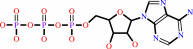 ATP
ATP
|
+
|
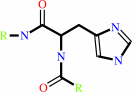 protein L-histidine
|
=
|
ADP
Bound ligand (Het Group name = )
matches with 81.25% similarity
|
+
|
protein N-phospho-L-histidine
|
|
|
|
|
|
|
|
|
|
Enzyme class 2:
|
|
E.C.3.1.3.-
- ?????
|
|
|
|
|
|
|
|
|
|
Note, where more than one E.C. class is given (as above), each may
correspond to a different protein domain or, in the case of polyprotein
precursors, to a different mature protein.
|
|
|
|
Molecule diagrams generated from .mol files obtained from the
KEGG ftp site
|
|
|
|
|
|
|
|
|
|
|
|
|
|
 |
|
|
|
|
|
|
| |
|
|
| |
|
DOI no:
|
J Biol Chem
276:41182-41190
(2001)
|
|
PubMed id:
|
|
|
|
|
|
| |
|
Structural and mutational analysis of the PhoQ histidine kinase catalytic domain. Insight into the reaction mechanism.
|
|
A.Marina,
C.Mott,
A.Auyzenberg,
W.A.Hendrickson,
C.D.Waldburger.
|
|
|
|
|
| |
ABSTRACT
|
|
|
|
| |
|
|
PhoQ is a transmembrane histidine kinase belonging to the family of
two-component signal transducing systems common in prokaryotes and lower
eukaryotes. In response to changes in environmental Mg(2+) concentration, PhoQ
regulates the level of phosphorylated PhoP, its cognate transcriptional
response-regulator. The PhoQ cytoplasmic region comprises two independently
folding domains: the histidine-containing phosphotransfer domain and the
ATP-binding kinase domain. We have determined the structure of the kinase domain
of Escherichia coli PhoQ complexed with the non-hydrolyzable ATP analog
adenosine 5'-(beta,gamma-imino)triphosphate and Mg(2+). Nucleotide binding
appears to be accompanied by conformational changes in the loop that surrounds
the ATP analog (ATP-lid) and has implications for interactions with the
substrate phosphotransfer domain. The high resolution (1.6 A) structure reveals
a detailed view of the nucleotide-binding site, allowing us to identify
potential catalytic residues. Mutagenic analyses of these residues provide new
insights into the catalytic mechanism of histidine phosphorylation in the
histidine kinase family. Comparison with the active site of the related GHL
ATPase family reveals differences that are proposed to account for the distinct
functions of these proteins.
|
|
|
|
|
|
| |
Selected figure(s)
|
|
|
|
| |
|
|

|
|

|
|
Figure 3.
Fig. 3. ATP-lid movement in PhoQ-KD nucleotide-bound
structure. Superimposition of C  traces from
PhoQ-KD (blue) and CheA-KD (yellow) shows the ATP-lid
displacement toward the main traces from
PhoQ-KD (blue) and CheA-KD (yellow) shows the ATP-lid
displacement toward the main  -sheet in
PhoQ (closed conformation). The AMPPNP molecule is shown in
magenta. Glycine C atoms are
shown as spheres, and side chains of the hydrophobic patch
residues are shown as sticks. Selected residues are labeled for
each protein in the color corresponding to the backbone trace.
hairpin
movement and the conserved Gly in the hairpin are also indicated. -sheet in
PhoQ (closed conformation). The AMPPNP molecule is shown in
magenta. Glycine C atoms are
shown as spheres, and side chains of the hydrophobic patch
residues are shown as sticks. Selected residues are labeled for
each protein in the color corresponding to the backbone trace.
hairpin
movement and the conserved Gly in the hairpin are also indicated.
|
|
Figure 4.
Fig. 4. AMPPNP binding site. Upper panel, plot of the
interactions between AMPPNP-Mg2+ and the protein drawn with the
program LIGPLOT (40). Lower panel, stereoview of structural
elements that form the ATP binding site in PhoQ-KD. Helices and
strands are partially transparent with the same colors as in
Fig. 1A. the AMPPNP molecule (yellow) and interacting side
chains (green) are depicted as ball-and-stick with the same
colors as in upper panel. Carbon, nitrogen, oxygen, and
phosphate are drawn in gray, blue, red, and black, respectively.
Water molecules are cyan spheres, and the Mg2+ ion is a green
sphere. Hydrogen bonds are shown as dotted magenta lines and the
magnesium coordination as dotted black lines.
|
|
|
|
|
|
| |
The above figures are
reprinted
by permission from the ASBMB:
J Biol Chem
(2001,
276,
41182-41190)
copyright 2001.
|
|
| |
Figures were
selected
by an automated process.
|
|
|
|
|
|
|
|
|
|
|
|
|
|
|
|
 |
 |
 |
|
Literature references that cite this PDB file's key reference
|
|
|
| |
PubMed id
|
|
Reference
|
|
|
|
|
|
M.T.Guarnieri,
B.S.Blagg,
and
R.Zhao
(2011).
A high-throughput TNP-ATP displacement assay for screening inhibitors of ATP-binding in bacterial histidine kinases.
|
| |
Assay Drug Dev Technol,
9,
174-183.
|
|
|
|
|
|
|
I.Maslennikov,
C.Klammt,
E.Hwang,
G.Kefala,
M.Okamura,
L.Esquivies,
K.Mörs,
C.Glaubitz,
W.Kwiatkowski,
Y.H.Jeon,
and
S.Choe
(2010).
Membrane domain structures of three classes of histidine kinase receptors by cell-free expression and rapid NMR analysis.
|
| |
Proc Natl Acad Sci U S A,
107,
10902-10907.
|
|
|
PDB codes:
|
|
|
|
|
|
|
|
M.L.López-Redondo,
F.Moronta,
P.Salinas,
J.Espinosa,
R.Cantos,
R.Dixon,
A.Marina,
and
A.Contreras
(2010).
Environmental control of phosphorylation pathways in a branched two-component system.
|
| |
Mol Microbiol,
78,
475-489.
|
|
|
|
|
|
|
P.D.Scheu,
Y.F.Liao,
J.Bauer,
H.Kneuper,
T.Basché,
G.Unden,
and
W.Erker
(2010).
Oligomeric sensor kinase DcuS in the membrane of Escherichia coli and in proteoliposomes: chemical cross-linking and FRET spectroscopy.
|
| |
J Bacteriol,
192,
3474-3483.
|
|
|
|
|
|
|
R.C.Stewart
(2010).
Protein histidine kinases: assembly of active sites and their regulation in signaling pathways.
|
| |
Curr Opin Microbiol,
13,
133-141.
|
|
|
|
|
|
|
J.K.Cheung,
M.M.Awad,
S.McGowan,
and
J.I.Rood
(2009).
Functional analysis of the VirSR phosphorelay from Clostridium perfringens.
|
| |
PLoS One,
4,
e5849.
|
|
|
|
|
|
|
M.J.Bick,
V.Lamour,
K.R.Rajashankar,
Y.Gordiyenko,
C.V.Robinson,
and
S.A.Darst
(2009).
How to switch off a histidine kinase: crystal structure of Geobacillus stearothermophilus KinB with the inhibitor Sda.
|
| |
J Mol Biol,
386,
163-177.
|
|
|
PDB code:
|
|
|
|
|
|
|
|
R.Gao,
and
A.M.Stock
(2009).
Biological insights from structures of two-component proteins.
|
| |
Annu Rev Microbiol,
63,
133-154.
|
|
|
|
|
|
|
S.Yamada,
H.Sugimoto,
M.Kobayashi,
A.Ohno,
H.Nakamura,
and
Y.Shiro
(2009).
Structure of PAS-linked histidine kinase and the response regulator complex.
|
| |
Structure,
17,
1333-1344.
|
|
|
PDB codes:
|
|
|
|
|
|
|
|
A.R.Mattoo,
M.Saif Zaman,
G.P.Dubey,
A.Arora,
A.Narayan,
N.Jailkhani,
K.Rathore,
S.Maiti,
and
Y.Singh
(2008).
Spo0B of Bacillus anthracis - a protein with pleiotropic functions.
|
| |
FEBS J,
275,
739-752.
|
|
|
|
|
|
|
C.E.Noriega,
R.Schmidt,
M.J.Gray,
L.L.Chen,
and
V.Stewart
(2008).
Autophosphorylation and dephosphorylation by soluble forms of the nitrate-responsive sensors NarX and NarQ from Escherichia coli K-12.
|
| |
J Bacteriol,
190,
3869-3876.
|
|
|
|
|
|
|
P.Sachdeva,
A.Narayan,
R.Misra,
V.Brahmachari,
and
Y.Singh
(2008).
Loss of kinase activity in Mycobacterium tuberculosis multidomain protein Rv1364c.
|
| |
FEBS J,
275,
6295-6308.
|
|
|
|
|
|
|
X.Yang,
J.Kuk,
and
K.Moffat
(2008).
Crystal structure of Pseudomonas aeruginosa bacteriophytochrome: photoconversion and signal transduction.
|
| |
Proc Natl Acad Sci U S A,
105,
14715-14720.
|
|
|
PDB code:
|
|
|
|
|
|
|
|
M.T.Laub,
and
M.Goulian
(2007).
Specificity in two-component signal transduction pathways.
|
| |
Annu Rev Genet,
41,
121-145.
|
|
|
|
|
|
|
K.I.Varughese,
I.Tsigelny,
and
H.Zhao
(2006).
The crystal structure of beryllofluoride Spo0F in complex with the phosphotransferase Spo0B represents a phosphotransfer pretransition state.
|
| |
J Bacteriol,
188,
4970-4977.
|
|
|
PDB code:
|
|
|
|
|
|
|
|
Z.Qin,
J.Zhang,
B.Xu,
L.Chen,
Y.Wu,
X.Yang,
X.Shen,
S.Molin,
A.Danchin,
H.Jiang,
and
D.Qu
(2006).
Structure-based discovery of inhibitors of the YycG histidine kinase: new chemical leads to combat Staphylococcus epidermidis infections.
|
| |
BMC Microbiol,
6,
96.
|
|
|
|
|
|
|
A.Marina,
C.D.Waldburger,
and
W.A.Hendrickson
(2005).
Structure of the entire cytoplasmic portion of a sensor histidine-kinase protein.
|
| |
EMBO J,
24,
4247-4259.
|
|
|
PDB code:
|
|
|
|
|
|
|
|
A.A.Pioszak,
and
A.J.Ninfa
(2004).
Mutations altering the N-terminal receiver domain of NRI (NtrC) That prevent dephosphorylation by the NRII-PII complex in Escherichia coli.
|
| |
J Bacteriol,
186,
5730-5740.
|
|
|
|
|
|
|
B.Karniol,
and
R.D.Vierstra
(2004).
The HWE histidine kinases, a new family of bacterial two-component sensor kinases with potentially diverse roles in environmental signaling.
|
| |
J Bacteriol,
186,
445-453.
|
|
|
|
|
|
|
H.Nakamura,
H.Kumita,
K.Imai,
T.Iizuka,
and
Y.Shiro
(2004).
ADP reduces the oxygen-binding affinity of a sensory histidine kinase, FixL: the possibility of an enhanced reciprocating kinase reaction.
|
| |
Proc Natl Acad Sci U S A,
101,
2742-2746.
|
|
|
|
|
|
|
A.A.Pioszak,
and
A.J.Ninfa
(2003).
Genetic and biochemical analysis of phosphatase activity of Escherichia coli NRII (NtrB) and its regulation by the PII signal transduction protein.
|
| |
J Bacteriol,
185,
1299-1315.
|
|
|
|
|
|
|
A.C.Shaver,
and
P.D.Sniegowski
(2003).
Spontaneously arising mutL mutators in evolving Escherichia coli populations are the result of changes in repeat length.
|
| |
J Bacteriol,
185,
6076-6082.
|
|
|
|
|
|
|
J.A.Lesley,
and
C.D.Waldburger
(2003).
Repression of Escherichia coli PhoP-PhoQ signaling by acetate reveals a regulatory role for acetyl coenzyme A.
|
| |
J Bacteriol,
185,
2563-2570.
|
|
|
|
|
|
|
L.Qin,
S.Cai,
Y.Zhu,
and
M.Inouye
(2003).
Cysteine-scanning analysis of the dimerization domain of EnvZ, an osmosensing histidine kinase.
|
| |
J Bacteriol,
185,
3429-3435.
|
|
|
|
|
|
|
P.M.Wolanin,
P.A.Thomason,
and
J.B.Stock
(2002).
Histidine protein kinases: key signal transducers outside the animal kingdom.
|
| |
Genome Biol,
3,
REVIEWS3013.
|
|
|
|
|
|
|
Y.Zhu,
and
M.Inouye
(2002).
The role of the G2 box, a conserved motif in the histidine kinase superfamily, in modulating the function of EnvZ.
|
| |
Mol Microbiol,
45,
653-663.
|
|
|
|
|
|
The most recent references are shown first.
Citation data come partly from CiteXplore and partly
from an automated harvesting procedure. Note that this is likely to be
only a partial list as not all journals are covered by
either method. However, we are continually building up the citation data
so more and more references will be included with time.
Where a reference describes a PDB structure, the PDB
codes are
shown on the right.
|
|


 Links
Links


