 |
PDBsum entry 1d5b

|
|
|
|
|
|

|

|

|

|
|

|
|

|
|

|
|

|
|

|
|

|
|
|
 |

|

|
|
|
|
|
|
|
|
|
|
|
|
|
|
|
|
|
|
|
|
|
|
|
|
|
|
|
|
|
|
|
|
|
|
|
Immune system
|
PDB id
|
|
|
|
1d5b
|
|
|
|
|
|
|
|
|
|
|
|
|
|
|

|

|

|
|
|
|
|
|
|
|
 |
Contents |
 |
|
|
|
|
|
|
|
|
|
|
|
|
* Residue conservation analysis
|
|
|
|
|
|
PDB id:
|
|
|
|
| Name: |
|
Immune system
|
|
|
Title:
|
|
Unliganded mature oxy-cope catalytic antibody
|
|
Structure:
|
|
Chimeric oxy-cope catalytic antibody az-28 (light chain). Chain: a, l. Fragment: chimeric fab fragment (unp q7ts98 reisues 23-129, p01834 residues 1-104). Engineered: yes. Other_details: the protein was produced as a chimeric fab fragment. The variable domains (chains a,l 1-107, chains b,h 1-113) are murine. The constant domains (chains a,l 108-211 and chains b,h 113-214) are human..
|
|
Source:
|
|
Mus musculus, homo sapiens. Mouse, human. Organism_taxid: 10090, 9606. Gene: igkc. Expressed in: escherichia coli. Expression_system_taxid: 562.
|
|
Biol. unit:
|
|
 Dimer (from
)
Dimer (from
)
|
|
Resolution:
|
|
|
2.80Å
|
R-factor:
|
0.232
|
R-free:
|
0.285
|
|
|
Authors:
|
|
E.C.Mundorff,M.A.Hanson,P.G.Schultz,R.C.Stevens
|
Key ref:

|
|
E.C.Mundorff
et al.
(2000).
Conformational effects in biological catalysis: an antibody-catalyzed oxy-cope rearrangement.
Biochemistry,
39,
627-632.
PubMed id:
DOI:
|
|
|
Date:
|
|
|
06-Oct-99
|
Release date:
|
09-Feb-00
|
|
|
|
|
|
|
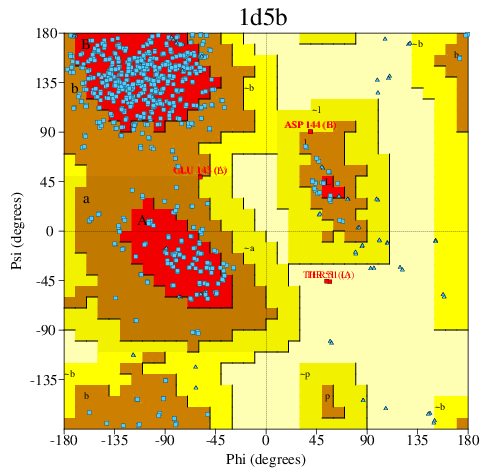
PROCHECK
|
|
|
|
|
|
Headers
|
|
|
|
References
|
|
|
|
|
|
|
|
|
|
|
|
|
|
|
|
 |
|
|
|
|
|
|
| |
|
DOI no:
|
Biochemistry
39:627-632
(2000)
|
|
PubMed id:
|
|
|
|
|
|
| |
|
Conformational effects in biological catalysis: an antibody-catalyzed oxy-cope rearrangement.
|
|
E.C.Mundorff,
M.A.Hanson,
A.Varvak,
H.Ulrich,
P.G.Schultz,
R.C.Stevens.
|
|
|
|
|
| |
ABSTRACT
|
|
|
|
| |
|
|
Antibody AZ-28 was generated against the chairlike transition-state analogue
(TSA) 1 and catalyzes the oxy-Cope rearrangement of substrate 2 to product 3.
The germline precursor to AZ-28 catalyzes the reaction with a 35-fold higher
rate (k(cat)/k(uncat) = 163 000), despite a 40-fold lower binding affinity for
TSA.1 (K(D) = 670 nM). To determine the structural basis for the differences in
the binding and catalytic properties of the germline and affinity-matured
antibodies, the X-ray crystal structures of the unliganded and TSA.1 complex of
antibody AZ-28 have been determined at 2.8 and 2.6 A resolution, respectively;
the structures of the unliganded and TSA.1 complex of the germline precursor to
AZ-28 were both determined at 2. 0 A resolution. In the affinity-matured
antibody.hapten complex the TSA is fixed in a catalytically unfavorable
conformation by a combination of van der Waals and hydrogen-bonding
interactions. The 2- and 5-phenyl substituents of TSA.1 are almost perpendicular
to the cyclohexyl ring, leading to decreased orbital overlap and decreased
stabilization of the putative transition state. The active site of the germline
antibody appears to have an increased degree of flexibility-CDRH3 moves 4.9 A
outward from the active site upon binding of TSA.1. We suggest that this
conformational flexibility in the germline antibody, which results in a lower
binding affinity for TSA.1, allows dynamic changes in the dihedral angle of the
2-phenyl substituent along the reaction coordinate. These conformational changes
in turn lead to enhanced orbital overlap and increased catalytic rate. These
studies suggest that protein and substrate dynamics play a key role in this
antibody-catalyzed reaction.
|
|
|
|
|
|
|
|
|
|
|
|
|
|
|
|
|
|
 |
 |
 |
|
Literature references that cite this PDB file's key reference
|
|
|
| |
PubMed id
|
|
Reference
|
|
|
|
|
|
S.E.Wong,
B.D.Sellers,
and
M.P.Jacobson
(2011).
Effects of somatic mutations on CDR loop flexibility during affinity maturation.
|
| |
Proteins,
79,
821-829.
|
|
|
|
|
|
|
S.Martí,
J.Andrés,
V.Moliner,
E.Silla,
I.Tuñón,
and
J.Bertrán
(2005).
Towards a rational design of antibody catalysts through computational chemistry.
|
| |
Angew Chem Int Ed Engl,
44,
904-909.
|
|
|
|
|
|
|
L.Zheng,
U.Baumann,
and
J.L.Reymond
(2004).
Molecular mechanism of enantioselective proton transfer to carbon in catalytic antibody 14D9.
|
| |
Proc Natl Acad Sci U S A,
101,
3387-3392.
|
|
|
PDB codes:
|
|
|
|
|
|
|
|
C.Breithaupt,
A.Schubart,
H.Zander,
A.Skerra,
R.Huber,
C.Linington,
and
U.Jacob
(2003).
Structural insights into the antigenicity of myelin oligodendrocyte glycoprotein.
|
| |
Proc Natl Acad Sci U S A,
100,
9446-9451.
|
|
|
PDB codes:
|
|
|
|
|
|
|
|
J.Yin,
S.E.Andryski,
A.E.Beuscher,
R.C.Stevens,
and
P.G.Schultz
(2003).
Structural evidence for substrate strain in antibody catalysis.
|
| |
Proc Natl Acad Sci U S A,
100,
856-861.
|
|
|
PDB codes:
|
|
|
|
|
|
|
|
P.Faller,
R.J.Debus,
K.Brettel,
M.Sugiura,
A.W.Rutherford,
and
A.Boussac
(2001).
Rapid formation of the stable tyrosyl radical in photosystem II.
|
| |
Proc Natl Acad Sci U S A,
98,
14368-14373.
|
|
|
|
|
|
|
B.Golinelli-Pimpaneau
(2000).
Novel reactions catalysed by antibodies.
|
| |
Curr Opin Struct Biol,
10,
697-708.
|
|
|
|
|
|
The most recent references are shown first.
Citation data come partly from CiteXplore and partly
from an automated harvesting procedure. Note that this is likely to be
only a partial list as not all journals are covered by
either method. However, we are continually building up the citation data
so more and more references will be included with time.
Where a reference describes a PDB structure, the PDB
codes are
shown on the right.
|
|
|


 Links
Links


