|
PDBsum entry 1b39

|
|
|
|
|
 |
Contents |
 |
|
|
|
|
|
|
|
|
|
|
|
|
|
|
* Residue conservation analysis
|
|
|
|
|
|
|
|
|
|
|
Enzyme class:
|
|
E.C.2.7.11.22
- cyclin-dependent kinase.
|
|
|
|
|
|
|
Reaction:
|
|
|
1.
|
L-seryl-[protein] + ATP = O-phospho-L-seryl-[protein] + ADP + H+
|
|
2.
|
L-threonyl-[protein] + ATP = O-phospho-L-threonyl-[protein] + ADP + H+
|
|
|
|
|
|
|
L-seryl-[protein]
Bound ligand (Het Group name = )
corresponds exactly
|
+
|
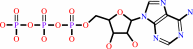 ATP
ATP
|
=
|
O-phospho-L-seryl-[protein]
|
+
|
 ADP
ADP
|
+
|
H(+)
|
|
|
|
|
|
|
L-threonyl-[protein]
Bound ligand (Het Group name = )
corresponds exactly
|
+
|
ATP
|
=
|
O-phospho-L-threonyl-[protein]
|
+
|
ADP
|
+
|
H(+)
|
|
|
|
|
|
|
|
|
|
|
|
|
Molecule diagrams generated from .mol files obtained from the
KEGG ftp site
|
|
|
|
|
|
|
|
|
|
|
|
|
|
 |
|
|
|
|
|
|
| |
|
|
| |
|
DOI no:
|
J Biol Chem
274:8746-8756
(1999)
|
|
PubMed id:
|
|
|
|
|
|
| |
|
Effects of phosphorylation of threonine 160 on cyclin-dependent kinase 2 structure and activity.
|
|
N.R.Brown,
M.E.Noble,
A.M.Lawrie,
M.C.Morris,
P.Tunnah,
G.Divita,
L.N.Johnson,
J.A.Endicott.
|
|
|
|
|
| |
ABSTRACT
|
|
|
|
| |
|
|
We have prepared phosphorylated cyclin-dependent protein kinase 2 (CDK2) for
crystallization using the CDK-activating kinase 1 (CAK1) from Saccharomyces
cerevisiae and have grown crystals using microseeding techniques.
Phosphorylation of monomeric human CDK2 by CAK1 is more efficient than
phosphorylation of the binary CDK2-cyclin A complex. Phosphorylated CDK2
exhibits histone H1 kinase activity corresponding to approximately 0.3% of that
observed with the fully activated phosphorylated CDK2-cyclin A complex.
Fluorescence measurements have shown that Thr160 phosphorylation increases the
affinity of CDK2 for both histone substrate and ATP and decreases its affinity
for ADP. By contrast, phosphorylation of CDK2 has a negligible effect on the
affinity for cyclin A. The crystal structures of the ATP-bound forms of
phosphorylated CDK2 and unphosphorylated CDK2 have been solved at 2.1-A
resolution. The structures are similar, with the major difference occurring in
the activation segment, which is disordered in phosphorylated CDK2. The greater
mobility of the activation segment in phosphorylated CDK2 and the absence of
spontaneous crystallization suggest that phosphorylated CDK2 may adopt several
different mobile states. The majority of these states are likely to correspond
to inactive conformations, but a small fraction of phosphorylated CDK2 may be in
an active conformation and hence explain the basal activity observed.
|
|
|
|
|
|
| |
Selected figure(s)
|
|
|
|
| |
|
|

|
|

|
|
Figure 2.
Fig. 2. CDK-associated phosphatase KAP dephosphorylates
phosphorylated CDK2. KAP specifically dephosphorylates monomeric
phosphorylated CDK2.
|
|
Figure 6.
Fig. 6. a, the fold of monomeric CDK2. The structure is
shown in a schematic representation with regions of  -sheet shown
as arrows and -sheet shown
as arrows and  -helix
shown as ribbons. The N-terminal domain is colored principally
white, with the exception of the glycine-rich loop (colored
magenta), and the C-helix (PSTAIRE helix, colored gold). The
region of the N-terminal domain for which no trace is visible
(residues 36-43) is indicated by small black spheres identifying
residues 35 and 44. ATP is shown in ball and stick
representation at the interface between the N- and C-terminal
domains. The C-terminal domain is colored pink, with the
activation segment (residues 145-172) highlighted in cyan. b,
comparison of electron density for the tip of the activation
segment. The upper stereo pair shows electron density defining
the conformation of residues at the tip of the activation
segment (residues 155-165) in the ATP complex of
unphosphorylated monomeric CDK2, while the lower stereo pair
shows the equivalent electron density in phosphorylated
monomeric CDK2. In this figure the phosphate group attached to
Thr^160 has been omitted from the phosphorylated CDK2 structure
for clarity. The maps were calculated using (2F[o] -helix
shown as ribbons. The N-terminal domain is colored principally
white, with the exception of the glycine-rich loop (colored
magenta), and the C-helix (PSTAIRE helix, colored gold). The
region of the N-terminal domain for which no trace is visible
(residues 36-43) is indicated by small black spheres identifying
residues 35 and 44. ATP is shown in ball and stick
representation at the interface between the N- and C-terminal
domains. The C-terminal domain is colored pink, with the
activation segment (residues 145-172) highlighted in cyan. b,
comparison of electron density for the tip of the activation
segment. The upper stereo pair shows electron density defining
the conformation of residues at the tip of the activation
segment (residues 155-165) in the ATP complex of
unphosphorylated monomeric CDK2, while the lower stereo pair
shows the equivalent electron density in phosphorylated
monomeric CDK2. In this figure the phosphate group attached to
Thr^160 has been omitted from the phosphorylated CDK2 structure
for clarity. The maps were calculated using (2F[o]  F[c]) [calc]
coefficients generated by REFMAC and are contoured at a level of
0.2e^ F[c]) [calc]
coefficients generated by REFMAC and are contoured at a level of
0.2e^  Å^
3. c,
B-factor plots for CDK2-ATP and phosphorylated CDK2-ATP. The
mean main chain B-factor of each residue along the polypeptide
chain is shown for unphosphorylated CDK2 (thin lines) and
phosphorylated CDK2 (thick lines). The outstanding regions of
difference include the glycine loop (residues 8-18) and the tip
of the activation segment (residues 155-165). d, detail of the
fold of the CDK2-ATP complex. The interaction of Tyr^159 and
Thr^160, at the tip of the activation segment, with residues
Glu^12-Tyr^15 in the glycine-rich loop is shown. The coloring
scheme is the same as for a. Å^
3. c,
B-factor plots for CDK2-ATP and phosphorylated CDK2-ATP. The
mean main chain B-factor of each residue along the polypeptide
chain is shown for unphosphorylated CDK2 (thin lines) and
phosphorylated CDK2 (thick lines). The outstanding regions of
difference include the glycine loop (residues 8-18) and the tip
of the activation segment (residues 155-165). d, detail of the
fold of the CDK2-ATP complex. The interaction of Tyr^159 and
Thr^160, at the tip of the activation segment, with residues
Glu^12-Tyr^15 in the glycine-rich loop is shown. The coloring
scheme is the same as for a.
|
|
|
|
|
|
| |
The above figures are
reprinted
by permission from the ASBMB:
J Biol Chem
(1999,
274,
8746-8756)
copyright 1999.
|
|
| |
Figures were
selected
by an automated process.
|
|
|
|
|
|
|
|
|
|
|
|
|
|
|
|
 |
 |
 |
|
Literature references that cite this PDB file's key reference
|
 Google scholar
|
|
|
| |
PubMed id
|
|
Reference
|
|
|
|
|
|
S.S.Taylor,
and
A.P.Kornev
(2011).
Protein kinases: evolution of dynamic regulatory proteins.
|
| |
Trends Biochem Sci,
36,
65-77.
|
|
|
|
|
|
|
F.C.Gomes,
N.O.Ali,
E.Brown,
R.G.Walker,
K.M.Grant,
and
J.C.Mottram
(2010).
Recombinant Leishmania mexicana CRK3:CYCA has protein kinase activity in the absence of phosphorylation on the T-loop residue Thr178.
|
| |
Mol Biochem Parasitol,
171,
89-96.
|
|
|
|
|
|
|
L.Kurzawa,
and
M.C.Morris
(2010).
Cell-cycle markers and biosensors.
|
| |
Chembiochem,
11,
1037-1047.
|
|
|
|
|
|
|
O.Doppelt-Azeroual,
F.Delfaud,
F.Moriaud,
and
A.G.de Brevern
(2010).
Fast and automated functional classification with MED-SuMo: an application on purine-binding proteins.
|
| |
Protein Sci,
19,
847-867.
|
|
|
|
|
|
|
T.N.Lombana,
N.Echols,
M.C.Good,
N.D.Thomsen,
H.L.Ng,
A.E.Greenstein,
A.M.Falick,
D.S.King,
and
T.Alber
(2010).
Allosteric activation mechanism of the Mycobacterium tuberculosis receptor Ser/Thr protein kinase, PknB.
|
| |
Structure,
18,
1667-1677.
|
|
|
PDB codes:
|
|
|
|
|
|
|
|
T.Takaki,
A.Echalier,
N.R.Brown,
T.Hunt,
J.A.Endicott,
and
M.E.Noble
(2009).
The structure of CDK4/cyclin D3 has implications for models of CDK activation.
|
| |
Proc Natl Acad Sci U S A,
106,
4171-4176.
|
|
|
PDB code:
|
|
|
|
|
|
|
|
A.C.Pike,
P.Rellos,
F.H.Niesen,
A.Turnbull,
A.W.Oliver,
S.A.Parker,
B.E.Turk,
L.H.Pearl,
and
S.Knapp
(2008).
Activation segment dimerization: a mechanism for kinase autophosphorylation of non-consensus sites.
|
| |
EMBO J,
27,
704-714.
|
|
|
PDB codes:
|
|
|
|
|
|
|
|
A.K.Mandal,
N.B.Nillegoda,
J.A.Chen,
and
A.J.Caplan
(2008).
Ydj1 protects nascent protein kinases from degradation and controls the rate of their maturation.
|
| |
Mol Cell Biol,
28,
4434-4444.
|
|
|
|
|
|
|
B.Seebeck,
I.Reulecke,
A.Kämper,
and
M.Rarey
(2008).
Modeling of metal interaction geometries for protein-ligand docking.
|
| |
Proteins,
71,
1237-1254.
|
|
|
|
|
|
|
I.Bártová,
J.Koca,
and
M.Otyepka
(2008).
Functional flexibility of human cyclin-dependent kinase-2 and its evolutionary conservation.
|
| |
Protein Sci,
17,
22-33.
|
|
|
|
|
|
|
I.Bártová,
J.Koca,
and
M.Otyepka
(2008).
Regulatory phosphorylation of cyclin-dependent kinase 2: insights from molecular dynamics simulations.
|
| |
J Mol Model,
14,
761-768.
|
|
|
|
|
|
|
J.Eswaran,
A.Bernad,
J.M.Ligos,
B.Guinea,
J.E.Debreczeni,
F.Sobott,
S.A.Parker,
R.Najmanovich,
B.E.Turk,
and
S.Knapp
(2008).
Structure of the human protein kinase MPSK1 reveals an atypical activation loop architecture.
|
| |
Structure,
16,
115-124.
|
|
|
|
|
|
|
R.A.Elling,
R.V.Fucini,
and
M.J.Romanowski
(2008).
Structures of the wild-type and activated catalytic domains of Brachydanio rerio Polo-like kinase 1 (Plk1): changes in the active-site conformation and interactions with ligands.
|
| |
Acta Crystallogr D Biol Crystallogr,
64,
909-918.
|
|
|
PDB codes:
|
|
|
|
|
|
|
|
J.L.Chung,
J.E.Beaver,
E.D.Scheeff,
and
P.E.Bourne
(2007).
Con-Struct Map: a comparative contact map analysis tool.
|
| |
Bioinformatics,
23,
2491-2492.
|
|
|
|
|
|
|
M.P.Mazanetz,
and
P.M.Fischer
(2007).
Untangling tau hyperphosphorylation in drug design for neurodegenerative diseases.
|
| |
Nat Rev Drug Discov,
6,
464-479.
|
|
|
|
|
|
|
E.S.Groban,
A.Narayanan,
and
M.P.Jacobson
(2006).
Conformational changes in protein loops and helices induced by post-translational phosphorylation.
|
| |
PLoS Comput Biol,
2,
e32.
|
|
|
|
|
|
|
J.Sridhar,
N.Akula,
and
N.Pattabiraman
(2006).
Selectivity and potency of cyclin-dependent kinase inhibitors.
|
| |
AAPS J,
8,
E204-E221.
|
|
|
|
|
|
|
M.De Vivo,
A.Cavalli,
G.Bottegoni,
P.Carloni,
and
M.Recanatini
(2006).
Role of phosphorylated Thr160 for the activation of the CDK2/Cyclin A complex.
|
| |
Proteins,
62,
89-98.
|
|
|
|
|
|
|
A.Cheng,
S.Gerry,
P.Kaldis,
and
M.J.Solomon
(2005).
Biochemical characterization of Cdk2-Speedy/Ringo A2.
|
| |
BMC Biochem,
6,
19.
|
|
|
|
|
|
|
R.Honda,
E.D.Lowe,
E.Dubinina,
V.Skamnaki,
A.Cook,
N.R.Brown,
and
L.N.Johnson
(2005).
The structure of cyclin E1/CDK2: implications for CDK2 activation and CDK2-independent roles.
|
| |
EMBO J,
24,
452-463.
|
|
|
PDB code:
|
|
|
|
|
|
|
|
Z.Fu,
M.J.Schroeder,
J.Shabanowitz,
P.Kaldis,
K.Togawa,
A.K.Rustgi,
D.F.Hunt,
and
T.W.Sturgill
(2005).
Activation of a nuclear Cdc2-related kinase within a mitogen-activated protein kinase-like TDY motif by autophosphorylation and cyclin-dependent protein kinase-activating kinase.
|
| |
Mol Cell Biol,
25,
6047-6064.
|
|
|
|
|
|
|
M.D.Niculescu,
Y.Yamamuro,
and
S.H.Zeisel
(2004).
Choline availability modulates human neuroblastoma cell proliferation and alters the methylation of the promoter region of the cyclin-dependent kinase inhibitor 3 gene.
|
| |
J Neurochem,
89,
1252-1259.
|
|
|
|
|
|
|
M.Hallberg,
G.V.Polozkov,
G.Z.Hu,
J.Beve,
C.M.Gustafsson,
H.Ronne,
and
S.Björklund
(2004).
Site-specific Srb10-dependent phosphorylation of the yeast Mediator subunit Med2 regulates gene expression from the 2-microm plasmid.
|
| |
Proc Natl Acad Sci U S A,
101,
3370-3375.
|
|
|
|
|
|
|
N.Fernandez-Fuentes,
A.Hermoso,
J.Espadaler,
E.Querol,
F.X.Aviles,
and
B.Oliva
(2004).
Classification of common functional loops of kinase super-families.
|
| |
Proteins,
56,
539-555.
|
|
|
|
|
|
|
N.LaRonde-LeBlanc,
and
A.Wlodawer
(2004).
Crystal structure of A. fulgidus Rio2 defines a new family of serine protein kinases.
|
| |
Structure,
12,
1585-1594.
|
|
|
PDB codes:
|
|
|
|
|
|
|
|
D.M.Glover
(2003).
Aurora A on the mitotic spindle is activated by the way it holds its partner.
|
| |
Mol Cell,
12,
797-799.
|
|
|
|
|
|
|
M.A.Seeliger,
S.E.Breward,
A.Friedler,
O.Schon,
and
L.S.Itzhaki
(2003).
Cooperative organization in a macromolecular complex.
|
| |
Nat Struct Biol,
10,
718-724.
|
|
|
|
|
|
|
N.C.Waters,
and
J.A.Geyer
(2003).
Cyclin-dependent protein kinases as therapeutic drug targets for antimalarial drug development.
|
| |
Expert Opin Ther Targets,
7,
7.
|
|
|
|
|
|
|
R.Bayliss,
T.Sardon,
I.Vernos,
and
E.Conti
(2003).
Structural basis of Aurora-A activation by TPX2 at the mitotic spindle.
|
| |
Mol Cell,
12,
851-862.
|
|
|
PDB codes:
|
|
|
|
|
|
|
|
J.L.Donato,
J.Ko,
J.L.Kutok,
T.Cheng,
T.Shirakawa,
X.Q.Mao,
D.Beach,
D.T.Scadden,
M.H.Sayegh,
and
C.N.Adra
(2002).
Human HTm4 is a hematopoietic cell cycle regulator.
|
| |
J Clin Invest,
109,
51-58.
|
|
|
|
|
|
|
K.E.Prehoda,
and
W.A.Lim
(2002).
How signaling proteins integrate multiple inputs: a comparison of N-WASP and Cdk2.
|
| |
Curr Opin Cell Biol,
14,
149-154.
|
|
|
|
|
|
|
L.M.Stevenson,
M.S.Deal,
J.C.Hagopian,
and
J.Lew
(2002).
Activation mechanism of CDK2: role of cyclin binding versus phosphorylation.
|
| |
Biochemistry,
41,
8528-8534.
|
|
|
|
|
|
|
L.N.Johnson,
E.De Moliner,
N.R.Brown,
H.Song,
D.Barford,
J.A.Endicott,
and
M.E.Noble
(2002).
Structural studies with inhibitors of the cell cycle regulatory kinase cyclin-dependent protein kinase 2.
|
| |
Pharmacol Ther,
93,
113-124.
|
|
|
|
|
|
|
R.A.Engh,
and
D.Bossemeyer
(2002).
Structural aspects of protein kinase control-role of conformational flexibility.
|
| |
Pharmacol Ther,
93,
99.
|
|
|
|
|
|
|
A.Cavalli,
C.Dezi,
G.Folkers,
L.Scapozza,
and
M.Recanatini
(2001).
Three-dimensional model of the cyclin-dependent kinase 1 (CDK1): Ab initio active site parameters for molecular dynamics studies of CDKS.
|
| |
Proteins,
45,
478-485.
|
|
|
|
|
|
|
C.Ellenrieder,
B.Bartosch,
G.Y.Lee,
M.Murphy,
C.Sweeney,
M.Hergersberg,
M.Carrington,
R.Jaussi,
and
T.Hunt
(2001).
The long form of CDK2 arises via alternative splicing and forms an active protein kinase with cyclins A and E.
|
| |
DNA Cell Biol,
20,
413-423.
|
|
|
|
|
|
|
H.Song,
N.Hanlon,
N.R.Brown,
M.E.Noble,
L.N.Johnson,
and
D.Barford
(2001).
Phosphoprotein-protein interactions revealed by the crystal structure of kinase-associated phosphatase in complex with phosphoCDK2.
|
| |
Mol Cell,
7,
615-626.
|
|
|
PDB codes:
|
|
|
|
|
|
|
|
J.K.Holmes,
and
M.J.Solomon
(2001).
The role of Thr160 phosphorylation of Cdk2 in substrate recognition.
|
| |
Eur J Biochem,
268,
4647-4652.
|
|
|
|
|
|
|
P.C.John,
M.Mews,
and
R.Moore
(2001).
Cyclin/Cdk complexes: their involvement in cell cycle progression and mitotic division.
|
| |
Protoplasma,
216,
119-142.
|
|
|
|
|
|
|
P.Kaldis,
P.M.Ojala,
L.Tong,
T.P.Mäkelä,
and
M.J.Solomon
(2001).
CAK-independent activation of CDK6 by a viral cyclin.
|
| |
Mol Biol Cell,
12,
3987-3999.
|
|
|
|
|
|
|
F.R.Cross,
and
K.Levine
(2000).
Genetic analysis of the relationship between activation loop phosphorylation and cyclin binding in the activation of the Saccharomyces cerevisiae Cdc28p cyclin-dependent kinase.
|
| |
Genetics,
154,
1549-1559.
|
|
|
|
|
|
|
R.L.Rich,
and
D.G.Myszka
(2000).
Skerra A, 2000. Engineered scaffolds for molecular recognition. Journal of Molecular Recognition13:167-187.
|
| |
J Mol Recognit,
13,
409-410.
|
|
|
|
|
|
|
X.Zhou,
F.Alber,
G.Folkers,
G.H.Gonnet,
and
G.Chelvanayagam
(2000).
An analysis of the helix-to-strand transition between peptides with identical sequence.
|
| |
Proteins,
41,
248-256.
|
|
|
|
|
|
|
J.A.Endicott,
M.E.Noble,
and
J.A.Tucker
(1999).
Cyclin-dependent kinases: inhibition and substrate recognition.
|
| |
Curr Opin Struct Biol,
9,
738-744.
|
|
|
|
|
|
|
K.Levine,
L.Kiang,
M.D.Jacobson,
R.P.Fisher,
and
F.R.Cross
(1999).
Directed evolution to bypass cyclin requirements for the Cdc28p cyclin-dependent kinase.
|
| |
Mol Cell,
4,
353-363.
|
|
|
|
|
|
The most recent references are shown first.
Citation data come partly from CiteXplore and partly
from an automated harvesting procedure. Note that this is likely to be
only a partial list as not all journals are covered by
either method. However, we are continually building up the citation data
so more and more references will be included with time.
Where a reference describes a PDB structure, the PDB
codes are
shown on the right.
|
|


 Links
Links