 |
PDBsum entry 1b23

|
|
|
|
|
|

|

|

|

|
|

|
|

|
|

|
|

|
|

|
|

|
|

|
|
|
 |

|

|
|
|
|
|
|
|
|
|
|
|
|
|
|
|
|
|
|
|
|
|
|
|
|
|
|
|
|
|
|
|
|
|
|
|
|
Gene regulation/RNA
|
PDB id
|
|
|
|
1b23
|
|
|
|
|
|
|
|
|
|
|
|
|
|
|

|

|

|
|
|
|
|
|
|
|
 |
Contents |
 |
|
|
|
|
|
|
|
|
|
|
|
|
|
|
|
|
* Residue conservation analysis
|
|
|
|
|
|
|
|
|
|
|
Enzyme class:
|
|
E.C.3.6.5.3
- protein-synthesizing GTPase.
|
|
|
|
|
|
|
Reaction:
|
|
GTP + H2O = GDP + phosphate + H+
|
|
|
|
|
|
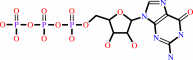 GTP
GTP
|
+
|
H2O
|
=
|
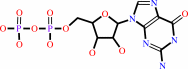 GDP
GDP
|
+
|
 phosphate
|
+
|
H(+)
|
|
|
|
|
|
|
|
|
|
|
|
|
Molecule diagrams generated from .mol files obtained from the
KEGG ftp site
|
|
|
|
|
|
|
|
|
|
|
|
|
|
 |
|
|
|
|
|
|
| |
|
|
| |
|
DOI no:
|
Structure
7:143-156
(1999)
|
|
PubMed id:
|
|
|
|
|
|
| |
|
The crystal structure of Cys-tRNACys-EF-Tu-GDPNP reveals general and specific features in the ternary complex and in tRNA.
|
|
P.Nissen,
S.Thirup,
M.Kjeldgaard,
J.Nyborg.
|
|
|
|
|
| |
ABSTRACT
|
|
|
|
| |
|
|
BACKGROUND:. The translation elongation factor EF-Tu in its GTP-bound state
forms a ternary complex with any aminoacylated tRNA (aa-tRNA), except initiator
tRNA and selenocysteinyl-tRNA. This complex delivers aa-tRNA to the ribosomal A
site during the elongation cycle of translation. The crystal structure of the
yeast Phe-tRNAPhe ternary complex with Thermus aquaticus EF-Tu-GDPNP (Phe-TC)
has previously been determined as one representative of this general yet highly
discriminating complex formation. RESULTS: The ternary complex of Escherichia
coli Cys-tRNACys and T. aquaticus EF-Tu-GDPNP (Cys-TC) has been solved and
refined at 2.6 degrees resolution. Conserved and variable features of the
aa-tRNA recognition and binding by EF-Tu-GTP have been revealed by comparison
with the Phe-TC structure. New tertiary interactions are observed in the tRNACys
structure. A 'kissing complex' is observed in the very close crystal packing
arrangement. CONCLUSIONS: The recognition of Cys-tRNACys by EF-Tu-GDPNP is
restricted to the aa-tRNA motif previously identified in Phe-TC and consists of
the aminoacylated 3' end, the phosphorylated 5' end and one side of the acceptor
stem and T stem. The aminoacyl bond is recognized somewhat differently, yet by
the same primary motif in EF-Tu, which suggests that EF-Tu adapts to subtle
variations in this moiety among all aa-tRNAs. New tertiary interactions revealed
by the Cys-tRNACys structure, such as a protonated C16:C59 pyrimidine pair, a
G15:G48 'Levitt pair' and an s4U8:A14:A46 base triple add to the generic
understanding of tRNA structure from sequence. The structure of the 'kissing
complex' shows a quasicontinuous helix with a distinct shape determined by the
number of base pairs.
|
|
|
|
|
|
| |
Selected figure(s)
|
|
|
|
| |
|
|

|
|
Figure 7.
Figure 7. Focus on the tertiary interactions in the E. coli
Cys-tRNA^Cys molecule by (a) a stereographic representation and
(b) a schematic clover leaf diagram. Residue numbers refer to
the yeast tRNA^Phe standard, thus residues 17 and 47 are missing
(see Figure 1b ). The acceptor stem has been omitted from (a)
for clarity and the schematic diagram in (b) includes only the
base–base interactions. Further, the variable loop in (b) has
been wrapped into the clover leaf center to indicate the unique
role of A46 in the tertiary interactions. Colour codes are as in
Figure 2 . Part (b) was produced using ‘The Gimp’
(http://www.gimp.org).
|
|
|
|
|
|
| |
The above figure is
reprinted
by permission from Cell Press:
Structure
(1999,
7,
143-156)
copyright 1999.
|
|
| |
Figure was
selected
by an automated process.
|
|
|
|
|
|
|
|
|
|
|
|
|
|
|
|
 |
 |
 |
|
Literature references that cite this PDB file's key reference
|
|
|
| |
PubMed id
|
|
Reference
|
|
|
|
|
|
D.Takeshita,
and
K.Tomita
(2012).
Molecular basis for RNA polymerization by Qβ replicase.
|
| |
Nat Struct Mol Biol,
19,
229-237.
|
|
|
PDB codes:
|
|
|
|
|
|
|
|
M.Y.Pavlov,
A.Zorzet,
D.I.Andersson,
and
M.Ehrenberg
(2011).
Activation of initiation factor 2 by ligands and mutations for rapid docking of ribosomal subunits.
|
| |
EMBO J,
30,
289-301.
|
|
|
|
|
|
|
A.Paleskava,
A.L.Konevega,
and
M.V.Rodnina
(2010).
Thermodynamic and kinetic framework of selenocysteyl-tRNASec recognition by elongation factor SelB.
|
| |
J Biol Chem,
285,
3014-3020.
|
|
|
|
|
|
|
K.W.Lin,
I.Yakymovych,
M.Jia,
M.Yakymovych,
and
S.Souchelnytskyi
(2010).
Phosphorylation of eEF1A1 at Ser300 by TβR-I results in inhibition of mRNA translation.
|
| |
Curr Biol,
20,
1615-1625.
|
|
|
|
|
|
|
M.Siwiak,
and
P.Zielenkiewicz
(2010).
A comprehensive, quantitative, and genome-wide model of translation.
|
| |
PLoS Comput Biol,
6,
e1000865.
|
|
|
|
|
|
|
R.Giegé,
and
C.Sauter
(2010).
Biocrystallography: past, present, future.
|
| |
HFSP J,
4,
109-121.
|
|
|
|
|
|
|
S.E.Kolitz,
and
J.R.Lorsch
(2010).
Eukaryotic initiator tRNA: finely tuned and ready for action.
|
| |
FEBS Lett,
584,
396-404.
|
|
|
|
|
|
|
J.Guo,
C.E.Melançon,
H.S.Lee,
D.Groff,
and
P.G.Schultz
(2009).
Evolution of amber suppressor tRNAs for efficient bacterial production of proteins containing nonnatural amino acids.
|
| |
Angew Chem Int Ed Engl,
48,
9148-9151.
|
|
|
|
|
|
|
J.M.Schrader,
S.J.Chapman,
and
O.C.Uhlenbeck
(2009).
Understanding the sequence specificity of tRNA binding to elongation factor Tu using tRNA mutagenesis.
|
| |
J Mol Biol,
386,
1255-1264.
|
|
|
|
|
|
|
X.Agirrezabala,
and
J.Frank
(2009).
Elongation in translation as a dynamic interaction among the ribosome, tRNA, and elongation factors EF-G and EF-Tu.
|
| |
Q Rev Biophys,
42,
159-200.
|
|
|
|
|
|
|
D.S.Kanibolotsky,
O.V.Novosyl'na,
C.M.Abbott,
B.S.Negrutskii,
and
A.V.El'skaya
(2008).
Multiple molecular dynamics simulation of the isoforms of human translation elongation factor 1A reveals reversible fluctuations between "open" and "closed" conformations and suggests specific for eEF1A1 affinity for Ca2+-calmodulin.
|
| |
BMC Struct Biol,
8,
4.
|
|
|
|
|
|
|
M.Dupasquier,
S.Kim,
K.Halkidis,
H.Gamper,
and
Y.M.Hou
(2008).
tRNA integrity is a prerequisite for rapid CCA addition: implication for quality control.
|
| |
J Mol Biol,
379,
579-588.
|
|
|
|
|
|
|
A.Fluitt,
E.Pienaar,
and
H.Viljoen
(2007).
Ribosome kinetics and aa-tRNA competition determine rate and fidelity of peptide synthesis.
|
| |
Comput Biol Chem,
31,
335-346.
|
|
|
|
|
|
|
H.Roy,
H.D.Becker,
M.H.Mazauric,
and
D.Kern
(2007).
Structural elements defining elongation factor Tu mediated suppression of codon ambiguity.
|
| |
Nucleic Acids Res,
35,
3420-3430.
|
|
|
|
|
|
|
K.B.Gromadski,
T.Schümmer,
A.Strømgaard,
C.R.Knudsen,
T.G.Kinzy,
and
M.V.Rodnina
(2007).
Kinetics of the interactions between yeast elongation factors 1A and 1Balpha, guanine nucleotides, and aminoacyl-tRNA.
|
| |
J Biol Chem,
282,
35629-35637.
|
|
|
|
|
|
|
L.E.Sanderson,
and
O.C.Uhlenbeck
(2007).
The 51-63 base pair of tRNA confers specificity for binding by EF-Tu.
|
| |
RNA,
13,
835-840.
|
|
|
|
|
|
|
L.E.Sanderson,
and
O.C.Uhlenbeck
(2007).
Directed mutagenesis identifies amino acid residues involved in elongation factor Tu binding to yeast Phe-tRNAPhe.
|
| |
J Mol Biol,
368,
119-130.
|
|
|
|
|
|
|
R.Fukunaga,
and
S.Yokoyama
(2007).
Structural insights into the first step of RNA-dependent cysteine biosynthesis in archaea.
|
| |
Nat Struct Mol Biol,
14,
272-279.
|
|
|
PDB codes:
|
|
|
|
|
|
|
|
B.Wang,
J.Zhou,
M.Lodder,
R.D.Anderson,
and
S.M.Hecht
(2006).
Tandemly activated tRNAs as participants in protein synthesis.
|
| |
J Biol Chem,
281,
13865-13868.
|
|
|
|
|
|
|
H.C.Losey,
A.J.Ruthenburg,
and
G.L.Verdine
(2006).
Crystal structure of Staphylococcus aureus tRNA adenosine deaminase TadA in complex with RNA.
|
| |
Nat Struct Mol Biol,
13,
153-159.
|
|
|
PDB code:
|
|
|
|
|
|
|
|
J.S.Weinger,
and
S.A.Strobel
(2006).
Participation of the tRNA A76 hydroxyl groups throughout translation.
|
| |
Biochemistry,
45,
5939-5948.
|
|
|
|
|
|
|
K.Suto,
Y.Shimizu,
K.Watanabe,
T.Ueda,
S.Fukai,
O.Nureki,
and
K.Tomita
(2006).
Crystal structures of leucyl/phenylalanyl-tRNA-protein transferase and its complex with an aminoacyl-tRNA analog.
|
| |
EMBO J,
25,
5942-5950.
|
|
|
PDB codes:
|
|
|
|
|
|
|
|
L.D.Dahl,
H.J.Wieden,
M.V.Rodnina,
and
C.R.Knudsen
(2006).
The importance of P-loop and domain movements in EF-Tu for guanine nucleotide exchange.
|
| |
J Biol Chem,
281,
21139-21146.
|
|
|
|
|
|
|
L.Yatime,
Y.Mechulam,
S.Blanquet,
and
E.Schmitt
(2006).
Structural switch of the gamma subunit in an archaeal aIF2 alpha gamma heterodimer.
|
| |
Structure,
14,
119-128.
|
|
|
PDB code:
|
|
|
|
|
|
|
|
M.Arita,
T.Suematsu,
A.Osanai,
T.Inaba,
H.Kamiya,
K.Kita,
M.Sisido,
Y.Watanabe,
and
T.Ohtsuki
(2006).
An evolutionary 'intermediate state' of mitochondrial translation systems found in Trichinella species of parasitic nematodes: co-evolution of tRNA and EF-Tu.
|
| |
Nucleic Acids Res,
34,
5291-5299.
|
|
|
|
|
|
|
Y.Shimizu,
and
T.Ueda
(2006).
SmpB triggers GTP hydrolysis of elongation factor Tu on ribosomes by compensating for the lack of codon-anticodon interaction during trans-translation initiation.
|
| |
J Biol Chem,
281,
15987-15996.
|
|
|
|
|
|
|
E.Kikovska,
M.Brännvall,
J.Kufel,
and
L.A.Kirsebom
(2005).
Substrate discrimination in RNase P RNA-mediated cleavage: importance of the structural environment of the RNase P cleavage site.
|
| |
Nucleic Acids Res,
33,
2012-2021.
|
|
|
|
|
|
|
J.Cabello-Villegas,
and
E.P.Nikonowicz
(2005).
Solution structure of psi32-modified anticodon stem-loop of Escherichia coli tRNAPhe.
|
| |
Nucleic Acids Res,
33,
6961-6971.
|
|
|
PDB code:
|
|
|
|
|
|
|
|
T.Rathinavelan,
and
N.Yathindra
(2005).
Molecular dynamics structures of peptide nucleic acid x DNA hybrid in the wild-type and mutated alleles of Ki-ras proto-oncogene--stereochemical rationale for the low affinity of PNA in the presence of an AC mismatch.
|
| |
FEBS J,
272,
4055-4070.
|
|
|
|
|
|
|
T.Suematsu,
A.Sato,
M.Sakurai,
K.Watanabe,
and
T.Ohtsuki
(2005).
A unique tRNA recognition mechanism of Caenorhabditis elegans mitochondrial EF-Tu2.
|
| |
Nucleic Acids Res,
33,
4683-4691.
|
|
|
|
|
|
|
A.Théobald-Dietrich,
M.Frugier,
R.Giegé,
and
J.Rudinger-Thirion
(2004).
Atypical archaeal tRNA pyrrolysine transcript behaves towards EF-Tu as a typical elongator tRNA.
|
| |
Nucleic Acids Res,
32,
1091-1096.
|
|
|
|
|
|
|
L.S.Harlow,
A.Kadziola,
K.F.Jensen,
and
S.Larsen
(2004).
Crystal structure of the phosphorolytic exoribonuclease RNase PH from Bacillus subtilis and implications for its quaternary structure and tRNA binding.
|
| |
Protein Sci,
13,
668-677.
|
|
|
PDB codes:
|
|
|
|
|
|
|
|
M.Steiner-Mosonyi,
C.Creuzenet,
R.A.Keates,
B.R.Strub,
and
D.Mangroo
(2004).
The Pseudomonas aeruginosa initiation factor IF-2 is responsible for formylation-independent protein initiation in P. aeruginosa.
|
| |
J Biol Chem,
279,
52262-52269.
|
|
|
|
|
|
|
P.Auffinger,
L.Bielecki,
and
E.Westhof
(2004).
Anion binding to nucleic acids.
|
| |
Structure,
12,
379-388.
|
|
|
|
|
|
|
S.Hauenstein,
C.M.Zhang,
Y.M.Hou,
and
J.J.Perona
(2004).
Shape-selective RNA recognition by cysteinyl-tRNA synthetase.
|
| |
Nat Struct Mol Biol,
11,
1134-1141.
|
|
|
PDB code:
|
|
|
|
|
|
|
|
T.Brodegger,
A.Stockmann,
J.Oberstrass,
W.Nellen,
and
H.Follmann
(2004).
Novel thioredoxin targets in Dictyostelium discoideum identified by two-hybrid analysis: interactions of thioredoxin with elongation factor 1alpha and yeast alcohol dehydrogenase.
|
| |
Biol Chem,
385,
1185-1192.
|
|
|
|
|
|
|
C.Evilia,
X.Ming,
S.Dassarma,
and
Y.M.Hou
(2003).
Aminoacylation of an unusual tRNA(Cys) from an extreme halophile.
|
| |
RNA,
9,
794-801.
|
|
|
|
|
|
|
G.R.Andersen,
P.Nissen,
and
J.Nyborg
(2003).
Elongation factors in protein biosynthesis.
|
| |
Trends Biochem Sci,
28,
434-441.
|
|
|
|
|
|
|
H.Yang,
F.Jossinet,
N.Leontis,
L.Chen,
J.Westbrook,
H.Berman,
and
E.Westhof
(2003).
Tools for the automatic identification and classification of RNA base pairs.
|
| |
Nucleic Acids Res,
31,
3450-3460.
|
|
|
|
|
|
|
S.Marzi,
W.Knight,
L.Brandi,
E.Caserta,
N.Soboleva,
W.E.Hill,
C.O.Gualerzi,
and
J.S.Lodmell
(2003).
Ribosomal localization of translation initiation factor IF2.
|
| |
RNA,
9,
958-969.
|
|
|
|
|
|
|
T.Navratil,
and
L.L.Spremulli
(2003).
Effects of mutagenesis of Gln97 in the switch II region of Escherichia coli elongation factor Tu on its interaction with guanine nucleotides, elongation factor Ts, and aminoacyl-tRNA.
|
| |
Biochemistry,
42,
13587-13595.
|
|
|
|
|
|
|
Y.Pan,
and
A.D.MacKerell
(2003).
Altered structural fluctuations in duplex RNA versus DNA: a conformational switch involving base pair opening.
|
| |
Nucleic Acids Res,
31,
7131-7140.
|
|
|
|
|
|
|
H.Asahara,
and
O.C.Uhlenbeck
(2002).
The tRNA specificity of Thermus thermophilus EF-Tu.
|
| |
Proc Natl Acad Sci U S A,
99,
3499-3504.
|
|
|
|
|
|
|
T.Ohtsuki,
A.Sato,
Y.Watanabe,
and
K.Watanabe
(2002).
A unique serine-specific elongation factor Tu found in nematode mitochondria.
|
| |
Nat Struct Biol,
9,
669-673.
|
|
|
|
|
|
|
C.Mayer,
A.Stortchevoi,
C.Köhrer,
U.Varshney,
and
U.L.RajBhandary
(2001).
Initiator tRNA and its role in initiation of protein synthesis.
|
| |
Cold Spring Harb Symp Quant Biol,
66,
195-206.
|
|
|
|
|
|
|
F.J.LaRiviere,
A.D.Wolfson,
and
O.C.Uhlenbeck
(2001).
Uniform binding of aminoacyl-tRNAs to elongation factor Tu by thermodynamic compensation.
|
| |
Science,
294,
165-168.
|
|
|
|
|
|
|
G.R.Andersen,
and
J.Nyborg
(2001).
Structural studies of eukaryotic elongation factors.
|
| |
Cold Spring Harb Symp Quant Biol,
66,
425-437.
|
|
|
|
|
|
|
L.Vitagliano,
M.Masullo,
F.Sica,
A.Zagari,
and
V.Bocchini
(2001).
The crystal structure of Sulfolobus solfataricus elongation factor 1alpha in complex with GDP reveals novel features in nucleotide binding and exchange.
|
| |
EMBO J,
20,
5305-5311.
|
|
|
PDB code:
|
|
|
|
|
|
|
|
M.Ibba
(2001).
Protein synthesis. Discriminating right from wrong.
|
| |
Science,
294,
70-71.
|
|
|
|
|
|
|
A.D.Frankel
(2000).
Fitting peptides into the RNA world.
|
| |
Curr Opin Struct Biol,
10,
332-340.
|
|
|
|
|
|
|
D.Fagegaltier,
N.Hubert,
K.Yamada,
T.Mizutani,
P.Carbon,
and
A.Krol
(2000).
Characterization of mSelB, a novel mammalian elongation factor for selenoprotein translation.
|
| |
EMBO J,
19,
4796-4805.
|
|
|
|
|
|
|
G.Raimo,
M.Masullo,
B.Lombardo,
and
V.Bocchini
(2000).
The archaeal elongation factor 1alpha bound to GTP forms a ternary complex with eubacterial and eukaryal aminoacyl-tRNA.
|
| |
Eur J Biochem,
267,
6012-6018.
|
|
|
|
|
|
|
M.V.Rodnina,
H.Stark,
A.Savelsbergh,
H.J.Wieden,
D.Mohr,
N.B.Matassova,
F.Peske,
T.Daviter,
C.O.Gualerzi,
and
W.Wintermeyer
(2000).
GTPases mechanisms and functions of translation factors on the ribosome.
|
| |
Biol Chem,
381,
377-387.
|
|
|
|
|
|
|
P.Nissen,
M.Kjeldgaard,
and
J.Nyborg
(2000).
Macromolecular mimicry.
|
| |
EMBO J,
19,
489-495.
|
|
|
|
|
|
|
R.Spurio,
L.Brandi,
E.Caserta,
C.L.Pon,
C.O.Gualerzi,
R.Misselwitz,
C.Krafft,
K.Welfle,
and
H.Welfle
(2000).
The C-terminal subdomain (IF2 C-2) contains the entire fMet-tRNA binding site of initiation factor IF2.
|
| |
J Biol Chem,
275,
2447-2454.
|
|
|
|
|
|
|
S.Blanquet,
Y.Mechulam,
and
E.Schmitt
(2000).
The many routes of bacterial transfer RNAs after aminoacylation.
|
| |
Curr Opin Struct Biol,
10,
95.
|
|
|
|
|
|
|
S.Meunier,
R.Spurio,
M.Czisch,
R.Wechselberger,
M.Guenneugues,
C.O.Gualerzi,
and
R.Boelens
(2000).
Structure of the fMet-tRNA(fMet)-binding domain of B. stearothermophilus initiation factor IF2.
|
| |
EMBO J,
19,
1918-1926.
|
|
|
PDB code:
|
|
|
|
|
|
|
|
T.A.Nissan,
and
J.J.Perona
(2000).
Alternative designs for construction of the class II transfer RNA tertiary core.
|
| |
RNA,
6,
1585-1596.
|
|
|
|
|
|
|
P.J.Beuning,
and
K.Musier-Forsyth
(1999).
Transfer RNA recognition by aminoacyl-tRNA synthetases.
|
| |
Biopolymers,
52,
1.
|
|
|
|
|
|
The most recent references are shown first.
Citation data come partly from CiteXplore and partly
from an automated harvesting procedure. Note that this is likely to be
only a partial list as not all journals are covered by
either method. However, we are continually building up the citation data
so more and more references will be included with time.
Where a reference describes a PDB structure, the PDB
codes are
shown on the right.
|
|


 Links
Links






