 |
PDBsum entry 6z4x

|
|
|
|
|
|

|

|

|

|
|

|
|

|
|

|
|

|
|

|
|

|
|
|
 |

|

|
|
|
|
|
|
|
|
|
|
|
|
|
|
|
|
|
|
|
|
|
|
|
|
|
|
|
|
|
|
|
|
|
|
|
Transcription
|
PDB id
|
|
|
|
6z4x
|
|
|
|
|
|
|
|
|
|
|
|
|
|
|

|

|

|
|
|
|
|
|
|
|
 |
Contents |
 |
|
|
|
|
|
|
|
|
|
|
|

 312 a.a.
|
|
|
|
|
|
|
|
|
|
|

 322 a.a.
|
|
|
|
|
|
|
|
|
|
|

 66 a.a.
|
|
|
|
|
|
|
|
|
|
|
|
|
|
|
|
|
PDB id:
|
|
|
|
| Name: |
|
Transcription
|
|
|
Title:
|
|
Structure of the cak complex form chaetomium thermophilum bound to atp-gamma-s
|
|
Structure:
|
|
Cyclin domain-containing protein. Chain: a, d. Engineered: yes. Protein kinase domain-containing protein. Chain: b, e. Engineered: yes. Ring-type domain-containing protein. Chain: c, f. Engineered: yes
|
|
Source:
|
|
Chaetomium thermophilum. Organism_taxid: 209285. Expressed in: escherichia coli. Expression_system_taxid: 562. Expressed in: spodoptera frugiperda. Expression_system_taxid: 7108. Expression_system_taxid: 562
|
|
Resolution:
|
|
|
2.98Å
|
R-factor:
|
0.205
|
R-free:
|
0.246
|
|
|
Authors:
|
|
S.Peissert,J.Kuper,C.Kisker
|
|
Key ref:
|
|
S.Peissert
et al.
(2020).
Structural basis for CDK7 activation by MAT1 and Cyclin H.
Proc Natl Acad Sci U S A,
117,
26739-26748.
PubMed id:
DOI:
|
|
|
Date:
|
|
|
26-May-20
|
Release date:
|
09-Dec-20
|
|
|
|
|
|
|
PROCHECK
|

|
|
|
|
|
Headers
|
|
|
|
References
|
|
|
|
|
|

|
|
G0SH78
(G0SH78_CHATD) -
Cyclin-like domain-containing protein from Chaetomium thermophilum (strain DSM 1495 / CBS 144.50 / IMI 039719)
|
|
|
|
Seq:
Struc:
|
|
|
|
425 a.a.
312 a.a.
|
|

|

|

|
|
|
|
|
|
|
|
|
|
|
|
|
|
|
|
|
Enzyme class:
|
|
Chains B, E:
E.C.2.7.11.22
- cyclin-dependent kinase.
|
|
|
|
|
|
|
Reaction:
|
|
|
1.
|
L-seryl-[protein] + ATP = O-phospho-L-seryl-[protein] + ADP + H+
|
|
2.
|
L-threonyl-[protein] + ATP = O-phospho-L-threonyl-[protein] + ADP + H+
|
|
|
|
|
|
|
L-seryl-[protein]
|
+
|
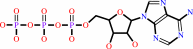 ATP
ATP
|
=
|
O-phospho-L-seryl-[protein]
|
+
|
 ADP
ADP
|
+
|
H(+)
|
|
|
|
|
|
|
L-threonyl-[protein]
|
+
|
ATP
|
=
|
O-phospho-L-threonyl-[protein]
|
+
|
ADP
|
+
|
H(+)
|
|
|
|
|
|
|
|
|
|
|
|
|
Molecule diagrams generated from .mol files obtained from the
KEGG ftp site
|
|
|
|
|
|
|
|
|
|
|
|
|
|
 |
|
|
|
|
|
|
| |
|
|
| |
|
DOI no:
|
Proc Natl Acad Sci U S A
117:26739-26748
(2020)
|
|
PubMed id:
|
|
|
|
|
|
| |
|
Structural basis for CDK7 activation by MAT1 and Cyclin H.
|
|
S.Peissert,
A.Schlosser,
R.Kendel,
J.Kuper,
C.Kisker.
|
|
|
|
|
| |
ABSTRACT
|
|
|
|
| |
|
|
Cyclin-dependent kinase 7 (CDK7), Cyclin H, and the RING-finger protein MAT1
form the heterotrimeric CDK-activating kinase (CAK) complex which is vital for
transcription and cell-cycle control. When associated with the general
transcription factor II H (TFIIH) it activates RNA polymerase II by
hyperphosphorylation of its C-terminal domain (CTD). In the absence of TFIIH the
trimeric complex phosphorylates the T-loop of CDKs that control cell-cycle
progression. CAK holds a special position among the CDK branch due to this dual
activity and the dependence on two proteins for activation. We solved the
structure of the CAK complex from the model organism Chaetomium
thermophilum at 2.6-Å resolution. Our structure reveals an intricate
network of interactions between CDK7 and its two binding partners MAT1 and
Cyclin H, providing a structural basis for the mechanism of CDK7 activation and
CAK activity regulation. In vitro activity measurements and functional
mutagenesis show that CDK7 activation can occur independent of T-loop
phosphorylation and is thus exclusively MAT1-dependent by positioning the CDK7
T-loop in its active conformation.
|
|
|
|
|
|
|
|
|
|
|
|
|
|
|
|
|
|
 |
 |
 |
|
| |


 Links
Links


