 |
PDBsum entry 5yv2

|
|
|
|
|
|

|

|

|

|
|

|
|

|
|

|
|

|
|

|
|

|
|

|
|
|
 |

|

|
|
|
|
|
|
|
|
|
|
|
|
|
|
|
|
|
|
|
|
|
|
|
|
|
|
|
|
|
|
|
|
|
|
|
|
DNA binding protein
|
PDB id
|
|
|
|
5yv2
|
|
|
|
|
|
|
|
|
|
|
|
|
|
|

|

|

|
|
|
|
|
|
|
PDB id:
|
|
|
|
| Name: |
|
DNA binding protein
|
|
|
Title:
|
|
DNA polymerase iv - DNA ternary complex 14
|
|
Structure:
|
|
DNA polymerase iv. Chain: f, a. Synonym: pol iv,translesion synthesis polymerase iv,tsl polymerase iv. Engineered: yes. Dtn1. Chain: g, b. Engineered: yes. Dtn2.
|
|
Source:
|
|
Escherichia coli k-12. Organism_taxid: 83333. Strain: k12. Gene: dinb, dinp, b0231, jw0221. Expressed in: escherichia coli. Expression_system_taxid: 562. Synthetic: yes. Organism_taxid: 83333
|
|
Resolution:
|
|
|
1.90Å
|
R-factor:
|
0.206
|
R-free:
|
0.245
|
|
|
Authors:
|
|
J.Kottur,D.T.Nair
|
|
Key ref:
|
|
J.Kottur
and
D.T.Nair
(2018).
Pyrophosphate hydrolysis is an intrinsic and critical step of the DNA synthesis reaction.
Nucleic Acids Res,
46,
5875-5885.
PubMed id:
DOI:
|
|
|
Date:
|
|
|
23-Nov-17
|
Release date:
|
05-Sep-18
|
|
|
|
|
|
|
PROCHECK
|

|
|
|
|
|
Headers
|
|
|
|
References
|
|
|
|
|
|

|
|
Q47155
(DPO4_ECOLI) -
DNA polymerase IV from Escherichia coli (strain K12)
|
|
|
|
Seq:
Struc:
|
|
|
|
351 a.a.
342 a.a.*
|
|

|

|

|
|
|
|
|
|
|
|
|
|
|
Key: |
 |
PfamA domain |
|
|
 |
Secondary structure |
|
|
*
PDB and UniProt seqs differ
at 1 residue position (black
cross)
|
|
|
|
|
|
|
|

|
|
|
|
T-C-T-A-G-G-G-T-C-C-T-A-G-G-A-C-C-C
18 bases
|
|
|
|
G-G-G-T-C-C-T-A-G-G-A-C-C-C-T
15 bases
|
|
|
|
T-C-T-A-G-G-G-T-C-C-T-A-G-G-A-C-C-C
18 bases
|
|
|
|
C-T-A-G-G-G-T-C-C-T-A-G-G-A-C-C-C-T
18 bases
|
|
|
|
|
|
|
|
|
|
|
|
|
|
Enzyme class:
|
|
E.C.2.7.7.7
- DNA-directed Dna polymerase.
|
|
|
|
|
|
|
Reaction:
|
|
DNA(n) + a 2'-deoxyribonucleoside 5'-triphosphate = DNA(n+1) + diphosphate
|
|
|
|
|
|
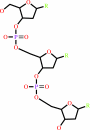 DNA(n)
|
+
|
2'-deoxyribonucleoside 5'-triphosphate
|
=
|
DNA(n+1)
|
+
|
diphosphate
Bound ligand (Het Group name = )
matches with 55.56% similarity
|
|
|
|
|
|
|
|
|
|
|
|
|
Molecule diagrams generated from .mol files obtained from the
KEGG ftp site
|
|
|
|
|
|
|
|
|
|
|
|
|
|
 |
|
|
|
|
|
|
| |
|
|
| |
|
DOI no:
|
Nucleic Acids Res
46:5875-5885
(2018)
|
|
PubMed id:
|
|
|
|
|
|
| |
|
Pyrophosphate hydrolysis is an intrinsic and critical step of the DNA synthesis reaction.
|
|
J.Kottur,
D.T.Nair.
|
|
|
|
|
| |
ABSTRACT
|
|
|
|
| |
|
|
DNA synthesis by DNA polymerases (dPols) is central to duplication and
maintenance of the genome in all living organisms. dPols catalyze the formation
of a phosphodiester bond between the incoming deoxynucleoside triphosphate and
the terminal primer nucleotide with the release of a pyrophosphate (PPi) group.
It is believed that formation of the phosphodiester bond is an endergonic
reaction and PPi has to be hydrolyzed by accompanying pyrophosphatase enzymes to
ensure that the free energy change of the DNA synthesis reaction is negative and
it can proceed in the forward direction. The fact that DNA synthesis proceeds in
vitro in the absence of pyrophosphatases represents a long-standing conundrum
regarding the thermodynamics of the DNA synthesis reaction. Using time-resolved
crystallography, we show that hydrolysis of PPi is an intrinsic and critical
step of the DNA synthesis reaction catalyzed by dPols. The hydrolysis of PPi
occurs after the formation of the phosphodiester bond and ensures that the DNA
synthesis reaction is energetically favorable without the need for additional
enzymes. Also, we observe that DNA synthesis is a two Mg2+ ion assisted stepwise
associative SN2 reaction. Overall, this study provides deep temporal insight
regarding the primary enzymatic reaction responsible for genome duplication.
|
|
|
|
|
|
|
|
|
|
|
|
|
|
|
|
|
|
 |
 |
 |
|


 Links
Links


