 |
PDBsum entry 5e5k

|
|
|
|
|
|

|

|

|

|
|

|
|

|
|

|
|

|
|

|
|

|
|
|
 |

|

|
|
|
|
|
|
|
|
|
|
|
|
|
|
|
|
|
|
|
|
|
|
|
|
|
|
|
|
|
|
|
|
|
|
|
Hydrolase/hydrolase inhibitor
|
PDB id
|
|
|
|
5e5k
|
|
|
|
|
|
|
|
|
|
|
|
|
|
|

|

|

|
|
|
|
|
|
|
PDB id:
|
|
|
|
| Name: |
|
Hydrolase/hydrolase inhibitor
|
|
|
Title:
|
|
Joint x-ray/neutron structure of HIV-1 protease triple mutant (v32i, i47v,v82i) with darunavir at ph 4.3
|
|
Structure:
|
|
HIV-1 protease. Chain: a, b. Synonym: pr160gag-pol. Ec: 3.4.23.16,2.7.7.49,2.7.7.7,3.1.26.13,3.1.13.2,2.7.7.-,3.1.-.-. Engineered: yes. Mutation: yes
|
|
Source:
|
|
Human immunodeficiency virus type 1 group m subtype b. HIV-1. Organism_taxid: 11686. Strain: isolate bru/lai. Gene: gag-pol. Expressed in: escherichia coli. Expression_system_taxid: 562
|
|
Resolution:
|
|
|
1.75Å
|
R-factor:
|
0.203
|
R-free:
|
0.218
|
|
|
Authors:
|
|
A.Y.Kovalevsky,A.Das
|
|
Key ref:
|
|
O.Gerlits
et al.
(2016).
Long-Range Electrostatics-Induced Two-Proton Transfer Captured by Neutron Crystallography in an Enzyme Catalytic Site.
Angew Chem Int Ed Engl,
55,
4924-4927.
PubMed id:
DOI:
|
|
|
Date:
|
|
|
08-Oct-15
|
Release date:
|
04-May-16
|
|
|
|
|
|
|
PROCHECK
|

|
|
|
|
|
Headers
|
|
|
|
References
|
|
|
|
|
|

|
|
P03367
(POL_HV1BR) -
Gag-Pol polyprotein from Human immunodeficiency virus type 1 group M subtype B (isolate BRU/LAI)
|
|
|
|
Seq:
Struc:
|
|
|
|
1447 a.a.
99 a.a.*
|
|

|

|

|
|
|
|
|
|
|
|
|
|
|
Key: |
 |
PfamA domain |
|
|
 |
Secondary structure |
|
 |
CATH domain |
|
|
*
PDB and UniProt seqs differ
at 8 residue positions (black
crosses)
|
|
|
|
|
|
|
|
|
|
|
|
|
Enzyme class 1:
|
|
E.C.2.7.7.-
- ?????
|
|
|
|
|
|
|
Enzyme class 2:
|
|
E.C.2.7.7.49
- RNA-directed Dna polymerase.
|
|
|
|
|
|
|
Reaction:
|
|
DNA(n) + a 2'-deoxyribonucleoside 5'-triphosphate = DNA(n+1) + diphosphate
|
|
|
|
|
|
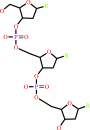 DNA(n)
|
+
|
2'-deoxyribonucleoside 5'-triphosphate
|
=
|
DNA(n+1)
|
+
|
 diphosphate
|
|
|
|
|
|
|
|
|
|
Enzyme class 3:
|
|
E.C.2.7.7.7
- DNA-directed Dna polymerase.
|
|
|
|
|
|
|
Reaction:
|
|
DNA(n) + a 2'-deoxyribonucleoside 5'-triphosphate = DNA(n+1) + diphosphate
|
|
|
|
|
|
DNA(n)
|
+
|
2'-deoxyribonucleoside 5'-triphosphate
|
=
|
DNA(n+1)
|
+
|
diphosphate
|
|
|
|
|
|
|
|
|
|
Enzyme class 4:
|
|
E.C.3.1.-.-
|
|
|
|
|
|
|
Enzyme class 5:
|
|
E.C.3.1.13.2
- exoribonuclease H.
|
|
|
|
|
|
|
Reaction:
|
|
Exonucleolytic cleavage to 5'-phosphomonoester oligonucleotides in both 5'- to 3'- and 3'- to 5'-directions.
|
|
|
|
|
|
Enzyme class 6:
|
|
E.C.3.1.26.13
- retroviral ribonuclease H.
|
|
|
|
|
|
|
Enzyme class 7:
|
|
E.C.3.4.23.16
- HIV-1 retropepsin.
|
|
|
|
|
|
|
Reaction:
|
|
Specific for a P1 residue that is hydrophobic, and P1' variable, but often Pro.
|
|
|
|
|
|
|
|
|
Note, where more than one E.C. class is given (as above), each may
correspond to a different protein domain or, in the case of polyprotein
precursors, to a different mature protein.
|
|
|
|
Molecule diagrams generated from .mol files obtained from the
KEGG ftp site
|
|
|
|
|
|
|
|
|
|
|
|
|
|
 |
|
|
|
|
|
|
| |
|
|
| |
|
DOI no:
|
Angew Chem Int Ed Engl
55:4924-4927
(2016)
|
|
PubMed id:
|
|
|
|
|
|
| |
|
Long-Range Electrostatics-Induced Two-Proton Transfer Captured by Neutron Crystallography in an Enzyme Catalytic Site.
|
|
O.Gerlits,
T.Wymore,
A.Das,
C.H.Shen,
J.M.Parks,
J.C.Smith,
K.L.Weiss,
D.A.Keen,
M.P.Blakeley,
J.M.Louis,
P.Langan,
I.T.Weber,
A.Kovalevsky.
|
|
|
|
|
| |
ABSTRACT
|
|
|
|
| |
|
|
Neutron crystallography was used to directly locate two protons before and after
a pH-induced two-proton transfer between catalytic aspartic acid residues and
the hydroxy group of the bound clinical drug darunavir, located in the catalytic
site of enzyme HIV-1 protease. The two-proton transfer is triggered by
electrostatic effects arising from protonation state changes of surface residues
far from the active site. The mechanism and pH effect are supported by quantum
mechanics/molecular mechanics (QM/MM) calculations. The low-pH proton
configuration in the catalytic site is deemed critical for the catalytic action
of this enzyme and may apply more generally to other aspartic proteases.
Neutrons therefore represent a superb probe to obtain structural details for
proton transfer reactions in biological systems at a truly atomic level.
|
|
|
|
|
|
|
|
|
|
|
|
|
|
|
|
|
|
 |
 |
 |
|


 Links
Links


