 |
PDBsum entry 4i2q

|
|
|
|
|
|

|

|

|

|
|

|
|

|
|

|
|

|
|

|
|

|
|
|
 |

|

|
|
|
|
|
|
|
|
|
|
|
|
|
|
|
|
|
|
|
|
|
|
|
|
|
|
|
|
|
|
|
|
|
|
|
Hydrolase, transferase/inhibitor
|
PDB id
|
|
|
|
4i2q
|
|
|
|
|
|
|
|
|
|
|
|
|
|
|

|

|

|
|
|
|
|
|
|
PDB id:
|
|
|
|
| Name: |
|
Hydrolase, transferase/inhibitor
|
|
|
Title:
|
|
Crystal structure of k103n/y181c mutant of HIV-1 reverse transcriptase in complex with rilpivirine (tmc278) analogue
|
|
Structure:
|
|
Gag-pol polyprotein. Chain: a. Fragment: p66 (unp residues 600-1154). Synonym: reverse transcriptase/ribonuclease h, exoribonuclease h, p66 rt, p51 rt. Ec: 3.4.23.16, 2.7.7.49, 2.7.7.7, 3.1.26.13, 3.1.13.2. Engineered: yes. Mutation: yes. Gag-pol polyprotein.
|
|
Source:
|
|
Human immunodeficiency virus type 1 bh10. HIV-1. Organism_taxid: 11678. Gene: gag-pol. Expressed in: escherichia coli. Expression_system_taxid: 562. Expression_system_taxid: 562
|
|
Resolution:
|
|
|
2.70Å
|
R-factor:
|
0.215
|
R-free:
|
0.277
|
|
|
Authors:
|
|
D.Patel,J.D.Bauman,K.Das,E.Arnold
|
|
Key ref:
|
|
B.C.Johnson
et al.
(2012).
A comparison of the ability of rilpivirine (TMC278) and selected analogues to inhibit clinically relevant HIV-1 reverse transcriptase mutants.
Retrovirology,
9,
99.
PubMed id:
|
|
|
Date:
|
|
|
22-Nov-12
|
Release date:
|
16-Jan-13
|
|
|
|
|
|
|
PROCHECK
|

|
|
|
|
|
Headers
|
|
|
|
References
|
|
|
|
|
|
|
|
|
|
|
|
Enzyme class 1:
|
|
Chains A, B:
E.C.2.7.7.-
- ?????
|
|
|
|
|
|
|
Enzyme class 2:
|
|
Chains A, B:
E.C.2.7.7.49
- RNA-directed Dna polymerase.
|
|
|
|
|
|
|
Reaction:
|
|
DNA(n) + a 2'-deoxyribonucleoside 5'-triphosphate = DNA(n+1) + diphosphate
|
|
|
|
|
|
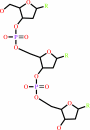 DNA(n)
|
+
|
2'-deoxyribonucleoside 5'-triphosphate
|
=
|
DNA(n+1)
|
+
|
 diphosphate
|
|
|
|
|
|
|
|
|
|
Enzyme class 3:
|
|
Chains A, B:
E.C.2.7.7.7
- DNA-directed Dna polymerase.
|
|
|
|
|
|
|
Reaction:
|
|
DNA(n) + a 2'-deoxyribonucleoside 5'-triphosphate = DNA(n+1) + diphosphate
|
|
|
|
|
|
DNA(n)
|
+
|
2'-deoxyribonucleoside 5'-triphosphate
|
=
|
DNA(n+1)
|
+
|
diphosphate
|
|
|
|
|
|
|
|
|
|
Enzyme class 4:
|
|
Chains A, B:
E.C.3.1.-.-
|
|
|
|
|
|
|
Enzyme class 5:
|
|
Chains A, B:
E.C.3.1.13.2
- exoribonuclease H.
|
|
|
|
|
|
|
Reaction:
|
|
Exonucleolytic cleavage to 5'-phosphomonoester oligonucleotides in both 5'- to 3'- and 3'- to 5'-directions.
|
|
|
|
|
|
Enzyme class 6:
|
|
Chains A, B:
E.C.3.1.26.13
- retroviral ribonuclease H.
|
|
|
|
|
|
|
Enzyme class 7:
|
|
Chains A, B:
E.C.3.4.23.16
- HIV-1 retropepsin.
|
|
|
|
|
|
|
Reaction:
|
|
Specific for a P1 residue that is hydrophobic, and P1' variable, but often Pro.
|
|
|
|
|
|
|
|
|
Note, where more than one E.C. class is given (as above), each may
correspond to a different protein domain or, in the case of polyprotein
precursors, to a different mature protein.
|
|
|
|
Molecule diagrams generated from .mol files obtained from the
KEGG ftp site
|
|
|
|
|
|
|
|
|
|
|
|
|
|
 |
|
|
|
|
|
|
| |
|
|
| |
|
|
Retrovirology
9:99
(2012)
|
|
PubMed id:
|
|
|
|
|
|
| |
|
A comparison of the ability of rilpivirine (TMC278) and selected analogues to inhibit clinically relevant HIV-1 reverse transcriptase mutants.
|
|
B.C.Johnson,
G.T.Pauly,
G.Rai,
D.Patel,
J.D.Bauman,
H.L.Baker,
K.Das,
J.P.Schneider,
D.J.Maloney,
E.Arnold,
C.J.Thomas,
S.H.Hughes.
|
|
|
|
|
| |
ABSTRACT
|
|
|
|
| |
|
|
ABSTRACT: BACKGROUND: The recently approved anti-AIDS drug rilpivirine (TMC278,
Edurant) is a nonnucleoside inhibitor (NNRTI) that binds to reverse
transcriptase (RT) and allosterically blocks the chemical step of DNA synthesis.
In contrast to earlier NNRTIs, rilpivirine retains potency against
well-characterized, clinically relevant RT mutants. Many structural analogues of
rilpivirine are described in the patent literature, but detailed analyses of
their antiviral activities have not been published. This work addresses the
ability of several of these analogues to inhibit the replication of wild-type
(WT) and drug-resistant HIV-1. RESULTS: We used a combination of structure
activity relationships and X-ray crystallography to examine NNRTIs that are
structurally related to rilpivirine to determine their ability to inhibit WT RT
and several clinically relevant RT mutants. Several analogues showed broad
activity with only modest losses of potency when challenged with drug-resistant
viruses. Structural analyses (crystallography or modeling) of several analogues
whose potencies were reduced by RT mutations provide insight into why these
compounds were less effective. CONCLUSIONS: Subtle variations between compounds
can lead to profound differences in their activities and resistance profiles.
Compounds with larger substitutions replacing the pyrimidine and benzonitrile
groups of rilpivirine, which reorient pocket residues, tend to lose more
activity against the mutants we tested. These results provide a deeper
understanding of how rilpivirine and related compounds interact with the NNRTI
binding pocket and should facilitate development of novel inhibitors.
|
|
|
|
|
|
|
|
|
|
|
|
|
|
|
|
|
|
 |
 |
 |
|
|


 Links
Links


