 |
PDBsum entry 4eal
|
|

|
|
PDB id:
|
|
|
|
| Name: |
|
Transferase
|
|
|
Title:
|
|
Co-crystal of ampk core with atp soaked with amp
|
|
Structure:
|
|
5'-amp-activated protein kinase catalytic subunit alpha-1. Chain: a. Synonym: ampk subunit alpha-1,acetyl-coa carboxylase kinase,acaca kinase,hydroxymethylglutaryl-coa reductase kinase,hmgcr kinase,tau- protein kinase prkaa1. Ec: 2.7.11.1,2.7.11.27,2.7.11.31,2.7.11.26. Engineered: yes. Other_details: chimera protein of residues 405-479 and residues 540- 559 from 5'-amp-activated protein kinase catalytic subunit alpha-1
|
|
Source:
|
|
Rattus norvegicus. Rat. Organism_taxid: 10116. Gene: prkaa1, ampk1. Expressed in: escherichia coli. Expression_system_taxid: 562. Gene: prkab1. Gene: prkag1.
|
|
Resolution:
|
|
|
2.51Å
|
R-factor:
|
0.235
|
R-free:
|
0.277
|
|
|
Authors:
|
|
L.Chen,J.Wang,Y.-Y.Zhang,S.F.Yan,D.Neumann,U.Schlattner,Z.-X.Wang,J.- W.Wu
|
|
Key ref:
|
|
L.Chen
et al.
(2012).
AMP-activated protein kinase undergoes nucleotide-dependent conformational changes.
Nat Struct Biol,
19,
716-718.
PubMed id:
|
|
|
Date:
|
|
|
22-Mar-12
|
Release date:
|
06-Jun-12
|
|
|
|
|
|
|
PROCHECK
|

|
|
|
|
|
Headers
|
|
|
|
References
|
|
|
|
|
|

|
|
P54645
(AAPK1_RAT) -
5'-AMP-activated protein kinase catalytic subunit alpha-1 from Rattus norvegicus
|
|
|
|
Seq:
Struc:
|
|
|
|
559 a.a.
92 a.a.*
|
|

|

|
|
|
|
|
|
|
|
|
|
|
|
|
|
|
|
|
|
Enzyme class 1:
|
|
Chain A:
E.C.2.7.11.1
- non-specific serine/threonine protein kinase.
|
|
|
|
|
|
|
Reaction:
|
|
|
1.
|
L-seryl-[protein] + ATP = O-phospho-L-seryl-[protein] + ADP + H+
|
|
2.
|
L-threonyl-[protein] + ATP = O-phospho-L-threonyl-[protein] + ADP + H+
|
|
|
|
|
|
|
L-seryl-[protein]
|
+
|
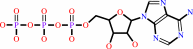 ATP
ATP
|
=
|
O-phospho-L-seryl-[protein]
Bound ligand (Het Group name = )
matches with 85.19% similarity
|
+
|
 ADP
ADP
|
+
|
H(+)
|
|
|
|
|
|
|
L-threonyl-[protein]
|
+
|
ATP
|
=
|
O-phospho-L-threonyl-[protein]
Bound ligand (Het Group name = )
matches with 85.19% similarity
|
+
|
ADP
|
+
|
H(+)
|
|
|
|
|
|
|
|
|
|
Enzyme class 2:
|
|
Chain A:
E.C.2.7.11.26
- [tau protein] kinase.
|
|
|
|
|
|
|
Reaction:
|
|
|
1.
|
L-seryl-[tau protein] + ATP = O-phospho-L-seryl-[tau protein] + ADP + H+
|
|
2.
|
L-threonyl-[tau protein] + ATP = O-phospho-L-threonyl-[tau protein] + ADP + H+
|
|
|
|
|
|
|
L-seryl-[tau protein]
|
+
|
ATP
|
=
|
O-phospho-L-seryl-[tau protein]
Bound ligand (Het Group name = )
matches with 85.19% similarity
|
+
|
ADP
|
+
|
H(+)
|
|
|
|
|
|
|
L-threonyl-[tau protein]
|
+
|
ATP
|
=
|
O-phospho-L-threonyl-[tau protein]
|
+
|
ADP
|
+
|
H(+)
|
|
|
|
|
|
|
|
|
|
Enzyme class 3:
|
|
Chain A:
E.C.2.7.11.31
- [hydroxymethylglutaryl-CoA reductase (NADPH)] kinase.
|
|
|
|
|
|
|
Reaction:
|
|
L-seryl-[3-hydroxy-3-methylglutaryl-coenzyme A reductase] + ATP = O-phospho-L-seryl-[3-hydroxy-3-methylglutaryl-coenzyme A reductase] + ADP + H+
|
|
|
|
|
|
L-seryl-[3-hydroxy-3-methylglutaryl-coenzyme A reductase]
|
+
|
ATP
|
=
|
O-phospho-L-seryl-[3-hydroxy-3-methylglutaryl-coenzyme A reductase]
Bound ligand (Het Group name = )
matches with 85.19% similarity
|
+
|
ADP
|
+
|
H(+)
|
|
|
|
|
|
|
|
|
|
|
|
|
Note, where more than one E.C. class is given (as above), each may
correspond to a different protein domain or, in the case of polyprotein
precursors, to a different mature protein.
|
|
|
|
Molecule diagrams generated from .mol files obtained from the
KEGG ftp site
|
|
|
|
|
|
|
|
|
|
|
|
|
|
 |
|
|
|
|
|
|
| |
|
|
| |
|
|
Nat Struct Biol
19:716-718
(2012)
|
|
PubMed id:
|
|
|
|
|
|
| |
|
AMP-activated protein kinase undergoes nucleotide-dependent conformational changes.
|
|
L.Chen,
J.Wang,
Y.Y.Zhang,
S.F.Yan,
D.Neumann,
U.Schlattner,
Z.X.Wang,
J.W.Wu.
|
|
|
|
|
| |
ABSTRACT
|
|
|
|
| |
|
|
The energy sensor AMP-activated protein kinase (AMPK) is a heterotrimeric
complex that is allosterically activated by AMP binding to the γ subunit.
Cocrystal structures of the mammalian AMPK core reveal occlusion of
nucleotide-binding site 3 of the γ subunit in the presence of ATP. However,
site 3 is occupied in the presence of AMP. Mutagenesis studies indicate that
sites 3 and 4 are important for AMPK allosteric activation.
|
|
|
|
|
|
|
|
|
|
|
|
|
|
|
|
|
|
 |
 |
 |
|
| |


 Links
Links


