
|
|
|
|
|
 |
Contents |
 |
|
|
|
|
|
|
|
|
|
|
|
 271 a.a.
|
|
|
|
|
|
|
|
|
|
|
 204 a.a.
|
|
|
|
|
|
|
|
|
|
|
 202 a.a.
|
|
|
|
|
|
|
|
|
|
|
 181 a.a.
|
|
|
|
|
|
|
|
|
|
|
 159 a.a.
|
|
|
|
|
|
|
|
|
|
|
 145 a.a.
|
|
|
|
|
|
|
|
|
|
|
 147 a.a.
|
|
|
|
|
|
|
|
|
|
|
 137 a.a.
|
|
|
|
|
|
|
|
|
|
|
 122 a.a.
|
|
|
|
|
|
|
|
|
|
|
 146 a.a.
|
|
|
|
|
|
|
|
|
|
|
 134 a.a.
|
|
|
|
|
|
|
|
|
|
|
 117 a.a.
|
|
|
|
|
|
|
|
|
|
|
 98 a.a.
|
|
|
|
|
|
|
|
|
|
|
 137 a.a.
|
|
|
|
|
|
|
|
|
|
|
 117 a.a.
|
|
|
|
|
|
|
|
|
|
|
 101 a.a.
|
|
|
|
|
|
|
|
|
|
|
 112 a.a.
|
|
|
|
|
|
|
|
|
|
|
 92 a.a.
|
|
|
|
|
|
|
|
|
|
|
 100 a.a.
|
|
|
|
|
|
|
|
|
|
|
 187 a.a.
|
|
|
|
|
|
|
|
|
|
|
 76 a.a.
|
|
|
|
|
|
|
|
|
|
|
 88 a.a.
|
|
|
|
|
|
|
|
|
|
|
 62 a.a.
|
|
|
|
|
|
|
|
|
|
|
 59 a.a.
|
|
|
|
|
|
|
|
|
|
|
 52 a.a.
|
|
|
|
|
|
|
|
|
|
|
 44 a.a.
|
|
|
|
|
|
|
|
|
|
|
 48 a.a.
|
|
|
|
|
|
|
|
|
|
|
 63 a.a.
|
|
|
|
|
|
|
|
|
|
|
 30 a.a.
|
|
|
|
|
|
|
|
|
|
|
* Residue conservation analysis
|
|
|
|
|
|
Obsolete entry |
|
|
PDB id:
|
|
|
|
| Name: |
|
Ribosome
|
|
|
Title:
|
|
Crystal structure of a translation termination complex formed with release factor rf2. This file contains the 50s subunit of the second 70s ribosome. The entire crystal structure contains two 70s ribosomes as described in remark 400.
|
|
Structure:
|
|
23s rrna. Chain: a. 5s rrna. Chain: b. 50s ribosomal protein l2. Chain: d. 50s ribosomal protein l3. Chain: e. 50s ribosomal protein l4.
|
|
Source:
|
|
Thermus thermophilus. Organism_taxid: 274. Strain: hb27. Strain: hb27
|
|
Resolution:
|
|
|
3.00Å
|
R-factor:
|
0.281
|
R-free:
|
0.316
|
|
|
Authors:
|
|
A.Korostelev,H.Asahara,L.Lancaster,M.Laurberg,A.Hirschi,H.F.Noller
|
Key ref:

|
|
A.Korostelev
et al.
(2008).
Crystal structure of a translation termination complex formed with release factor RF2.
Proc Natl Acad Sci U S A,
105,
19684-19689.
PubMed id:
DOI:

|
|
|
Date:
|
|
|
27-Oct-08
|
Release date:
|
23-Dec-08
|
|
|
|
|
|
|
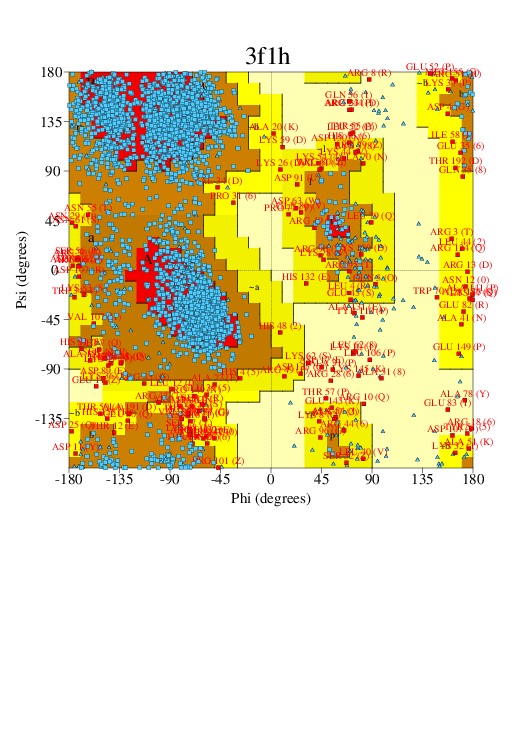
PROCHECK
|
|
|
|
|
|
Headers
|
|
|
|
References
|
|
|
|
|
|

|
|
Q72I07
(RL2_THET2) -
50S ribosomal protein L2 from Thermus thermophilus (strain ATCC BAA-163 / DSM 7039 / HB27)
|
|
|
|
Seq:
Struc:
|
|
|
|
276 a.a.
271 a.a.
|
|

|

|

|
|
|
|
|
|
|
|
|
|
|
|

|
|
Q72I04
(RL3_THET2) -
50S ribosomal protein L3 from Thermus thermophilus (strain ATCC BAA-163 / DSM 7039 / HB27)
|
|
|
|
Seq:
Struc:
|
|
|
|
206 a.a.
204 a.a.
|
|
|

|
|
|
|
|
|
|
|
|
|
|
|
|

|
|
Q72I05
(RL4_THET2) -
50S ribosomal protein L4 from Thermus thermophilus (strain ATCC BAA-163 / DSM 7039 / HB27)
|
|
|
|
Seq:
Struc:
|
|
|
|
205 a.a.
202 a.a.
|
|
|

|
|
|
|
|
|
|
|
|
|
|
|
|

|
|
Q72I16
(RL5_THET2) -
50S ribosomal protein L5 from Thermus thermophilus (strain ATCC BAA-163 / DSM 7039 / HB27)
|
|
|
|
Seq:
Struc:
|
|
|
|
182 a.a.
181 a.a.
|
|
|

|
|
|
|
|
|
|
|
|
|
|
|
|

|
|
Q72I19
(RL6_THET2) -
50S ribosomal protein L6 from Thermus thermophilus (strain ATCC BAA-163 / DSM 7039 / HB27)
|
|
|
|
Seq:
Struc:
|
|
|
|
180 a.a.
159 a.a.
|
|
|

|
|
|
|
|
|
|
|
|
|
|
|
|

|
|
Q72GV5
(RL9_THET2) -
50S ribosomal protein L9 from Thermus thermophilus (strain ATCC BAA-163 / DSM 7039 / HB27)
|
|
|
|
Seq:
Struc:
|
|
|
|
148 a.a.
145 a.a.
|
|
|

|
|
|
|
|
|
|
|
|
|
|
|
|

|
|
P36238
(RL11_THETH) -
50S ribosomal protein L11 from Thermus thermophilus
|
|
|
|
Seq:
Struc:
|
|
|
|
147 a.a.
147 a.a.
|
|
|

|
|
|
|
|
|
|
|
|
|
|
|
|

|
|
Q72IN1
(RL13_THET2) -
50S ribosomal protein L13 from Thermus thermophilus (strain ATCC BAA-163 / DSM 7039 / HB27)
|
|
|
|
Seq:
Struc:
|
|
|
|
140 a.a.
137 a.a.
|
|
|

|
|
|
|
|
|
|
|
|
|
|
|
|

|
|
Q72I14
(RL14_THET2) -
50S ribosomal protein L14 from Thermus thermophilus (strain ATCC BAA-163 / DSM 7039 / HB27)
|
|
|
|
Seq:
Struc:
|
|
|
|
122 a.a.
122 a.a.
|
|
|

|
|
|
|
|
|
|
|
|
|
|
|
|

|
|
Q72I23
(RL15_THET2) -
50S ribosomal protein L15 from Thermus thermophilus (strain ATCC BAA-163 / DSM 7039 / HB27)
|
|
|
|
Seq:
Struc:
|
|
|
|
150 a.a.
146 a.a.
|
|
|
|
|
|
|
|
|
|
|
|
|
|
|
|

|
|
Q72I11
(RL16_THET2) -
50S ribosomal protein L16 from Thermus thermophilus (strain ATCC BAA-163 / DSM 7039 / HB27)
|
|
|
|
Seq:
Struc:
|
|
|
|
141 a.a.
134 a.a.
|
|
|

|
|
|
|
|
|
|
|
|
|
|
|
|

|
|
Q72I33
(RL17_THET2) -
50S ribosomal protein L17 from Thermus thermophilus (strain ATCC BAA-163 / DSM 7039 / HB27)
|
|
|
|
Seq:
Struc:
|
|
|
|
118 a.a.
117 a.a.
|
|
|

|
|
|
|
|
|
|
|
|
|
|
|
|

|
|
Q72I20
(RL18_THET2) -
50S ribosomal protein L18 from Thermus thermophilus (strain ATCC BAA-163 / DSM 7039 / HB27)
|
|
|
|
Seq:
Struc:
|
|
|
|
112 a.a.
98 a.a.
|
|
|

|
|
|
|
|
|
|
|
|
|
|
|
|

|
|
Q72JU9
(RL19_THET2) -
50S ribosomal protein L19 from Thermus thermophilus (strain ATCC BAA-163 / DSM 7039 / HB27)
|
|
|
|
Seq:
Struc:
|
|
|
|
146 a.a.
137 a.a.
|
|
|
|
|
|
|
|
|
|
|
|
|
|
|
|

|
|
Q72L76
(RL20_THET2) -
50S ribosomal protein L20 from Thermus thermophilus (strain ATCC BAA-163 / DSM 7039 / HB27)
|
|
|
|
Seq:
Struc:
|
|
|
|
118 a.a.
117 a.a.
|
|
|

|
|
|
|
|
|
|
|
|
|
|
|
|

|
|
Q72HR2
(RL21_THET2) -
50S ribosomal protein L21 from Thermus thermophilus (strain ATCC BAA-163 / DSM 7039 / HB27)
|
|
|
|
Seq:
Struc:
|
|
|
|
101 a.a.
101 a.a.
|
|
|

|
|
|
|
|
|
|
|
|
|
|
|
|

|
|
Q72I09
(RL22_THET2) -
50S ribosomal protein L22 from Thermus thermophilus (strain ATCC BAA-163 / DSM 7039 / HB27)
|
|
|
|
Seq:
Struc:
|
|
|
|
113 a.a.
112 a.a.
|
|
|

|
|
|
|
|
|
|
|
|
|
|
|
|

|
|
Q72I06
(RL23_THET2) -
50S ribosomal protein L23 from Thermus thermophilus (strain ATCC BAA-163 / DSM 7039 / HB27)
|
|
|
|
Seq:
Struc:
|
|
|
|
96 a.a.
92 a.a.
|
|
|

|
|
|
|
|
|
|
|
|
|
|
|
|

|
|
Q72I15
(RL24_THET2) -
50S ribosomal protein L24 from Thermus thermophilus (strain ATCC BAA-163 / DSM 7039 / HB27)
|
|
|
|
Seq:
Struc:
|
|
|
|
110 a.a.
100 a.a.
|
|
|

|
|
|
|
|
|
|
|
|
|
|
|
|

|
|
Q72IA7
(RL25_THET2) -
50S ribosomal protein L25 from Thermus thermophilus (strain ATCC BAA-163 / DSM 7039 / HB27)
|
|
|
|
Seq:
Struc:
|
|
|
|
206 a.a.
187 a.a.
|
|
|

|
|
|
|
|
|
|
|
|
|
|
|
|

|
|
Q72HR3
(RL27_THET2) -
50S ribosomal protein L27 from Thermus thermophilus (strain ATCC BAA-163 / DSM 7039 / HB27)
|
|
|
|
Seq:
Struc:
|
|
|
|
85 a.a.
76 a.a.
|
|
|

|
|
|
|
|
|
|
|
|
|
|
|
|

|
|
Q72G84
(Q72G84_THET2) -
50S ribosomal protein L28 from Thermus thermophilus (strain ATCC BAA-163 / DSM 7039 / HB27)
|
|
|
|
Seq:
Struc:
|
|
|
|
98 a.a.
88 a.a.
|
|
|

|
|
|
|
|
|
|
|
|
|
|
|
|

|
|
Q72I12
(RL29_THET2) -
50S ribosomal protein L29 from Thermus thermophilus (strain ATCC BAA-163 / DSM 7039 / HB27)
|
|
|
|
Seq:
Struc:
|
|
|
|
72 a.a.
62 a.a.
|
|
|

|
|
|
|
|
|
|
|
|
|
|
|
|

|
|
Q72I22
(RL30_THET2) -
50S ribosomal protein L30 from Thermus thermophilus (strain ATCC BAA-163 / DSM 7039 / HB27)
|
|
|
|
Seq:
Struc:
|
|
|
|
60 a.a.
59 a.a.
|
|
|

|
|
|
|
|
|
|
|
|
|
|
|
|

|
|
P62652
(RL32_THET2) -
50S ribosomal protein L32 from Thermus thermophilus (strain ATCC BAA-163 / DSM 7039 / HB27)
|
|
|
|
Seq:
Struc:
|
|
|
|
60 a.a.
52 a.a.
|
|
|

|
|
|
|
|
|
|
|
|
|
|
|
|

|
|
Q72GW3
(RL33_THET2) -
50S ribosomal protein L33 from Thermus thermophilus (strain ATCC BAA-163 / DSM 7039 / HB27)
|
|
|
|
Seq:
Struc:
|
|
|
|
54 a.a.
44 a.a.
|
|
|

|
|
|
|
|
|
|
|
|
|
|
|
|

|
|
P80340
(RL34_THET8) -
50S ribosomal protein L34 from Thermus thermophilus (strain ATCC 27634 / DSM 579 / HB8)
|
|
|
|
Seq:
Struc:
|
|
|
|
49 a.a.
48 a.a.
|
|
|

|
|
|
|
|
|
|
|
|
|
|
|
|
|
|
|
|
|
|
|
|
|
 |
|
|
|
|
|
|
| |
|
DOI no:
|
Proc Natl Acad Sci U S A
105:19684-19689
(2008)
|
|
PubMed id:
|
|
|
|
|
|
| |
|
Crystal structure of a translation termination complex formed with release factor RF2.
|
|
A.Korostelev,
H.Asahara,
L.Lancaster,
M.Laurberg,
A.Hirschi,
J.Zhu,
S.Trakhanov,
W.G.Scott,
H.F.Noller.
|
|
|
|
|
| |
ABSTRACT
|
|
|
|
| |
|
|
We report the crystal structure of a translation termination complex formed by
the Thermus thermophilus 70S ribosome bound with release factor RF2, in response
to a UAA stop codon, solved at 3 A resolution. The backbone of helix alpha5 and
the side chain of serine of the conserved SPF motif of RF2 recognize U1 and A2
of the stop codon, respectively. A3 is unstacked from the first 2 bases,
contacting Thr-216 and Val-203 of RF2 and stacking on G530 of 16S rRNA. The
structure of the RF2 complex supports our previous proposal that conformational
changes in the ribosome in response to recognition of the stop codon stabilize
rearrangement of the switch loop of the release factor, resulting in docking of
the universally conserved GGQ motif in the PTC of the 50S subunit. As seen for
the RF1 complex, the main-chain amide nitrogen of glutamine in the GGQ motif is
positioned to contribute directly to catalysis of peptidyl-tRNA hydrolysis,
consistent with mutational studies, which show that most side-chain
substitutions of the conserved glutamine have little effect. We show that when
the H-bonding capability of the main-chain N-H of the conserved glutamine is
eliminated by substitution with proline, peptidyl-tRNA esterase activity is
abolished, consistent with its proposed role in catalysis.
|
|
|
|
|
|
| |
Selected figure(s)
|
|
|
|
| |
|
|

|
|

|
|
Figure 1.
Comparison of the structures of the RF1 and RF2 termination
complexes. (A) RF2 termination complex (this work), showing RF2
(yellow), P-site tRNA (orange), E-site tRNA (red), mRNA (green),
16S rRNA (cyan), 23S and 5S rRNA (gray), 30S proteins (blue),
and 50S proteins (magenta). (B) RF1 termination complex (9);
molecular components are colored similarly as in A. (C) RF2 in
its ribosome-bound conformation, rotated ≈180° from the
view shown in A, with domains numbered. The GGQ and SPF motifs
are shown in red, and the switch loop is shown in orange. (D)
RF1 in its ribosome-bound conformation. The GGQ and PVT motifs
are indicated in red and the switch loop is shown in orange.
|
|
Figure 2.
Interactions with the UAA stop codon in the decoding center
in the RF1 and RF2 termination complexes. (A) Stereoview of the
σ[A]-weighted 3F[obs] − 2F[calc] electron density map of the
stop codon and surrounding elements of RF2 and the ribosome.
Electron density is contoured at 1.0 σ for RF2, and at 1.5 σ
for rRNA and mRNA, and colored yellow (RF1), green (mRNA), and
blue (16S rRNA). (B) Interaction of the hydroxyl group of
Ser-206 of the SPF motif of RF2 with A2 of the stop codon. (C)
Interaction of Thr-216 of RF2 with A3 of the stop codon. (D)
Comparison of the positions of Thr-186 of the PVT motif of RF1
(gray) and Ser-206 of the SPF motif of RF2 (yellow), showing
their different modes of recognition of U1 and A2 of the UAA
stop codon. The structures of the two termination complexes were
globally superimposed. (E) Packing of RF2 around A3 of the UAA
stop codon. Val-203 would be positioned to exclude water from
H-bonding to O6 of guanine, helping to discriminate against
guanine at position 3. The structure model is represented as Van
der Waals surfaces for RF2 (yellow) and mRNA (green); 16S rRNA
is shown in blue.
|
|
|
|
| |
Figures were
selected
by an automated process.
|
|
|
|
|
|
|
|
|
|
|
|
|
|
|
|
 |
 |
 |
|
Literature references that cite this PDB file's key reference
|
|
|
| |
PubMed id
|
|
Reference
|
|
|
|
|
|
B.P.Klaholz
(2011).
Molecular recognition and catalysis in translation termination complexes.
|
| |
Trends Biochem Sci,
36,
282-292.
|
|
|
|
|
|
|
J.Zhu,
A.Korostelev,
D.A.Costantino,
J.P.Donohue,
H.F.Noller,
and
J.S.Kieft
(2011).
Crystal structures of complexes containing domains from two viral internal ribosome entry site (IRES) RNAs bound to the 70S ribosome.
|
| |
Proc Natl Acad Sci U S A,
108,
1839-1844.
|
|
|
PDB codes:
|
|
|
|
|
|
|
|
K.Kipper,
S.Sild,
C.Hetényi,
J.Remme,
and
A.Liiv
(2011).
Pseudouridylation of 23S rRNA helix 69 promotes peptide release by release factor RF2 but not by release factor RF1.
|
| |
Biochimie,
93,
834-844.
|
|
|
|
|
|
|
S.Kuhlenkoetter,
W.Wintermeyer,
and
M.V.Rodnina
(2011).
Different substrate-dependent transition states in the active site of the ribosome.
|
| |
Nature,
476,
351-354.
|
|
|
|
|
|
|
T.Becker,
J.P.Armache,
A.Jarasch,
A.M.Anger,
E.Villa,
H.Sieber,
B.A.Motaal,
T.Mielke,
O.Berninghausen,
and
R.Beckmann
(2011).
Structure of the no-go mRNA decay complex Dom34-Hbs1 bound to a stalled 80S ribosome.
|
| |
Nat Struct Mol Biol,
18,
715-720.
|
|
|
PDB code:
|
|
|
|
|
|
|
|
A.Korostelev,
J.Zhu,
H.Asahara,
and
H.F.Noller
(2010).
Recognition of the amber UAG stop codon by release factor RF1.
|
| |
EMBO J,
29,
2577-2585.
|
|
|
PDB codes:
|
|
|
|
|
|
|
|
C.L.Ng,
K.Lang,
N.A.Meenan,
A.Sharma,
A.C.Kelley,
C.Kleanthous,
and
V.Ramakrishnan
(2010).
Structural basis for 16S ribosomal RNA cleavage by the cytotoxic domain of colicin E3.
|
| |
Nat Struct Mol Biol,
17,
1241-1246.
|
|
|
PDB codes:
|
|
|
|
|
|
|
|
D.E.Burakovsky,
P.V.Sergiev,
M.A.Steblyanko,
A.V.Kubarenko,
A.L.Konevega,
A.A.Bogdanov,
M.V.Rodnina,
and
O.A.Dontsova
(2010).
Mutations at the accommodation gate of the ribosome impair RF2-dependent translation termination.
|
| |
RNA,
16,
1848-1853.
|
|
|
|
|
|
|
D.J.Young,
C.D.Edgar,
E.S.Poole,
and
W.P.Tate
(2010).
The codon specificity of eubacterial release factors is determined by the sequence and size of the recognition loop.
|
| |
RNA,
16,
1623-1633.
|
|
|
|
|
|
|
D.J.Young,
C.D.Edgar,
J.Murphy,
J.Fredebohm,
E.S.Poole,
and
W.P.Tate
(2010).
Bioinformatic, structural, and functional analyses support release factor-like MTRF1 as a protein able to decode nonstandard stop codons beginning with adenine in vertebrate mitochondria.
|
| |
RNA,
16,
1146-1155.
|
|
|
|
|
|
|
H.Jin,
A.C.Kelley,
D.Loakes,
and
V.Ramakrishnan
(2010).
Structure of the 70S ribosome bound to release factor 2 and a substrate analog provides insights into catalysis of peptide release.
|
| |
Proc Natl Acad Sci U S A,
107,
8593-8598.
|
|
|
PDB codes:
|
|
|
|
|
|
|
|
H.S.Zaher,
and
R.Green
(2010).
Hyperaccurate and error-prone ribosomes exploit distinct mechanisms during tRNA selection.
|
| |
Mol Cell,
39,
110-120.
|
|
|
|
|
|
|
H.S.Zaher,
and
R.Green
(2010).
Kinetic basis for global loss of fidelity arising from mismatches in the P-site codon:anticodon helix.
|
| |
RNA,
16,
1980-1989.
|
|
|
|
|
|
|
J.A.Dunkle,
and
J.H.Cate
(2010).
Ribosome structure and dynamics during translocation and termination.
|
| |
Annu Rev Biophys,
39,
227-244.
|
|
|
|
|
|
|
J.Sund,
M.Andér,
and
J.Aqvist
(2010).
Principles of stop-codon reading on the ribosome.
|
| |
Nature,
465,
947-950.
|
|
|
|
|
|
|
K.N.Bulygin,
Y.S.Khairulina,
P.M.Kolosov,
A.G.Ven'yaminova,
D.M.Graifer,
Y.N.Vorobjev,
L.Y.Frolova,
L.L.Kisselev,
and
G.G.Karpova
(2010).
Three distinct peptides from the N domain of translation termination factor eRF1 surround stop codon in the ribosome.
|
| |
RNA,
16,
1902-1914.
|
|
|
|
|
|
|
L.B.Jenner,
N.Demeshkina,
G.Yusupova,
and
M.Yusupov
(2010).
Structural aspects of messenger RNA reading frame maintenance by the ribosome.
|
| |
Nat Struct Mol Biol,
17,
555-560.
|
|
|
PDB codes:
|
|
|
|
|
|
|
|
L.Jenner,
N.Demeshkina,
G.Yusupova,
and
M.Yusupov
(2010).
Structural rearrangements of the ribosome at the tRNA proofreading step.
|
| |
Nat Struct Mol Biol,
17,
1072-1078.
|
|
|
|
|
|
|
P.C.Whitford,
P.Geggier,
R.B.Altman,
S.C.Blanchard,
J.N.Onuchic,
and
K.Y.Sanbonmatsu
(2010).
Accommodation of aminoacyl-tRNA into the ribosome involves reversible excursions along multiple pathways.
|
| |
RNA,
16,
1196-1204.
|
|
|
|
|
|
|
R.E.Stanley,
G.Blaha,
R.L.Grodzicki,
M.D.Strickler,
and
T.A.Steitz
(2010).
The structures of the anti-tuberculosis antibiotics viomycin and capreomycin bound to the 70S ribosome.
|
| |
Nat Struct Mol Biol,
17,
289-293.
|
|
|
PDB codes:
|
|
|
|
|
|
|
|
S.L.He,
and
R.Green
(2010).
Visualization of codon-dependent conformational rearrangements during translation termination.
|
| |
Nat Struct Mol Biol,
17,
465-470.
|
|
|
|
|
|
|
S.P.McClory,
J.M.Leisring,
D.Qin,
and
K.Fredrick
(2010).
Missense suppressor mutations in 16S rRNA reveal the importance of helices h8 and h14 in aminoacyl-tRNA selection.
|
| |
RNA,
16,
1925-1934.
|
|
|
|
|
|
|
A.Korostelev,
M.Laurberg,
and
H.F.Noller
(2009).
Multistart simulated annealing refinement of the crystal structure of the 70S ribosome.
|
| |
Proc Natl Acad Sci U S A,
106,
18195-18200.
|
|
|
|
|
|
|
B.Hetrick,
K.Lee,
and
S.Joseph
(2009).
Kinetics of stop codon recognition by release factor 1.
|
| |
Biochemistry,
48,
11178-11184.
|
|
|
|
|
|
|
H.S.Zaher,
and
R.Green
(2009).
Fidelity at the molecular level: lessons from protein synthesis.
|
| |
Cell,
136,
746-762.
|
|
|
|
|
|
|
M.Simonović,
and
T.A.Steitz
(2009).
A structural view on the mechanism of the ribosome-catalyzed peptide bond formation.
|
| |
Biochim Biophys Acta,
1789,
612-623.
|
|
|
|
|
|
|
R.Yang,
L.R.Cruz-Vera,
and
C.Yanofsky
(2009).
23S rRNA nucleotides in the peptidyl transferase center are essential for tryptophanase operon induction.
|
| |
J Bacteriol,
191,
3445-3450.
|
|
|
|
|
|
|
T.M.Schmeing,
and
V.Ramakrishnan
(2009).
What recent ribosome structures have revealed about the mechanism of translation.
|
| |
Nature,
461,
1234-1242.
|
|
|
|
|
|
|
W.Niu,
Z.Chen,
L.A.Bush-Pelc,
A.Bah,
P.S.Gandhi,
and
E.Di Cera
(2009).
Mutant N143P reveals how Na+ activates thrombin.
|
| |
J Biol Chem,
284,
36175-36185.
|
|
|
PDB codes:
|
|
|
|
|
|
|
|
W.Zhang,
J.A.Dunkle,
and
J.H.Cate
(2009).
Structures of the ribosome in intermediate states of ratcheting.
|
| |
Science,
325,
1014-1017.
|
|
|
PDB codes:
|
|
|
|
|
|
|
The most recent references are shown first.
Citation data come partly from CiteXplore and partly
from an automated harvesting procedure. Note that this is likely to be
only a partial list as not all journals are covered by
either method. However, we are continually building up the citation data
so more and more references will be included with time.
Where a reference describes a PDB structure, the PDB
codes are
shown on the right.
|

| |


 Links
Links


