|
PDBsum entry 3evd

|
|
|
|
|
 |
Contents |
 |
|
|
|
|
|
|
|
|
|
|
|
|
* Residue conservation analysis
|
|
|
|
|
|
|
|
|
|
|
Enzyme class 1:
|
|
E.C.2.1.1.56
- mRNA (guanine-N(7))-methyltransferase.
|
|
|
|
|
|
|
Reaction:
|
|
a 5'-end (5'-triphosphoguanosine)-ribonucleoside in mRNA + S-adenosyl-L- methionine = a 5'-end (N(7)-methyl 5'-triphosphoguanosine)-ribonucleoside in mRNA + S-adenosyl-L-homocysteine
|
|
|
|
|
|
5'-end (5'-triphosphoguanosine)-ribonucleoside in mRNA
|
+
|
 S-adenosyl-L- methionine
|
=
|
5'-end (N(7)-methyl 5'-triphosphoguanosine)-ribonucleoside in mRNA
|
+
|
S-adenosyl-L-homocysteine
Bound ligand (Het Group name = )
corresponds exactly
|
|
|
|
|
|
|
|
|
|
Enzyme class 2:
|
|
E.C.2.1.1.57
- methyltransferase cap1.
|
|
|
|
|
|
|
Reaction:
|
|
a 5'-end (N(7)-methyl 5'-triphosphoguanosine)-ribonucleoside in mRNA + S-adenosyl-L-methionine = a 5'-end (N(7)-methyl 5'-triphosphoguanosine)- (2'-O-methyl-ribonucleoside) in mRNA + S-adenosyl-L-homocysteine + H+
|
|
|
|
|
|
5'-end (N(7)-methyl 5'-triphosphoguanosine)-ribonucleoside in mRNA
|
+
|
S-adenosyl-L-methionine
|
=
|
5'-end (N(7)-methyl 5'-triphosphoguanosine)- (2'-O-methyl-ribonucleoside) in mRNA
|
+
|
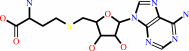 S-adenosyl-L-homocysteine
|
+
|
H(+)
Bound ligand (Het Group name = )
corresponds exactly
|
|
|
|
|
|
|
|
|
|
Enzyme class 3:
|
|
E.C.2.7.7.48
- RNA-directed Rna polymerase.
|
|
|
|
|
|
|
Reaction:
|
|
RNA(n) + a ribonucleoside 5'-triphosphate = RNA(n+1) + diphosphate
|
|
|
|
|
|
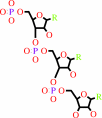 RNA(n)
|
+
|
ribonucleoside 5'-triphosphate
|
=
|
RNA(n+1)
Bound ligand (Het Group name = )
matches with 69.23% similarity
|
+
|
 diphosphate
|
|
|
|
|
|
|
|
|
|
Enzyme class 4:
|
|
E.C.3.4.21.91
- flavivirin.
|
|
|
|
|
|
|
Reaction:
|
|
Selective hydrolysis of Xaa-Xaa-|-Xbb bonds in which each of the Xaa can be either Arg or Lys and Xbb can be either Ser or Ala.
|
|
|
|
|
|
Enzyme class 5:
|
|
E.C.3.6.1.15
- nucleoside-triphosphate phosphatase.
|
|
|
|
|
|
|
Reaction:
|
|
a ribonucleoside 5'-triphosphate + H2O = a ribonucleoside 5'-diphosphate + phosphate + H+
|
|
|
|
|
|
ribonucleoside 5'-triphosphate
|
+
|
H2O
|
=
|
ribonucleoside 5'-diphosphate
|
+
|
 phosphate
|
+
|
H(+)
|
|
|
|
|
|
|
|
|
|
Enzyme class 6:
|
|
E.C.3.6.4.13
- Rna helicase.
|
|
|
|
|
|
|
Reaction:
|
|
ATP + H2O = ADP + phosphate + H+
|
|
|
|
|
|
ATP
Bound ligand (Het Group name = )
matches with 96.88% similarity
|
+
|
H2O
|
=
|
 ADP
ADP
|
+
|
phosphate
|
+
|
H(+)
|
|
|
|
|
|
|
|
|
|
|
|
|
Note, where more than one E.C. class is given (as above), each may
correspond to a different protein domain or, in the case of polyprotein
precursors, to a different mature protein.
|
|
|
|
Molecule diagrams generated from .mol files obtained from the
KEGG ftp site
|
|
|
|
|
|
|
|
|
|
|
|
|
|
 |
|
|
|
|
|
|
| |
|
|
| |
|
DOI no:
|
J Mol Biol
385:1643-1654
(2009)
|
|
PubMed id:
|
|
|
|
|
|
| |
|
Analysis of flavivirus NS5 methyltransferase cap binding.
|
|
B.J.Geiss,
A.A.Thompson,
A.J.Andrews,
R.L.Sons,
H.H.Gari,
S.M.Keenan,
O.B.Peersen.
|
|
|
|
|
| |
ABSTRACT
|
|
|
|
| |
|
|
The flavivirus 2'-O-nucleoside N-terminal RNA methyltransferase (MTase) enzyme
is responsible for methylating the viral RNA cap structure. To increase our
understanding of the mechanism of viral RNA cap binding we performed a detailed
structural and biochemical characterization of the guanosine cap-binding pocket
of the dengue (DEN) and yellow fever (YF) virus MTase enzymes. We solved an
improved 2.1 A resolution crystal structure of DEN2 Mtase, new 1.5 A resolution
crystal structures of the YF virus MTase domain in apo form, and a new 1.45 A
structure in complex with guanosine triphosphate and RNA cap analog. Our
structures clarify the previously reported DEN MTase structure, suggest novel
protein-cap interactions, and provide a detailed view of guanine specificity.
Furthermore, the structures of the DEN and YF proteins are essentially
identical, indicating a large degree of structural conservation amongst the
flavivirus MTases. Guanosine triphosphate analog competition assays and
mutagenesis analysis, performed to analyze the biochemical characteristics of
cap binding, determined that the major interaction points are (i) guanine ring
via pi-pi stacking with Phe24, N1 hydrogen interaction with the Leu19 backbone
carbonyl via a water bridge, and C2 amine interaction with Leu16 and Leu19
backbone carbonyls; (ii) ribose 2' hydroxyl interaction with Lys13 and Asn17;
and (iii) alpha-phosphate interactions with Lys28 and Ser215. Based on our
mutational and analog studies, the guanine ring and alpha-phosphate interactions
provide most of the energy for cap binding, while the combination of the water
bridge between the guanine N1 and Leu19 carbonyl and the hydrogen bonds between
the C2 amine and Leu16/Leu19 carbonyl groups provide for specific guanine
recognition. A detailed model of how the flavivirus MTase protein binds RNA cap
structures is presented.
|
|
|
|
|
|
| |
Selected figure(s)
|
|
|
|
| |
|
|

|
|

|
|
Figure 2.
Fig. 2. Structural details of the cap-binding site and ligand
complexes in the citrate (a–c) and MPD (d–f) crystal forms.
2F[o] − F[c] maps contoured at 1.8σ are shown for the apo (a
and d) and the bound GTP ligand (b and e) structures. Composite
2500K simulated-anneal omit maps are shown for the nonmethylated
GpppA cap analog in the citrate crystal form (c) and for the N7
methylated GpppA cap analog in the MPD crystal form (f). The
view in panel (c) is from the top of the GpppA binding site to
show the stacking interactions involving Phe24 and the guanosine
and adenosine from the cap analog. “W” denotes the bridging
water molecule. Residues described in the text are labeled in
(a) and (e).
|
|
Figure 4.
Fig. 4. Conservation of binding-site residues amongst
flavivirus family members. Black background denotes nonsimilar
substitutions, and the shaded rectangles bring attention to
residues where increased variability is observed. Numbering for
YF is noted and is used throughout the manuscript to describe
all MTase residues. Residues with side chains within
hydrogen-bonding distance of GTP are marked with an asterisk
(*). Residues with backbone carbonyl groups interacting with the
conserved water and the guanine ring are marked with the symbol
(@).
|
|
|
|
|
|
| |
The above figures are
reprinted
by permission from Elsevier:
J Mol Biol
(2009,
385,
1643-1654)
copyright 2009.
|
|
| |
Figures were
selected
by an automated process.
|
|
|
|
|
|
|
|
|
|
|
|
|
|
|
|
 |
 |
 |
|
Literature references that cite this PDB file's key reference
|
|
|
| |
PubMed id
|
|
Reference
|
|
|
|
|
|
B.Selisko,
F.F.Peyrane,
B.Canard,
K.Alvarez,
and
E.Decroly
(2010).
Biochemical characterization of the (nucleoside-2'O)-methyltransferase activity of dengue virus protein NS5 using purified capped RNA oligonucleotides (7Me)GpppAC(n) and GpppAC(n).
|
| |
J Gen Virol,
91,
112-121.
|
|
|
|
|
|
|
L.J.Yap,
D.Luo,
K.Y.Chung,
S.P.Lim,
C.Bodenreider,
C.Noble,
P.Y.Shi,
and
J.Lescar
(2010).
Crystal structure of the dengue virus methyltransferase bound to a 5'-capped octameric RNA.
|
| |
PLoS One,
5,
0.
|
|
|
PDB code:
|
|
|
|
|
|
|
|
B.J.Geiss,
H.Stahla,
A.M.Hannah,
H.H.Gari,
and
S.M.Keenan
(2009).
Focus on flaviviruses: current and future drug targets.
|
| |
Future Med Chem,
1,
327.
|
|
|
|
|
|
|
M.Issur,
B.J.Geiss,
I.Bougie,
F.Picard-Jean,
S.Despins,
J.Mayette,
S.E.Hobdey,
and
M.Bisaillon
(2009).
The flavivirus NS5 protein is a true RNA guanylyltransferase that catalyzes a two-step reaction to form the RNA cap structure.
|
| |
RNA,
15,
2340-2350.
|
|
|
|
|
|
The most recent references are shown first.
Citation data come partly from CiteXplore and partly
from an automated harvesting procedure. Note that this is likely to be
only a partial list as not all journals are covered by
either method. However, we are continually building up the citation data
so more and more references will be included with time.
Where a reference describes a PDB structure, the PDB
code is
shown on the right.
|
|


 Links
Links