 |
PDBsum entry 3p8o

|
|
|
|
|
|

|

|

|

|
|

|
|

|
|

|
|

|
|

|
|

|
|
|
 |

|

|
|
|
|
|
|
|
|
|
|
|
|
|
|
|
|
|
|
|
|
|
|
|
|
|
|
|
|
|
|
|
|
|
|
|
Hydrolase/hydrolase inhibitor
|
PDB id
|
|
|
|
3p8o
|
|
|
|
|
|
|
|
|
|
|
|
|
|
|

|

|

|
|
|
|
|
|
|
|
|
|
|
Enzyme class 1:
|
|
Chains A, B, C, D:
E.C.2.7.7.48
- RNA-directed Rna polymerase.
|
|
|
|
|
|
|
Reaction:
|
|
RNA(n) + a ribonucleoside 5'-triphosphate = RNA(n+1) + diphosphate
|
|
|
|
|
|
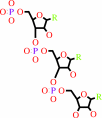 RNA(n)
|
+
|
ribonucleoside 5'-triphosphate
|
=
|
RNA(n+1)
|
+
|
 diphosphate
|
|
|
|
|
|
|
|
|
|
Enzyme class 2:
|
|
Chains A, B, C, D:
E.C.3.4.21.98
- hepacivirin.
|
|
|
|
|
|
|
Reaction:
|
|
Hydrolysis of four peptide bonds in the viral precursor polyprotein, commonly with Asp or Glu in the P6 position, Cys or Thr in P1 and Ser or Ala in P1'.
|
|
|
|
|
|
Enzyme class 3:
|
|
Chains A, B, C, D:
E.C.3.4.22.-
- ?????
|
|
|
|
|
|
|
Enzyme class 4:
|
|
Chains A, B, C, D:
E.C.3.6.1.15
- nucleoside-triphosphate phosphatase.
|
|
|
|
|
|
|
Reaction:
|
|
a ribonucleoside 5'-triphosphate + H2O = a ribonucleoside 5'-diphosphate + phosphate + H+
|
|
|
|
|
|
ribonucleoside 5'-triphosphate
|
+
|
H2O
|
=
|
ribonucleoside 5'-diphosphate
|
+
|
 phosphate
|
+
|
H(+)
|
|
|
|
|
|
|
|
|
|
Enzyme class 5:
|
|
Chains A, B, C, D:
E.C.3.6.4.13
- Rna helicase.
|
|
|
|
|
|
|
Reaction:
|
|
ATP + H2O = ADP + phosphate + H+
|
|
|
|
|
|
 ATP
ATP
|
+
|
H2O
|
=
|
 ADP
ADP
|
+
|
phosphate
|
+
|
H(+)
|
|
|
|
|
|
|
|
|
|
|
|
|
Note, where more than one E.C. class is given (as above), each may
correspond to a different protein domain or, in the case of polyprotein
precursors, to a different mature protein.
|
|
|
|
Molecule diagrams generated from .mol files obtained from the
KEGG ftp site
|
|
|
|
|
|
|
|
|
|
|
|
|
|
 |
|
|
|
|
|
|
| |
|
|
| |
|
DOI no:
|
J Biol Chem
286:11434-11443
(2011)
|
|
PubMed id:
|
|
|
|
|
|
| |
|
Combined X-ray, NMR, and kinetic analyses reveal uncommon binding characteristics of the hepatitis C virus NS3-NS4A protease inhibitor BI 201335.
|
|
C.T.Lemke,
N.Goudreau,
S.Zhao,
O.Hucke,
D.Thibeault,
M.Llinàs-Brunet,
P.W.White.
|
|
|
|
|
| |
ABSTRACT
|
|
|
|
| |
|
|
Hepatitis C virus infection, a major cause of liver disease worldwide, is
curable, but currently approved therapies have suboptimal efficacy.
Supplementing these therapies with direct-acting antiviral agents has the
potential to considerably improve treatment prospects for hepatitis C
virus-infected patients. The critical role played by the viral NS3 protease
makes it an attractive target, and despite its shallow, solvent-exposed active
site, several potent NS3 protease inhibitors are currently in the clinic. BI
201335, which is progressing through Phase IIb trials, contains a unique
C-terminal carboxylic acid that binds noncovalently to the active site and a
bromo-quinoline substitution on its proline residue that provides significant
potency. In this work we have used stopped flow kinetics, x-ray crystallography,
and NMR to characterize these distinctive features. Key findings include: slow
association and dissociation rates within a single-step binding mechanism; the
critical involvement of water molecules in acid binding; and protein side chain
rearrangements, a bromine-oxygen halogen bond, and profound pK(a) changes within
the catalytic triad associated with binding of the bromo-quinoline moiety.
|
|
|
|
|
|
|
|
|
|
|
|
|
|
|
|
|
|
 |
 |
 |
|
|


 Links
Links


