 |
PDBsum entry 3i7e

|
|
|
|
|
 |
Contents |
 |
|
|
|
|
|
|
|
|
|
|
|
|
* Residue conservation analysis
|
|
|
|
|
|
|
|
|
|
|
Enzyme class 1:
|
|
E.C.2.7.7.-
- ?????
|
|
|
|
|
|
|
Enzyme class 2:
|
|
E.C.2.7.7.49
- RNA-directed Dna polymerase.
|
|
|
|
|
|
|
Reaction:
|
|
DNA(n) + a 2'-deoxyribonucleoside 5'-triphosphate = DNA(n+1) + diphosphate
|
|
|
|
|
|
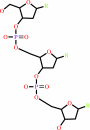 DNA(n)
|
+
|
2'-deoxyribonucleoside 5'-triphosphate
|
=
|
DNA(n+1)
|
+
|
 diphosphate
|
|
|
|
|
|
|
|
|
|
Enzyme class 3:
|
|
E.C.2.7.7.7
- DNA-directed Dna polymerase.
|
|
|
|
|
|
|
Reaction:
|
|
DNA(n) + a 2'-deoxyribonucleoside 5'-triphosphate = DNA(n+1) + diphosphate
|
|
|
|
|
|
DNA(n)
|
+
|
2'-deoxyribonucleoside 5'-triphosphate
|
=
|
DNA(n+1)
|
+
|
diphosphate
|
|
|
|
|
|
|
|
|
|
Enzyme class 4:
|
|
E.C.3.1.-.-
|
|
|
|
|
|
|
Enzyme class 5:
|
|
E.C.3.1.13.2
- exoribonuclease H.
|
|
|
|
|
|
|
Reaction:
|
|
Exonucleolytic cleavage to 5'-phosphomonoester oligonucleotides in both 5'- to 3'- and 3'- to 5'-directions.
|
|
|
|
|
|
Enzyme class 6:
|
|
E.C.3.1.26.13
- retroviral ribonuclease H.
|
|
|
|
|
|
|
Enzyme class 7:
|
|
E.C.3.4.23.16
- HIV-1 retropepsin.
|
|
|
|
|
|
|
Reaction:
|
|
Specific for a P1 residue that is hydrophobic, and P1' variable, but often Pro.
|
|
|
|
|
|
|
|
|
Note, where more than one E.C. class is given (as above), each may
correspond to a different protein domain or, in the case of polyprotein
precursors, to a different mature protein.
|
|
|
|
Molecule diagrams generated from .mol files obtained from the
KEGG ftp site
|
|
|
|
|
|
|
|
|
|
|
|
|
|
 |
|
|
|
|
|
|
| |
|
|
| |
|
|
J Med Chem
52:7689-7705
(2009)
|
|
PubMed id:
|
|
|
|
|
|
| |
|
Design, synthesis, protein-ligand X-ray structure, and biological evaluation of a series of novel macrocyclic human immunodeficiency virus-1 protease inhibitors to combat drug resistance.
|
|
A.K.Ghosh,
S.Kulkarni,
D.D.Anderson,
L.Hong,
A.Baldridge,
Y.F.Wang,
A.A.Chumanevich,
A.Y.Kovalevsky,
Y.Tojo,
M.Amano,
Y.Koh,
J.Tang,
I.T.Weber,
H.Mitsuya.
|
|
|
|
|
| |
ABSTRACT
|
|
|
|
| |
|
|
The structure-based design, synthesis, and biological evaluation of a series of
nonpeptidic macrocyclic HIV protease inhibitors are described. The inhibitors
are designed to effectively fill in the hydrophobic pocket in the S1'-S2'
subsites and retain all major hydrogen bonding interactions with the protein
backbone similar to darunavir (1) or inhibitor 2. The ring size, the effect of
methyl substitution, and unsaturation within the macrocyclic ring structure were
assessed. In general, cyclic inhibitors were significantly more potent than
their acyclic homologues, saturated rings were less active than their
unsaturated analogues and a preference for 10- and 13-membered macrocylic rings
was revealed. The addition of methyl substituents resulted in a reduction of
potency. Both inhibitors 14b and 14c exhibited marked enzyme inhibitory and
antiviral activity, and they exerted potent activity against multidrug-resistant
HIV-1 variants. Protein-ligand X-ray structures of inhibitors 2 and 14c provided
critical molecular insights into the ligand-binding site interactions.
|
|
|
|
|
|
|
|
|
|
|
|
|
|
|
|
|
|
 |
 |
 |
|
Literature references that cite this PDB file's key reference
|
|
|
| |
PubMed id
|
|
Reference
|
|
|
|
|
|
A.K.Agarwal,
and
C.W.Fishwick
(2010).
Structure-based design of anti-infectives.
|
| |
Ann N Y Acad Sci,
1213,
20-45.
|
|
|
|
|
|
|
Y.Tojo,
Y.Koh,
M.Amano,
M.Aoki,
D.Das,
S.Kulkarni,
D.D.Anderson,
A.K.Ghosh,
and
H.Mitsuya
(2010).
Novel protease inhibitors (PIs) containing macrocyclic components and 3(R),3a(S),6a(R)-bis-tetrahydrofuranylurethane that are potent against multi-PI-resistant HIV-1 variants in vitro.
|
| |
Antimicrob Agents Chemother,
54,
3460-3470.
|
|
|
|
|
|
The most recent references are shown first.
Citation data come partly from CiteXplore and partly
from an automated harvesting procedure. Note that this is likely to be
only a partial list as not all journals are covered by
either method. However, we are continually building up the citation data
so more and more references will be included with time.
|
|


 Links
Links


