
|
|
|
|
|
 |
Contents |
 |
|
|
|
|
|
|
|
|
|
|
|
|
|
|
* Residue conservation analysis
|
|
|
|
|
|
PDB id:
|
|
|
|
| Name: |
|
Hydrolase/hormone
|
|
|
Title:
|
|
Crystal structure of human insulin degrading enzyme in complex with iodinated insulin
|
|
Structure:
|
|
Insulin-degrading enzyme. Chain: a, b. Fragment: residues 42-1019. Synonym: insulin protease, insulysin, insulinase. Engineered: yes. Mutation: yes. Insulin a chain. Chain: c, e. Fragment: residues 90-110.
|
|
Source:
|
|
Homo sapiens. Human. Organism_taxid: 9606. Expressed in: escherichia coli. Expression_system_taxid: 562. Synthetic: yes. Organism_taxid: 9606
|
|
Resolution:
|
|
|
2.80Å
|
R-factor:
|
0.172
|
R-free:
|
0.220
|
|
|
Authors:
|
|
M.Manolopoulou,Q.Guo,E.Malito,A.B.Schilling,W.J.Tang
|
Key ref:

|
|
M.Manolopoulou
et al.
(2009).
Molecular Basis of Catalytic Chamber-assisted Unfolding and Cleavage of Human Insulin by Human Insulin-degrading Enzyme.
J Biol Chem,
284,
14177-14188.
PubMed id:
DOI:

|
|
|
Date:
|
|
|
06-Mar-09
|
Release date:
|
24-Mar-09
|
|
|
|
|
|
|
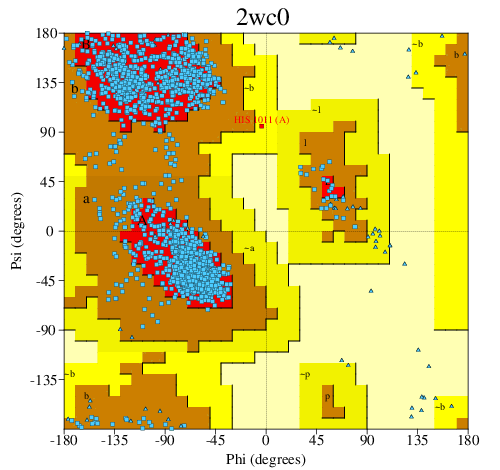
PROCHECK
|
|
|
|
|
|
Headers
|
|
|
|
References
|
|
|
|
|
|

|
|
P14735
(IDE_HUMAN) -
Insulin-degrading enzyme from Homo sapiens
|
|
|
|
Seq:
Struc:
|
|
|
|
1019 a.a.
953 a.a.*
|
|

|

|

|
|
|
|
|
|
|
|
|
|
|
|
|
|
|
|
|
Enzyme class:
|
|
Chains A, B:
E.C.3.4.24.56
- insulysin.
|
|
|
|
|
|
|
Reaction:
|
|
Degradation of insulin, glucagon and other polypeptides. No action on proteins.
|
|
|
|
|
|
Cofactor:
|
|
Zn(2+)
|
|
|
|
|
|
|
|
|
|
|
|
|
|
|
|
|
|
 |
|
|
|
|
|
|
| |
|
DOI no:
|
J Biol Chem
284:14177-14188
(2009)
|
|
PubMed id:
|
|
|
|
|
|
| |
|
Molecular Basis of Catalytic Chamber-assisted Unfolding and Cleavage of Human Insulin by Human Insulin-degrading Enzyme.
|
|
M.Manolopoulou,
Q.Guo,
E.Malito,
A.B.Schilling,
W.J.Tang.
|
|
|
|
|
| |
ABSTRACT
|
|
|
|
| |
|
|
Insulin is a hormone vital for glucose homeostasis, and insulin-degrading enzyme
(IDE) plays a key role in its clearance. IDE exhibits a remarkable specificity
to degrade insulin without breaking the disulfide bonds that hold the insulin A
and B chains together. Using Fourier transform ion cyclotron resonance (FTICR)
mass spectrometry to obtain high mass accuracy, and electron capture
dissociation (ECD) to selectively break the disulfide bonds in gas phase
fragmentation, we determined the cleavage sites and composition of human insulin
fragments generated by human IDE. Our time-dependent analysis of IDE-digested
insulin fragments reveals that IDE is highly processive in its initial cleavage
at the middle of both the insulin A and B chains. This ensures that IDE
effectively splits insulin into inactive N- and C-terminal halves without
breaking the disulfide bonds. To understand the molecular basis of the
recognition and unfolding of insulin by IDE, we determined a 2.6-A resolution
insulin-bound IDE structure. Our structure reveals that IDE forms an enclosed
catalytic chamber that completely engulfs and intimately interacts with a
partially unfolded insulin molecule. This structure also highlights how the
unique size, shape, charge distribution, and exosite of the IDE catalytic
chamber contribute to its high affinity ( approximately 100 nm) for insulin. In
addition, this structure shows how IDE utilizes the interaction of its exosite
with the N terminus of the insulin A chain as well as other properties of the
catalytic chamber to guide the unfolding of insulin and allowing for the
processive cleavages.
|
|
|
|
|
|
| |
Selected figure(s)
|
|
|
|
| |
|
|

|
|

|
|
Figure 3.
Structure of insulin-bound IDE. A, global view of the
structure of insulin-bound IDE-CF-E111Q monomer. IDE domains
1–4 (IDE-D1 to IDE-D4) are colored green, blue, yellow, and
red, respectively. Insulin A and B chains are colored magenta
and cyan, respectively. The zinc ion is colored gray. B,
composite omit map of insulin contoured at 1.5σ. C,
electrostatic surface representation of insulin and IDE. The
molecular surface is color-coded as calculated by Adaptive
Poisson-Boltzmann Solver. The molecular surface is colored as
calculated by Adaptive Poisson-Boltzmann Solver (51) (<–6 kT
in red, 0 kT in white, and >+6 kT in blue). The interaction
surface between the N- and C-terminal domains of IDE and insulin
is marked by yellow dashed lines based on the contact residues
displayed using CCP4 molecular graphics (30).
|
|
Figure 4.
Characterization of the IDE-insulin interaction. A, details
of the interaction between insulin and IDE. Additional hydrogen
bond networks are shown in the three right panels for clarity.
IDE and insulin are colored as in Fig. 3. B, comparison of
insulin in its free T-state form (PDB code 1G7A) and IDE-bound
form. C, comparison of surface charge distribution of the
partially unfolded insulin in insulin-bound IDE with T-state
insulin modeled into the catalytic chamber of IDE. Surface
representation of the substrate binding chamber of IDE was
generated by the software Voidoo (31). The outer surface of IDE
and the substrate chamber are colored pale green and dark green.
The electrostatic surface representations of the IDE-bound
insulin and T-state insulin models are calculated by Adaptive
Poisson-Boltzmann Solver. D, comparison of IDE-bound insulin
structure with the solution structures of insulin Ala^A2-DKP.
Insulin Ala^A2-DKP has an Ile to Ala mutation in A2 residue of
insulin-DKP, which is an engineered monomeric insulin. Left
shows the comparison of IDE-bound insulin (colored in red and
salmon for insulin A and B chain, respectively) with an
exemplary NMR structure of insulin Ala^A2-DKP (PDB code 1K3M;
colored in green and lime green for insulin A and B chain,
respectively), and an exemplary NMR structure of insulin-DKP
(PDB code 2JMN; colored in blue and light blue for insulin A and
B chain, respectively). For a fair comparison, solution
structures of insulin Ala^A2-DKP and insulin-DKP are also shown
in the middle and right, respectively.
|
|
|
|
|
|
| |
The above figures are
reprinted
by permission from the ASBMB:
J Biol Chem
(2009,
284,
14177-14188)
copyright 2009.
|
|
| |
Figures were
selected
by an automated process.
|
|
|
|
|
|
|
|
|
|
|
|
|
|
|
|
 |
 |
 |
|
Literature references that cite this PDB file's key reference
|
|
|
| |
PubMed id
|
|
Reference
|
|
|
|
|
|
M.A.Leissring,
E.Malito,
S.Hedouin,
L.Reinstatler,
T.Sahara,
S.O.Abdul-Hay,
S.Choudhry,
G.M.Maharvi,
A.H.Fauq,
M.Huzarska,
P.S.May,
S.Choi,
T.P.Logan,
B.E.Turk,
L.C.Cantley,
M.Manolopoulou,
W.J.Tang,
R.L.Stein,
G.D.Cuny,
and
D.J.Selkoe
(2010).
Designed inhibitors of insulin-degrading enzyme regulate the catabolism and activity of insulin.
|
| |
PLoS One,
5,
e10504.
|
|
|
PDB code:
|
|
|
|
|
|
|
|
M.Ren,
Q.Guo,
L.Guo,
M.Lenz,
F.Qian,
R.R.Koenen,
H.Xu,
A.B.Schilling,
C.Weber,
R.D.Ye,
A.R.Dinner,
and
W.J.Tang
(2010).
Polymerization of MIP-1 chemokine (CCL3 and CCL4) and clearance of MIP-1 by insulin-degrading enzyme.
|
| |
EMBO J,
29,
3952-3966.
|
|
|
PDB codes:
|
|
|
|
|
|
|
|
Q.Guo,
M.Manolopoulou,
Y.Bian,
A.B.Schilling,
and
W.J.Tang
(2010).
Molecular basis for the recognition and cleavages of IGF-II, TGF-alpha, and amylin by human insulin-degrading enzyme.
|
| |
J Mol Biol,
395,
430-443.
|
|
|
PDB codes:
|
|
|
|
|
|
|
|
L.A.Ralat,
M.Ren,
A.B.Schilling,
and
W.J.Tang
(2009).
Protective role of Cys-178 against the inactivation and oligomerization of human insulin-degrading enzyme by oxidation and nitrosylation.
|
| |
J Biol Chem,
284,
34005-34018.
|
|
|
|
|
|
The most recent references are shown first.
Citation data come partly from CiteXplore and partly
from an automated harvesting procedure. Note that this is likely to be
only a partial list as not all journals are covered by
either method. However, we are continually building up the citation data
so more and more references will be included with time.
Where a reference describes a PDB structure, the PDB
code is
shown on the right.
|
 |
|


 Links
Links


