|
PDBsum entry 2w3d

|
|
|
|
|
 |
Contents |
 |
|
|
|
|
|
|
|
|
|
|
|
|
|
|
* Residue conservation analysis
|
|
|
|
|
|
|
|
|
|
|
Enzyme class:
|
|
E.C.2.7.13.3
- histidine kinase.
|
|
|
|
|
|
|
Reaction:
|
|
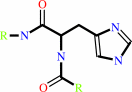
ATP + protein L-histidine = ADP + protein N-phospho-L-histidine
|
|
|
|
|
|
 ATP
ATP
|
+
|
 protein L-histidine
|
=
|
 ADP
ADP
|
+
|
protein N-phospho-L-histidine
|
|
|
|
|
|
|
|
|
|
|
|
|
Molecule diagrams generated from .mol files obtained from the
KEGG ftp site
|
|
|
|
|
|
|
|
|
|
|
|
|
|
 |
|
|
|
|
|
|
| |
|
|
| |
|
DOI no:
|
J Biol Chem
284:13057-13067
(2009)
|
|
PubMed id:
|
|
|
|
|
|
| |
|
Structural Insight into the Heme-based Redox Sensing by DosS from Mycobacterium tuberculosis.
|
|
H.Y.Cho,
H.J.Cho,
Y.M.Kim,
J.I.Oh,
B.S.Kang.
|
|
|
|
|
| |
ABSTRACT
|
|
|
|
| |
|
|
Mycobacterium tuberculosis is thought to undergo transformation into its
non-replicating persistence state under the influence of hypoxia or nitric oxide
(NO). This transformation is thought to be mediated via two sensor histidine
kinases, DosS and DosT, each of which contains two GAF domains that are
responsible for detecting oxygen tension. In this study we determined the
crystal structures of the first GAF domain (GAF-A) of DosS, which shows an
interaction with a heme. A b-type heme was embedded in a hydrophobic cavity of
the GAF-A domain and was roughly perpendicular to the beta-sheet of the GAF
domain. The heme iron was liganded by His-149 at the proximal heme axial
position. The iron, in the oxidized form, was six-coordinated with a water
molecule at the distal position. Upon reduction, the iron, in ferrous form, was
five-coordinated, and when the GAF domain was exposed to atmospheric O(2), the
ferrous form was oxidized to generate the Met form rather than a ferrous
O(2)-bound form. Because the heme is isolated inside the GAF domain, its
accessibility is restricted. However, a defined hydrogen bond network found at
the heme site could accelerate the electron transferability and would explain
why DosS was unable to bind O(2). Flavin nucleotides were shown to reduce the
heme iron of DosS while NADH was unable to do so. These results suggest that
DosS is a redox sensor and detects hypoxic conditions by its reduction.
|
|
|
|
|
|
| |
Selected figure(s)
|
|
|
|
| |
|
|

|
|

|
|
Figure 2.
Electron density maps around the heme at DosS GAF-A. A, water
molecule interacts with the heme iron at the distal position in
the native structure. B, ferrous iron is five coordinated in the
reduced form of GAF-A. C, upon air exposure, a water molecule
ligands the heme iron at the distal position. D, cyanide
interacts with the heme at the distal position, and Tyr-171
guides the cyanide interaction. The 2F[o]-F[c] electron density
maps were contoured at the 1.5 σ level.
|
|
Figure 3.
Interactions of ligand and residues at the heme sites. The
numbers next to the dashed lines indicate the distances
(Å) between two atoms. The residues are water molecules at
the heme sites of the native (A), selenomethionine-substituted
(B), reduced by sodium dithionite (C) air-oxidized (D), and
cyanide complex (E) forms of DosS GAF-A. Mol-A is shown in each
of the asymmetric units of the five crystals.
|
|
|
|
|
|
| |
The above figures are
reprinted
by permission from the ASBMB:
J Biol Chem
(2009,
284,
13057-13067)
copyright 2009.
|
|
| |
Figures were
selected
by an automated process.
|
|
|
|
|
|
|
|
|
|
|
|
|
|
|
|
 |
 |
 |
|
Literature references that cite this PDB file's key reference
|
|
|
| |
PubMed id
|
|
Reference
|
|
|
|
|
|
J.Perry,
K.Koteva,
and
G.Wright
(2011).
Receptor domains of two-component signal transduction systems.
|
| |
Mol Biosyst,
7,
1388-1398.
|
|
|
|
|
|
|
P.R.Chen,
P.Brugarolas,
and
C.He
(2011).
Redox signaling in human pathogens.
|
| |
Antioxid Redox Signal,
14,
1107-1118.
|
|
|
|
|
|
|
J.Cheung,
and
W.A.Hendrickson
(2010).
Sensor domains of two-component regulatory systems.
|
| |
Curr Opin Microbiol,
13,
116-123.
|
|
|
|
|
|
|
M.J.Kim,
K.J.Park,
I.J.Ko,
Y.M.Kim,
and
J.I.Oh
(2010).
Different roles of DosS and DosT in the hypoxic adaptation of Mycobacteria.
|
| |
J Bacteriol,
192,
4868-4875.
|
|
|
|
|
|
|
N.K.Taneja,
S.Dhingra,
A.Mittal,
M.Naresh,
and
J.S.Tyagi
(2010).
Mycobacterium tuberculosis transcriptional adaptation, growth arrest and dormancy phenotype development is triggered by vitamin C.
|
| |
PLoS One,
5,
e10860.
|
|
|
|
|
|
|
R.W.Honaker,
R.L.Leistikow,
I.L.Bartek,
and
M.I.Voskuil
(2009).
Unique roles of DosT and DosS in DosR regulon induction and Mycobacterium tuberculosis dormancy.
|
| |
Infect Immun,
77,
3258-3263.
|
|
|
|
|
|
The most recent references are shown first.
Citation data come partly from CiteXplore and partly
from an automated harvesting procedure. Note that this is likely to be
only a partial list as not all journals are covered by
either method. However, we are continually building up the citation data
so more and more references will be included with time.
|
|


 Links
Links