
|
|
|
|
|
 |
Contents |
 |
|
|
|
|
|
|
|
|
|
|
|
 102 a.a.
|
|
|
|
|
|
|
|
|
|
|
 73 a.a.
|
|
|
|
|
|
|
|
|
|
|
 304 a.a.
|
|
|
|
|
|
|
|
|
|
|
* Residue conservation analysis
|
|
|
|
|
|
PDB id:
|
|
|
|
| Name: |
|
Transferase
|
|
|
Title:
|
|
Crystal structure of the regulatory fragment of mammalian ampk in complexes with amp
|
|
Structure:
|
|
5'-amp-activated protein kinase catalytic subunit alpha-1. Chain: a. Fragment: residues 396-548. Synonym: amp-activated protein kinase, ampk alpha-1 chain. Engineered: yes. 5'-amp-activated protein kinase subunit beta-2. Chain: b. Fragment: residues 187-272. Synonym: amp-activated protein kinase, ampk beta-2 chain.
|
|
Source:
|
|
Rattus norvegicus. Rat. Organism_taxid: 10116. Expressed in: escherichia coli. Expression_system_taxid: 562. Homo sapiens. Human. Organism_taxid: 9606. Expression_system_taxid: 562
|
|
Resolution:
|
|
|
2.10Å
|
R-factor:
|
0.213
|
R-free:
|
0.237
|
|
|
Authors:
|
|
B.Xiao,R.Heath,P.Saiu,F.C.Leiper,P.Leone,C.Jing,P.A.Walker,L.Haire, J.F.Eccleston,C.T.Davis,S.R.Martin,D.Carling,S.J.Gamblin
|
Key ref:

|
|
B.Xiao
et al.
(2007).
Structural basis for AMP binding to mammalian AMP-activated protein kinase.
Nature,
449,
496-500.
PubMed id:
DOI:

|
|
|
Date:
|
|
|
13-Aug-07
|
Release date:
|
25-Sep-07
|
|
|
|
|
|
|
PROCHECK
|

|
|
|
|
|
Headers
|
|
|
|
References
|
|
|
|
|
|

|
|
P54645
(AAPK1_RAT) -
5'-AMP-activated protein kinase catalytic subunit alpha-1 from Rattus norvegicus
|
|
|
|
Seq:
Struc:
|
|
|
|
559 a.a.
102 a.a.*
|
|

|

|
|
|
|
|
|
|
|
|
|
|
|
|
|
|
|
|
|
Enzyme class 1:
|
|
Chain A:
E.C.2.7.11.1
- non-specific serine/threonine protein kinase.
|
|
|
|
|
|
|
Reaction:
|
|
|
1.
|
L-seryl-[protein] + ATP = O-phospho-L-seryl-[protein] + ADP + H+
|
|
2.
|
L-threonyl-[protein] + ATP = O-phospho-L-threonyl-[protein] + ADP + H+
|
|
|
|
|
|
|
L-seryl-[protein]
|
+
|
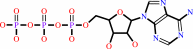 ATP
ATP
|
=
|
O-phospho-L-seryl-[protein]
Bound ligand (Het Group name = )
matches with 85.19% similarity
|
+
|
 ADP
ADP
|
+
|
H(+)
|
|
|
|
|
|
|
L-threonyl-[protein]
|
+
|
ATP
|
=
|
O-phospho-L-threonyl-[protein]
Bound ligand (Het Group name = )
matches with 85.19% similarity
|
+
|
ADP
|
+
|
H(+)
|
|
|
|
|
|
|
|
|
|
Enzyme class 2:
|
|
Chain A:
E.C.2.7.11.26
- [tau protein] kinase.
|
|
|
|
|
|
|
Reaction:
|
|
|
1.
|
L-seryl-[tau protein] + ATP = O-phospho-L-seryl-[tau protein] + ADP + H+
|
|
2.
|
L-threonyl-[tau protein] + ATP = O-phospho-L-threonyl-[tau protein] + ADP + H+
|
|
|
|
|
|
|
L-seryl-[tau protein]
|
+
|
ATP
|
=
|
O-phospho-L-seryl-[tau protein]
Bound ligand (Het Group name = )
matches with 85.19% similarity
|
+
|
ADP
|
+
|
H(+)
|
|
|
|
|
|
|
L-threonyl-[tau protein]
|
+
|
ATP
|
=
|
O-phospho-L-threonyl-[tau protein]
Bound ligand (Het Group name = )
matches with 85.19% similarity
|
+
|
ADP
|
+
|
H(+)
|
|
|
|
|
|
|
|
|
|
Enzyme class 3:
|
|
Chain A:
E.C.2.7.11.31
- [hydroxymethylglutaryl-CoA reductase (NADPH)] kinase.
|
|
|
|
|
|
|
Reaction:
|
|
L-seryl-[3-hydroxy-3-methylglutaryl-coenzyme A reductase] + ATP = O-phospho-L-seryl-[3-hydroxy-3-methylglutaryl-coenzyme A reductase] + ADP + H+
|
|
|
|
|
|
L-seryl-[3-hydroxy-3-methylglutaryl-coenzyme A reductase]
|
+
|
ATP
|
=
|
O-phospho-L-seryl-[3-hydroxy-3-methylglutaryl-coenzyme A reductase]
Bound ligand (Het Group name = )
matches with 85.19% similarity
|
+
|
ADP
|
+
|
H(+)
|
|
|
|
|
|
|
|
|
|
|
|
|
Note, where more than one E.C. class is given (as above), each may
correspond to a different protein domain or, in the case of polyprotein
precursors, to a different mature protein.
|
|
|
|
Molecule diagrams generated from .mol files obtained from the
KEGG ftp site
|
|
|
|
|
|
|
|
|
|
|
|
|
|
 |
|
|
|
|
|
|
| |
|
|
| |
|
DOI no:
|
Nature
449:496-500
(2007)
|
|
PubMed id:
|
|
|
|
|
|
| |
|
Structural basis for AMP binding to mammalian AMP-activated protein kinase.
|
|
B.Xiao,
R.Heath,
P.Saiu,
F.C.Leiper,
P.Leone,
C.Jing,
P.A.Walker,
L.Haire,
J.F.Eccleston,
C.T.Davis,
S.R.Martin,
D.Carling,
S.J.Gamblin.
|
|
|
|
|
| |
ABSTRACT
|
|
|
|
| |
|
|
AMP-activated protein kinase (AMPK) regulates cellular metabolism in response to
the availability of energy and is therefore a target for type II diabetes
treatment. It senses changes in the ratio of AMP/ATP by binding both species in
a competitive manner. Thus, increases in the concentration of AMP activate AMPK
resulting in the phosphorylation and differential regulation of a series of
downstream targets that control anabolic and catabolic pathways. We report here
the crystal structure of the regulatory fragment of mammalian AMPK in complexes
with AMP and ATP. The phosphate groups of AMP/ATP lie in a groove on the surface
of the gamma domain, which is lined with basic residues, many of which are
associated with disease-causing mutations. Structural and solution studies
reveal that two sites on the gamma domain bind either AMP or Mg.ATP, whereas a
third site contains a tightly bound AMP that does not exchange. Our binding
studies indicate that under physiological conditions AMPK mainly exists in its
inactive form in complex with Mg.ATP, which is much more abundant than AMP. Our
modelling studies suggest how changes in the concentration of AMP ([AMP])
enhance AMPK activity levels. The structure also suggests a mechanism for
propagating AMP/ATP signalling whereby a phosphorylated residue from the alpha
and/or beta subunits binds to the gamma subunit in the presence of AMP but not
when ATP is bound.
|
|
|
|
|
|
| |
Selected figure(s)
|
|
|
|
| |
|
|

|
|

|
|
Figure 1.
Figure 1: Structure of mammalian AMPK. a, Diagram
representation of the three components of the heterotrimer; the
constructs used for crystallization are shown hatched. b, Ribbon
representation of the crystallized complex with three bound AMPs
in two orthogonal views. The three domains are coloured
according to a and the AMP molecules are shown in ball-and-stick
representation. For ease of viewing the ends of two loops that
are disordered in the structure (  470–523
and 470–523
and  223–232)
are joined-up by a thin black line, also the first 12 residues
of that
interact with a neighbouring molecule in the crystal lattice are
omitted. On the right-hand panel, thin black arrows indicate the
position of the approximate two-fold axes relating the four CBS
motifs. The 223–232)
are joined-up by a thin black line, also the first 12 residues
of that
interact with a neighbouring molecule in the crystal lattice are
omitted. On the right-hand panel, thin black arrows indicate the
position of the approximate two-fold axes relating the four CBS
motifs. The  subunit
comprises Bateman domain 1 (CBS1 + 2) and Bateman domain 2 (CBS3
+ 4). The interface between the two CBS motifs of each Bateman
domain generates two potential adenyl-binding sites, each being
made up from a strand and a helix from each CBS motif—these
elements, for the AMP-2 site, are coloured in a lighter shade in
b and are shown in more detail in c. subunit
comprises Bateman domain 1 (CBS1 + 2) and Bateman domain 2 (CBS3
+ 4). The interface between the two CBS motifs of each Bateman
domain generates two potential adenyl-binding sites, each being
made up from a strand and a helix from each CBS motif—these
elements, for the AMP-2 site, are coloured in a lighter shade in
b and are shown in more detail in c.
|
|
Figure 3.
Figure 3: Front and back views of the three adenyl moieties
bound to the bold gamma- domain,
shown in surface representation. The surface is coloured
according to electrostatic potential (blue, positive; red,
negative) and the labelled nucleotides are in ball-and-stick
representation, with the magnesium ions shown as yellow spheres.
The lower panel represents approximately the same orientation
of the molecule shown in the right-hand panel of Fig. 1b,
whereas the upper panel is viewed from the back. The left-hand
panels show the domain
from the AMP complex, whereas the right-hand panels focus on the
phosphate-binding groove from the AMP[3] and (Mg domain,
shown in surface representation. The surface is coloured
according to electrostatic potential (blue, positive; red,
negative) and the labelled nucleotides are in ball-and-stick
representation, with the magnesium ions shown as yellow spheres.
The lower panel represents approximately the same orientation
of the molecule shown in the right-hand panel of Fig. 1b,
whereas the upper panel is viewed from the back. The left-hand
panels show the domain
from the AMP complex, whereas the right-hand panels focus on the
phosphate-binding groove from the AMP[3] and (Mg  ATP)[2]AMP[1]
complexes. ATP)[2]AMP[1]
complexes.
|
|
|
|
|
|
| |
The above figures are
reprinted
by permission from Macmillan Publishers Ltd:
Nature
(2007,
449,
496-500)
copyright 2007.
|
|
| |
Figures were
selected
by an automated process.
|
|
|
|
|
|
|
|
|
|
|
|
|
|
|
|
 |
 |
 |
|
Literature references that cite this PDB file's key reference
|
|
|
| |
PubMed id
|
|
Reference
|
|
|
|
|
|
D.G.Hardie,
F.A.Ross,
and
S.A.Hawley
(2012).
AMPK: a nutrient and energy sensor that maintains energy homeostasis.
|
| |
Nat Rev Mol Cell Biol,
13,
251-262.
|
|
|
|
|
|
|
L.Chen,
J.Wang,
Y.Y.Zhang,
S.F.Yan,
D.Neumann,
U.Schlattner,
Z.X.Wang,
and
J.W.Wu
(2012).
AMP-activated protein kinase undergoes nucleotide-dependent conformational changes.
|
| |
Nat Struct Mol Biol,
19,
716-718.
|
|
|
PDB codes:
|
|
|
|
|
|
|
|
A.Ruiz,
X.Xu,
and
M.Carlson
(2011).
Roles of two protein phosphatases, Reg1-Glc7 and Sit4, and glycogen synthesis in regulation of SNF1 protein kinase.
|
| |
Proc Natl Acad Sci U S A,
108,
6349-6354.
|
|
|
|
|
|
|
B.Xiao,
M.J.Sanders,
E.Underwood,
R.Heath,
F.V.Mayer,
D.Carmena,
C.Jing,
P.A.Walker,
J.F.Eccleston,
L.F.Haire,
P.Saiu,
S.A.Howell,
R.Aasland,
S.R.Martin,
D.Carling,
and
S.J.Gamblin
(2011).
Structure of mammalian AMPK and its regulation by ADP.
|
| |
Nature,
472,
230-233.
|
|
|
PDB codes:
|
|
|
|
|
|
|
|
C.Beauloye,
L.Bertrand,
S.Horman,
and
L.Hue
(2011).
AMPK activation, a preventive therapeutic target in the transition from cardiac injury to heart failure.
|
| |
Cardiovasc Res,
90,
224-233.
|
|
|
|
|
|
|
D.G.Hardie
(2011).
Energy sensing by the AMP-activated protein kinase and its effects on muscle metabolism.
|
| |
Proc Nutr Soc,
70,
92-99.
|
|
|
|
|
|
|
D.G.Hardie
(2011).
AMP-activated protein kinase: a cellular energy sensor with a key role in metabolic disorders and in cancer.
|
| |
Biochem Soc Trans,
39,
1.
|
|
|
|
|
|
|
D.G.Hardie
(2011).
Cell biology. Why starving cells eat themselves.
|
| |
Science,
331,
410-411.
|
|
|
|
|
|
|
D.G.Hardie
(2011).
Signal transduction: How cells sense energy.
|
| |
Nature,
472,
176-177.
|
|
|
|
|
|
|
J.Jämsen,
H.Tuominen,
A.A.Baykov,
and
R.Lahti
(2011).
Mutational analysis of residues in the regulatory CBS domains of Moorella thermoacetica pyrophosphatase corresponding to disease-related residues of human proteins.
|
| |
Biochem J,
433,
497-504.
|
|
|
|
|
|
|
L.A.Martínez-Cruz,
J.A.Encinar,
P.Sevilla,
I.Oyenarte,
I.Gómez-García,
D.Aguado-Llera,
F.García-Blanco,
J.Gómez,
and
J.L.Neira
(2011).
Nucleotide-induced conformational transitions in the CBS domain protein MJ0729 of Methanocaldococcus jannaschii.
|
| |
Protein Eng Des Sel,
24,
161-169.
|
|
|
|
|
|
|
L.Zhu,
L.Chen,
X.M.Zhou,
Y.Y.Zhang,
Y.J.Zhang,
J.Zhao,
S.R.Ji,
J.W.Wu,
and
Y.Wu
(2011).
Structural insights into the architecture and allostery of full-length AMP-activated protein kinase.
|
| |
Structure,
19,
515-522.
|
|
|
|
|
|
|
N.Handa,
T.Takagi,
S.Saijo,
S.Kishishita,
D.Takaya,
M.Toyama,
T.Terada,
M.Shirouzu,
A.Suzuki,
S.Lee,
T.Yamauchi,
M.Okada-Iwabu,
M.Iwabu,
T.Kadowaki,
Y.Minokoshi,
and
S.Yokoyama
(2011).
Structural basis for compound C inhibition of the human AMP-activated protein kinase α2 subunit kinase domain.
|
| |
Acta Crystallogr D Biol Crystallogr,
67,
480-487.
|
|
|
PDB codes:
|
|
|
|
|
|
|
|
R.Flavin,
G.Zadra,
and
M.Loda
(2011).
Metabolic alterations and targeted therapies in prostate cancer.
|
| |
J Pathol,
223,
283-294.
|
|
|
|
|
|
|
V.A.Narkar,
W.Fan,
M.Downes,
R.T.Yu,
J.W.Jonker,
W.A.Alaynick,
E.Banayo,
M.S.Karunasiri,
S.Lorca,
and
R.M.Evans
(2011).
Exercise and PGC-1α-independent synchronization of type I muscle metabolism and vasculature by ERRγ.
|
| |
Cell Metab,
13,
283-293.
|
|
|
|
|
|
|
B.Viollet,
S.Horman,
J.Leclerc,
L.Lantier,
M.Foretz,
M.Billaud,
S.Giri,
and
F.Andreelli
(2010).
AMPK inhibition in health and disease.
|
| |
Crit Rev Biochem Mol Biol,
45,
276-295.
|
|
|
|
|
|
|
C.Cantó,
and
J.Auwerx
(2010).
AMP-activated protein kinase and its downstream transcriptional pathways.
|
| |
Cell Mol Life Sci,
67,
3407-3423.
|
|
|
|
|
|
|
C.Moffat,
and
M.Ellen Harper
(2010).
Metabolic functions of AMPK: aspects of structure and of natural mutations in the regulatory gamma subunits.
|
| |
IUBMB Life,
62,
739-745.
|
|
|
|
|
|
|
D.Moreno,
M.C.Towler,
D.G.Hardie,
E.Knecht,
and
P.Sanz
(2010).
The laforin-malin complex, involved in Lafora disease, promotes the incorporation of K63-linked ubiquitin chains into AMP-activated protein kinase beta subunits.
|
| |
Mol Biol Cell,
21,
2578-2588.
|
|
|
|
|
|
|
J.A.Zorn,
and
J.A.Wells
(2010).
Turning enzymes ON with small molecules.
|
| |
Nat Chem Biol,
6,
179-188.
|
|
|
|
|
|
|
J.S.Oakhill,
Z.P.Chen,
J.W.Scott,
R.Steel,
L.A.Castelli,
N.Ling,
S.L.Macaulay,
and
B.E.Kemp
(2010).
β-Subunit myristoylation is the gatekeeper for initiating metabolic stress sensing by AMP-activated protein kinase (AMPK).
|
| |
Proc Natl Acad Sci U S A,
107,
19237-19241.
|
|
|
|
|
|
|
J.Zhang,
G.Vemuri,
and
J.Nielsen
(2010).
Systems biology of energy homeostasis in yeast.
|
| |
Curr Opin Microbiol,
13,
382-388.
|
|
|
|
|
|
|
N.Kazgan,
T.Williams,
L.J.Forsberg,
and
J.E.Brenman
(2010).
Identification of a nuclear export signal in the catalytic subunit of AMP-activated protein kinase.
|
| |
Mol Biol Cell,
21,
3433-3442.
|
|
|
|
|
|
|
S.A.Hawley,
F.A.Ross,
C.Chevtzoff,
K.A.Green,
A.Evans,
S.Fogarty,
M.C.Towler,
L.J.Brown,
O.A.Ogunbayo,
A.M.Evans,
and
D.G.Hardie
(2010).
Use of cells expressing gamma subunit variants to identify diverse mechanisms of AMPK activation.
|
| |
Cell Metab,
11,
554-565.
|
|
|
|
|
|
|
S.Fogarty,
S.A.Hawley,
K.A.Green,
N.Saner,
K.J.Mustard,
and
D.G.Hardie
(2010).
Calmodulin-dependent protein kinase kinase-beta activates AMPK without forming a stable complex: synergistic effects of Ca2+ and AMP.
|
| |
Biochem J,
426,
109-118.
|
|
|
|
|
|
|
S.Mangat,
D.Chandrashekarappa,
R.R.McCartney,
K.Elbing,
and
M.C.Schmidt
(2010).
Differential roles of the glycogen-binding domains of beta subunits in regulation of the Snf1 kinase complex.
|
| |
Eukaryot Cell,
9,
173-183.
|
|
|
|
|
|
|
Z.Wang,
X.Wang,
K.Qu,
P.Zhu,
N.Guo,
R.Zhang,
Z.Abliz,
H.Yu,
and
H.Zhu
(2010).
Binding of cordycepin monophosphate to AMP-activated protein kinase and its effect on AMP-activated protein kinase activation.
|
| |
Chem Biol Drug Des,
76,
340-344.
|
|
|
|
|
|
|
A.Gruzman,
G.Babai,
and
S.Sasson
(2009).
Adenosine Monophosphate-Activated Protein Kinase (AMPK) as a New Target for Antidiabetic Drugs: A Review on Metabolic, Pharmacological and Chemical Considerations.
|
| |
Rev Diabet Stud,
6,
13-36.
|
|
|
|
|
|
|
A.M.Evans,
D.G.Hardie,
C.Peers,
C.N.Wyatt,
B.Viollet,
P.Kumar,
M.L.Dallas,
F.Ross,
N.Ikematsu,
H.L.Jordan,
B.L.Barr,
J.N.Rafferty,
and
O.Ogunbayo
(2009).
Ion channel regulation by AMPK: the route of hypoxia-response coupling in thecarotid body and pulmonary artery.
|
| |
Ann N Y Acad Sci,
1177,
89.
|
|
|
|
|
|
|
A.McBride,
and
D.G.Hardie
(2009).
AMP-activated protein kinase--a sensor of glycogen as well as AMP and ATP?
|
| |
Acta Physiol (Oxf),
196,
99.
|
|
|
|
|
|
|
A.McBride,
S.Ghilagaber,
A.Nikolaev,
and
D.G.Hardie
(2009).
The glycogen-binding domain on the AMPK beta subunit allows the kinase to act as a glycogen sensor.
|
| |
Cell Metab,
9,
23-34.
|
|
|
|
|
|
|
B.D.Hegarty,
N.Turner,
G.J.Cooney,
and
E.W.Kraegen
(2009).
Insulin resistance and fuel homeostasis: the role of AMP-activated protein kinase.
|
| |
Acta Physiol (Oxf),
196,
129-145.
|
|
|
|
|
|
|
B.Viollet,
B.Guigas,
J.Leclerc,
S.Hébrard,
L.Lantier,
R.Mounier,
F.Andreelli,
and
M.Foretz
(2009).
AMP-activated protein kinase in the regulation of hepatic energy metabolism: from physiology to therapeutic perspectives.
|
| |
Acta Physiol (Oxf),
196,
81-98.
|
|
|
|
|
|
|
D.B.Shackelford,
and
R.J.Shaw
(2009).
The LKB1-AMPK pathway: metabolism and growth control in tumour suppression.
|
| |
Nat Rev Cancer,
9,
563-575.
|
|
|
|
|
|
|
E.A.Richter,
and
N.B.Ruderman
(2009).
AMPK and the biochemistry of exercise: implications for human health and disease.
|
| |
Biochem J,
418,
261-275.
|
|
|
|
|
|
|
E.Zeqiraj,
B.M.Filippi,
S.Goldie,
I.Navratilova,
J.Boudeau,
M.Deak,
D.R.Alessi,
and
D.M.van Aalten
(2009).
ATP and MO25alpha regulate the conformational state of the STRADalpha pseudokinase and activation of the LKB1 tumour suppressor.
|
| |
PLoS Biol,
7,
e1000126.
|
|
|
PDB code:
|
|
|
|
|
|
|
|
G.R.Steinberg
(2009).
Role of the AMP-activated protein kinase in regulating fatty acid metabolism during exercise.
|
| |
Appl Physiol Nutr Metab,
34,
315-322.
|
|
|
|
|
|
|
H.Klein,
L.Garneau,
N.T.Trinh,
A.Privé,
F.Dionne,
E.Goupil,
D.Thuringer,
L.Parent,
E.Brochiero,
and
R.Sauvé
(2009).
Inhibition of the KCa3.1 channels by AMP-activated protein kinase in human airway epithelial cells.
|
| |
Am J Physiol Cell Physiol,
296,
C285-C295.
|
|
|
|
|
|
|
J.S.Oakhill,
J.W.Scott,
and
B.E.Kemp
(2009).
Structure and function of AMP-activated protein kinase.
|
| |
Acta Physiol (Oxf),
196,
3.
|
|
|
|
|
|
|
L.Chen,
Z.H.Jiao,
L.S.Zheng,
Y.Y.Zhang,
S.T.Xie,
Z.X.Wang,
and
J.W.Wu
(2009).
Structural insight into the autoinhibition mechanism of AMP-activated protein kinase.
|
| |
Nature,
459,
1146-1149.
|
|
|
PDB codes:
|
|
|
|
|
|
|
|
L.G.Karagounis,
and
J.A.Hawley
(2009).
The 5' adenosine monophosphate-activated protein kinase: regulating the ebb and flow of cellular energetics.
|
| |
Int J Biochem Cell Biol,
41,
2360-2363.
|
|
|
|
|
|
|
M.Bendayan,
I.Londono,
B.E.Kemp,
G.D.Hardie,
N.Ruderman,
and
M.Prentki
(2009).
Association of AMP-activated protein kinase subunits with glycogen particles as revealed in situ by immunoelectron microscopy.
|
| |
J Histochem Cytochem,
57,
963-971.
|
|
|
|
|
|
|
R.Scholz,
M.Suter,
T.Weimann,
C.Polge,
P.V.Konarev,
R.F.Thali,
R.D.Tuerk,
B.Viollet,
T.Wallimann,
U.Schlattner,
and
D.Neumann
(2009).
Homo-oligomerization and activation of AMP-activated protein kinase are mediated by the kinase domain alphaG-helix.
|
| |
J Biol Chem,
284,
27425-27437.
|
|
|
|
|
|
|
S.Fogarty,
and
D.G.Hardie
(2009).
C-terminal Phosphorylation of LKB1 Is Not Required for Regulation of AMP-activated Protein Kinase, BRSK1, BRSK2, or Cell Cycle Arrest.
|
| |
J Biol Chem,
284,
77-84.
|
|
|
|
|
|
|
T.E.Jensen,
J.F.Wojtaszewski,
and
E.A.Richter
(2009).
AMP-activated protein kinase in contraction regulation of skeletal muscle metabolism: necessary and/or sufficient?
|
| |
Acta Physiol (Oxf),
196,
155-174.
|
|
|
|
|
|
|
W.Wang,
and
K.L.Guan
(2009).
AMP-activated protein kinase and cancer.
|
| |
Acta Physiol (Oxf),
196,
55-63.
|
|
|
|
|
|
|
E.Baena-González,
and
J.Sheen
(2008).
Convergent energy and stress signaling.
|
| |
Trends Plant Sci,
13,
474-482.
|
|
|
|
|
|
|
J.Qi,
J.Gong,
T.Zhao,
J.Zhao,
P.Lam,
J.Ye,
J.Z.Li,
J.Wu,
H.M.Zhou,
and
P.Li
(2008).
Downregulation of AMP-activated protein kinase by Cidea-mediated ubiquitination and degradation in brown adipose tissue.
|
| |
EMBO J,
27,
1537-1548.
|
|
|
|
|
|
|
J.W.Scott,
B.J.van Denderen,
S.B.Jorgensen,
J.E.Honeyman,
G.R.Steinberg,
J.S.Oakhill,
T.J.Iseli,
A.Koay,
P.R.Gooley,
D.Stapleton,
and
B.E.Kemp
(2008).
Thienopyridone drugs are selective activators of AMP-activated protein kinase beta1-containing complexes.
|
| |
Chem Biol,
15,
1220-1230.
|
|
|
|
|
|
|
M.Lucas,
D.Kortazar,
E.Astigarraga,
J.A.Fernández,
J.M.Mato,
M.L.Martínez-Chantar,
and
L.A.Martínez-Cruz
(2008).
Purification, crystallization and preliminary X-ray diffraction analysis of the CBS-domain pair from the Methanococcus jannaschii protein MJ0100.
|
| |
Acta Crystallogr Sect F Struct Biol Cryst Commun,
64,
936-941.
|
|
|
|
|
|
|
M.Momcilovic,
S.H.Iram,
Y.Liu,
and
M.Carlson
(2008).
Roles of the glycogen-binding domain and Snf4 in glucose inhibition of SNF1 protein kinase.
|
| |
J Biol Chem,
283,
19521-19529.
|
|
|
|
|
|
|
N.P.King,
T.M.Lee,
M.R.Sawaya,
D.Cascio,
and
T.O.Yeates
(2008).
Structures and functional implications of an AMP-binding cystathionine beta-synthase domain protein from a hyperthermophilic archaeon.
|
| |
J Mol Biol,
380,
181-192.
|
|
|
PDB codes:
|
|
|
|
|
|
|
|
P.Fernández-Millán,
D.Kortazar,
M.Lucas,
M.L.Martínez-Chantar,
E.Astigarraga,
J.A.Fernández,
O.Sabas,
A.Albert,
J.M.Mato,
and
L.A.Martínez-Cruz
(2008).
Crystallization and preliminary crystallographic analysis of merohedrally twinned crystals of MJ0729, a CBS-domain protein from Methanococcus jannaschii.
|
| |
Acta Crystallogr Sect F Struct Biol Cryst Commun,
64,
605-609.
|
|
|
|
|
|
|
S.M.Andrade,
S.M.Costa,
J.W.Borst,
A.van Hoek,
and
A.J.Visser
(2008).
Translational and rotational motions of albumin sensed by a non-covalent associated porphyrin under physiological and acidic conditions: a fluorescence correlation spectroscopy and time resolved anisotropy study.
|
| |
J Fluoresc,
18,
601-610.
|
|
|
|
|
|
|
T.J.Iseli,
J.S.Oakhill,
M.F.Bailey,
S.Wee,
M.Walter,
B.J.van Denderen,
L.A.Castelli,
F.Katsis,
L.A.Witters,
D.Stapleton,
S.L.Macaulay,
B.J.Michell,
and
B.E.Kemp
(2008).
AMP-activated protein kinase subunit interactions: beta1:gamma1 association requires beta1 Thr-263 and Tyr-267.
|
| |
J Biol Chem,
283,
4799-4807.
|
|
|
|
|
|
|
T.Williams,
and
J.E.Brenman
(2008).
LKB1 and AMPK in cell polarity and division.
|
| |
Trends Cell Biol,
18,
193-198.
|
|
|
|
|
|
|
U.Riek,
R.Scholz,
P.Konarev,
A.Rufer,
M.Suter,
A.Nazabal,
P.Ringler,
M.Chami,
S.A.Müller,
D.Neumann,
M.Forstner,
M.Hennig,
R.Zenobi,
A.Engel,
D.Svergun,
U.Schlattner,
and
T.Wallimann
(2008).
Structural properties of AMP-activated protein kinase: dimerization, molecular shape, and changes upon ligand binding.
|
| |
J Biol Chem,
283,
18331-18343.
|
|
|
|
|
|
|
Y.Zhuang,
and
W.K.Miskimins
(2008).
Cell cycle arrest in Metformin treated breast cancer cells involves activation of AMPK, downregulation of cyclin D1, and requires p27Kip1 or p21Cip1.
|
| |
J Mol Signal,
3,
18.
|
|
|
|
|
|
|
B.E.Kemp,
J.S.Oakhill,
and
J.W.Scott
(2007).
AMPK structure and regulation from three angles.
|
| |
Structure,
15,
1161-1163.
|
|
|
|
|
|
|
D.G.Hardie
(2007).
AMPK and SNF1: Snuffing Out Stress.
|
| |
Cell Metab,
6,
339-340.
|
|
|
|
|
|
The most recent references are shown first.
Citation data come partly from CiteXplore and partly
from an automated harvesting procedure. Note that this is likely to be
only a partial list as not all journals are covered by
either method. However, we are continually building up the citation data
so more and more references will be included with time.
Where a reference describes a PDB structure, the PDB
codes are
shown on the right.
|
 |
|


 Links
Links


