 |
PDBsum entry 2k1e

|
|
|
|
|
|

|

|

|

|
|

|
|

|
|

|
|

|
|

|
|
|
 |

|

|
|
|
|
|
|
|
|
|
|
|
|
|
|
|
|
|
|
|
|
|
|
|
|
|
|
|
|
|
|
|
|
|
|
Membrane protein
|
PDB id
|
|
|
|
2k1e
|
|
|
|
|
|
|
|
|
|
|
|
|
|
|

|

|

|
|
|
|
|
|
|
|
 |
Contents |
 |
|
|
|
|
|
|
|
|
* Residue conservation analysis
|
|
|
|
|
|
PDB id:
|
|
|
|
| Name: |
|
Membrane protein
|
|
|
Title:
|
|
Nmr studies of a channel protein without membranes: structure and dynamics of water-solubilized kcsa
|
|
Structure:
|
|
Water soluble analogue of potassium channel, kcsa. Chain: a, b, c, d. Engineered: yes
|
|
Source:
|
|
Escherichia coli. Expressed in: escherichia coli. Other_details: designed variant of kcsa
|
|
NMR struc:
|
|
20 models
|
|
|
Authors:
|
|
D.Ma,Y.Xu,T.Tillman,P.Tang,E.Meirovitch,R.Eckenhoff,A.Carnini
|
Key ref:

|
|
D.Ma
et al.
(2008).
NMR studies of a channel protein without membranes: structure and dynamics of water-solubilized KcsA.
Proc Natl Acad Sci U S A,
105,
16537-16542.
PubMed id:
DOI:

|
|
|
Date:
|
|
|
29-Feb-08
|
Release date:
|
11-Nov-08
|
|
|
|
|
|
|
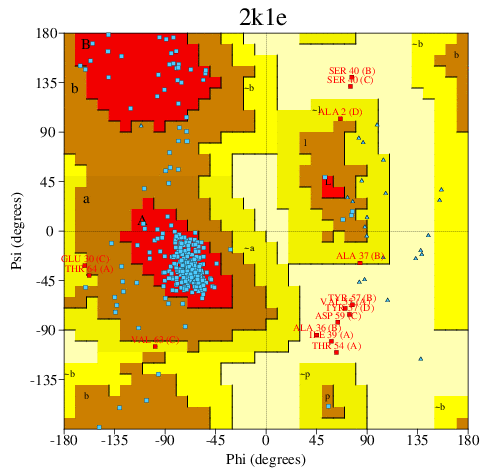
PROCHECK
|
|
|
|
|
|
Headers
|
|
|
|
References
|
|
|
|
|
|

|
|
No UniProt id for this chain
|
|
|
|
|
|
|
|
|
|
|
|
|
|
|
Key: |
|
 |
Secondary structure |
|
 |
CATH domain |
|
|
|
|
|
|
|
|
|
|
|
|
|
|
|
|
|
 |
|
|
|
|
|
|
| |
|
DOI no:
|
Proc Natl Acad Sci U S A
105:16537-16542
(2008)
|
|
PubMed id:
|
|
|
|
|
|
| |
|
NMR studies of a channel protein without membranes: structure and dynamics of water-solubilized KcsA.
|
|
D.Ma,
T.S.Tillman,
P.Tang,
E.Meirovitch,
R.Eckenhoff,
A.Carnini,
Y.Xu.
|
|
|
|
|
| |
ABSTRACT
|
|
|
|
| |
|
|
Structural studies of polytopic membrane proteins are often hampered by the
vagaries of these proteins in membrane mimetic environments and by the
difficulties in handling them with conventional techniques. Designing and
creating water-soluble analogues with preserved native structures offer an
attractive alternative. We report here solution NMR studies of WSK3, a
water-soluble analogue of the potassium channel KcsA. The WSK3 NMR structure
(PDB ID code 2K1E) resembles the KcsA crystal structures, validating the
approach. By more stringent comparison criteria, however, the introduction of
several charged residues aimed at improving water solubility seems to have led
to the possible formations of a few salt bridges and hydrogen bonds not present
in the native structure, resulting in slight differences in the structure of
WSK3 relative to KcsA. NMR dynamics measurements show that WSK3 is highly
flexible in the absence of a lipid environment. Reduced spectral density mapping
and model-free analyses reveal dynamic characteristics consistent with an
isotropically tumbling tetramer experiencing slow (nanosecond) motions with
unusually low local ordering. An altered hydrogen-bond network near the
selectivity filter and the pore helix, and the intrinsically dynamic nature of
the selectivity filter, support the notion that this region is crucial for slow
inactivation. Our results have implications not only for the design of
water-soluble analogues of membrane proteins but also for our understanding of
the basic determinants of intrinsic protein structure and dynamics.
|
|
|
|
|
|
| |
Selected figure(s)
|
|
|
|
| |
|
|

|
|

|
|
Figure 1.
Comparison of WSK3 with KcsA. (A and B) The averaged NMR
structure (green in A) and the 20 lowest energy structures
(black in B) of WSK3 are superimposed on the low-K^+ KcsA
crystal structure (1K4D in light gray). In A, the mutations made
to facilitate water solubility and agitoxin-2 binding are
highlighted in orange and black, respectively. (C) Sequence
alignment and relative numbering of KcsA and WSK3. The mutations
are highlighted in gold. The selectivity filter is enclosed in
the red rectangle. The kink near V85 in WSK3 is marked with an
asterisk. The underlined residues are non-α-helix in some
structures.
|
|
Figure 3.
Stabilization of the selectivity filter and tetramer
conformation in WSK3 by a network of salt bridges and hydrogen
bonds. Important side chains are depicted in the licorice
representation, with hydrogen bonds indicated by red dashed
lines. (A and B) The same region is depicted from different
viewing angles. (C) Quaternary relationship among W46, W47, E50,
Y57, and R68 in WSK3. W67 and W68 in KcsA are shown in black
lines for comparison. (D) Comparison of the selectivity filter
between WSK3 structure and KcsA crystal structures obtained in
the presence of high (1K4C) and low (1K4D) K^+ concentrations.
WSK3 is depicted in thick sticks and KcsA in thin lines. Element
colors: C, gray; N, blue; O, red; and K, yellow. K^+ locations
are taken from the crystal structures and not from the NMR data.
|
|
|
|
| |
Figures were
selected
by an automated process.
|
|
|
|
|
|
|
|
|
|
|
|
|
|
|
|
 |
 |
 |
|
Literature references that cite this PDB file's key reference
|
|
|
| |
PubMed id
|
|
Reference
|
|
|
|
|
|
I.Samish,
C.M.MacDermaid,
J.M.Perez-Aguilar,
and
J.G.Saven
(2011).
Theoretical and computational protein design.
|
| |
Annu Rev Phys Chem,
62,
129-149.
|
|
|
|
|
|
|
I.Bahar,
T.R.Lezon,
A.Bakan,
and
I.H.Shrivastava
(2010).
Normal mode analysis of biomolecular structures: functional mechanisms of membrane proteins.
|
| |
Chem Rev,
110,
1463-1497.
|
|
|
|
|
|
|
J.G.Saven
(2010).
Computational protein design: Advances in the design and redesign of biomolecular nanostructures.
|
| |
Curr Opin Colloid Interface Sci,
15,
13-17.
|
|
|
|
|
|
|
H.J.Kim,
S.C.Howell,
W.D.Van Horn,
Y.H.Jeon,
and
C.R.Sanders
(2009).
Recent Advances in the Application of Solution NMR Spectroscopy to Multi-Span Integral Membrane Proteins.
|
| |
Prog Nucl Magn Reson Spectrosc,
55,
335-360.
|
|
|
|
|
|
|
W.D.Van Horn,
H.J.Kim,
C.D.Ellis,
A.Hadziselimovic,
E.S.Sulistijo,
M.D.Karra,
C.Tian,
F.D.Sönnichsen,
and
C.R.Sanders
(2009).
Solution nuclear magnetic resonance structure of membrane-integral diacylglycerol kinase.
|
| |
Science,
324,
1726-1729.
|
|
|
PDB code:
|
|
|
|
|
|
|
The most recent references are shown first.
Citation data come partly from CiteXplore and partly
from an automated harvesting procedure. Note that this is likely to be
only a partial list as not all journals are covered by
either method. However, we are continually building up the citation data
so more and more references will be included with time.
Where a reference describes a PDB structure, the PDB
code is
shown on the right.
|
|


 Links
Links


