 |
PDBsum entry 2f6t

|
|
|
|
|
 |
Contents |
 |
|
|
|
|
|
|
|
|
|
|
|
|
|
|
* Residue conservation analysis
|
|
|
|
|
|
PDB id:
|
|
|
|
| Name: |
|
Hydrolase
|
|
|
Title:
|
|
Protein tyrosine phosphatase 1b with sulfamic acid inhibitors
|
|
Structure:
|
|
Tyrosine-protein phosphatase, non-receptor type 1. Chain: a. Fragment: catalytic domain, residues 1-298. Synonym: protein-tyrosine phosphatase 1b, ptp-1b. Engineered: yes
|
|
Source:
|
|
Homo sapiens. Human. Organism_taxid: 9606. Gene: ptpn1, ptp1b. Expressed in: escherichia coli bl21(de3). Expression_system_taxid: 469008.
|
|
Resolution:
|
|
|
1.70Å
|
R-factor:
|
0.167
|
R-free:
|
0.192
|
|
|
Authors:
|
|
A.G.Evdokimov,M.E.Pokross,S.R.Klopfenstein
|
|
Key ref:
|
|
S.R.Klopfenstein
et al.
(2006).
1,2,3,4-Tetrahydroisoquinolinyl sulfamic acids as phosphatase PTP1B inhibitors.
Bioorg Med Chem Lett,
16,
1574-1578.
PubMed id:
DOI:
|
|
|
Date:
|
|
|
29-Nov-05
|
Release date:
|
13-Dec-05
|
|
|
|
|
|
|
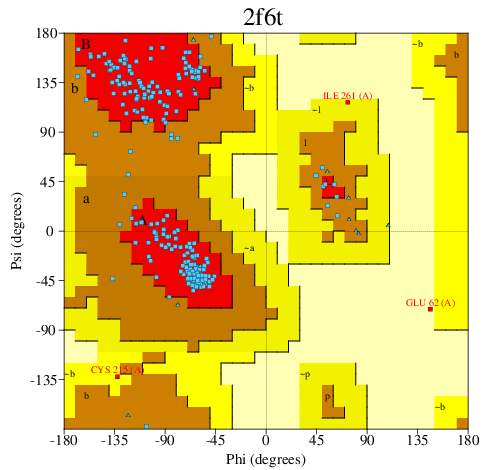
PROCHECK
|
|
|
|
|
|
Headers
|
|
|
|
References
|
|
|
|
|
|

|
|
P18031
(PTN1_HUMAN) -
Tyrosine-protein phosphatase non-receptor type 1 from Homo sapiens
|
|
|
|
Seq:
Struc:
|
|
|
|
435 a.a.
297 a.a.
|
|

|

|

|
|
|
|
|
|
|
|
|
|
|
Key: |
 |
PfamA domain |
|
|
 |
Secondary structure |
|
 |
CATH domain |
|
|
|
|
|
|
|
|
|
|
|
|
|
Enzyme class:
|
|
E.C.3.1.3.48
- protein-tyrosine-phosphatase.
|
|
|
|
|
|
|
Reaction:
|
|
O-phospho-L-tyrosyl-[protein] + H2O = L-tyrosyl-[protein] + phosphate
|
|
|
|
|
|
O-phospho-L-tyrosyl-[protein]
|
+
|
H2O
|
=
|
L-tyrosyl-[protein]
|
+
|
 phosphate
|
|
|
|
|
|
|
|
|
|
|
|
|
Molecule diagrams generated from .mol files obtained from the
KEGG ftp site
|
|
|
|
|
|
|
|
|
|
|
|
|
|
 |
|
|
|
|
|
|
| |
|
|
| |
|
DOI no:
|
Bioorg Med Chem Lett
16:1574-1578
(2006)
|
|
PubMed id:
|
|
|
|
|
|
| |
|
1,2,3,4-Tetrahydroisoquinolinyl sulfamic acids as phosphatase PTP1B inhibitors.
|
|
S.R.Klopfenstein,
A.G.Evdokimov,
A.O.Colson,
N.T.Fairweather,
J.J.Neuman,
M.B.Maier,
J.L.Gray,
G.S.Gerwe,
G.E.Stake,
B.W.Howard,
J.A.Farmer,
M.E.Pokross,
T.R.Downs,
B.Kasibhatla,
K.G.Peters.
|
|
|
|
|
| |
ABSTRACT
|
|
|
|
| |
|
|
High-throughput screening of the P&GP corporate repository against several
protein tyrosine phosphatases identified the sulfamic acid moiety as potential
phosphotyrosine mimetic. Incorporation of the sulfamic acid onto a
1,2,3,4-tetrahydroisoquinoline scaffold provided a promising starting point for
PTP1B inhibitor design.
|
|
|
|
|
|
|
|
|
|
|
|
|
|
|
|
|
|
 |
 |
 |
|
Literature references that cite this PDB file's key reference
|
|
|
| |
PubMed id
|
|
Reference
|
|
|
|
|
|
C.Abad-Zapatero,
O.Perišić,
J.Wass,
A.P.Bento,
J.Overington,
B.Al-Lazikani,
and
M.E.Johnson
(2010).
Ligand efficiency indices for an effective mapping of chemico-biological space: the concept of an atlas-like representation.
|
| |
Drug Discov Today,
15,
804-811.
|
|
|
|
|
|
|
D.Vidović,
and
S.C.Schürer
(2009).
Knowledge-based characterization of similarity relationships in the human protein-tyrosine phosphatase family for rational inhibitor design.
|
| |
J Med Chem,
52,
6649-6659.
|
|
|
|
|
|
|
R.Maccari,
R.Ottanà,
R.Ciurleo,
P.Paoli,
G.Manao,
G.Camici,
C.Laggner,
and
T.Langer
(2009).
Structure-based optimization of benzoic acids as inhibitors of protein tyrosine phosphatase 1B and low molecular weight protein tyrosine phosphatase.
|
| |
ChemMedChem,
4,
957-962.
|
|
|
|
|
|
|
S.Cheng,
X.Zhang,
W.Wang,
M.Zhao,
M.Zheng,
H.W.Chang,
J.Wu,
and
S.Peng
(2009).
A class of novel N-(3S-1,2,3,4-tetrahydroisoquinoline-3-carbonyl)-L-amino acid derivatives: their synthesis, anti-thrombotic activity evaluation, and 3D QSAR analysis.
|
| |
Eur J Med Chem,
44,
4904-4919.
|
|
|
|
|
|
|
R.Maccari,
P.Paoli,
R.Ottanà,
M.Jacomelli,
R.Ciurleo,
G.Manao,
T.Steindl,
T.Langer,
M.G.Vigorita,
and
G.Camici
(2007).
5-Arylidene-2,4-thiazolidinediones as inhibitors of protein tyrosine phosphatases.
|
| |
Bioorg Med Chem,
15,
5137-5149.
|
|
|
|
|
|
The most recent references are shown first.
Citation data come partly from CiteXplore and partly
from an automated harvesting procedure. Note that this is likely to be
only a partial list as not all journals are covered by
either method. However, we are continually building up the citation data
so more and more references will be included with time.
|
|


 Links
Links


