 |
PDBsum entry 2af6

|
|
|
|
|
 |
Contents |
 |
|
|
|
|
|
|
|
|
|
|
|
|
|
|
* Residue conservation analysis
|
|
|
|
|
|
PDB id:
|
|
|
|
| Name: |
|
Transferase
|
|
|
Title:
|
|
Crystal structure of mycobacterium tuberculosis flavin dependent thymidylate synthase (mtb thyx) in the presence of co-factor fad and substrate analog 5-bromo-2'-deoxyuridine-5'-monophosphate (brdump)
|
|
Structure:
|
|
Thymidylate synthase thyx. Chain: a, b, c, d, e, f, g, h. Synonym: ts, tsase. Engineered: yes. Mutation: yes
|
|
Source:
|
|
Mycobacterium tuberculosis. Organism_taxid: 1773. Gene: thyx. Expressed in: escherichia coli. Expression_system_taxid: 562.
|
|
Biol. unit:
|
|
 Tetramer (from
)
Tetramer (from
)
|
|
Resolution:
|
|
|
2.01Å
|
R-factor:
|
0.198
|
R-free:
|
0.243
|
|
|
Authors:
|
|
P.Sampathkumar,S.Turley,J.E.Ulmer,H.G.Rhie,C.H.Sibley,W.G.Hol
|
Key ref:

|
|
P.Sampathkumar
et al.
(2005).
Structure of the Mycobacterium tuberculosis flavin dependent thymidylate synthase (MtbThyX) at 2.0A resolution.
J Mol Biol,
352,
1091-1104.
PubMed id:
DOI:

|
|
|
Date:
|
|
|
25-Jul-05
|
Release date:
|
04-Oct-05
|
|
|
|
|
|
|
PROCHECK
|

|
|
|
|
|
Headers
|
|
|
|
References
|
|
|
|
|
|

|
|
P9WG57
(THYX_MYCTU) -
Flavin-dependent thymidylate synthase from Mycobacterium tuberculosis (strain ATCC 25618 / H37Rv)
|
|
|
|
Seq:
Struc:
|
|
|
|
250 a.a.
245 a.a.*
|
|

|

|
|
|
|
|
|
|
|
|
|
|
|
Key: |
|
 |
Secondary structure |
|
 |
CATH domain |
|
|
*
PDB and UniProt seqs differ
at 2 residue positions (black
crosses)
|
|
|
|
|
|
|
|
|
|
|
|
|
Enzyme class:
|
|
E.C.2.1.1.148
- thymidylate synthase (FAD).
|
|
|
|
|
|
|
Reaction:
|
|
dUMP + (6R)-5,10-methylene-5,6,7,8-tetrahydrofolate + NADPH + H+ = dTMP + (6S)-5,6,7,8-tetrahydrofolate + NADP+
|
|
|
|
|
|
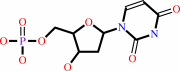 dUMP
dUMP
|
+
|
(6R)-5,10-methylene-5,6,7,8-tetrahydrofolate
Bound ligand (Het Group name = )
matches with 95.24% similarity
|
+
|
 NADPH
NADPH
|
+
|
H(+)
Bound ligand (Het Group name = )
matches with 71.19% similarity
|
=
|
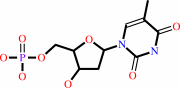 dTMP
dTMP
|
+
|
(6S)-5,6,7,8-tetrahydrofolate
|
+
|
 NADP(+)
|
|
|
|
|
|
|
|
|
|
|
|
|
Molecule diagrams generated from .mol files obtained from the
KEGG ftp site
|
|
|
|
|
|
|
|
|
|
|
|
|
|
 |
|
|
|
|
|
|
| |
|
|
| |
|
DOI no:
|
J Mol Biol
352:1091-1104
(2005)
|
|
PubMed id:
|
|
|
|
|
|
| |
|
Structure of the Mycobacterium tuberculosis flavin dependent thymidylate synthase (MtbThyX) at 2.0A resolution.
|
|
P.Sampathkumar,
S.Turley,
J.E.Ulmer,
H.G.Rhie,
C.H.Sibley,
W.G.Hol.
|
|
|
|
|
| |
ABSTRACT
|
|
|
|
| |
|
|
A novel flavin-dependent thymidylate synthase was identified recently as an
essential gene in many archaebacteria and some pathogenic eubacteria. This
enzyme, ThyX, is a potential antibacterial drug target, since humans and most
eukaryotes lack the thyX gene and depend upon the conventional thymidylate
synthase (TS) for their dTMP requirements. We have cloned and overexpressed the
thyX gene (Rv2754c) from Mycobacterium tuberculosis in Escherichia coli. The
M.tuberculosis ThyX (MtbThyX) enzyme complements the E.coli chi2913 strain that
lacks its conventional TS activity. The crystal structure of the homotetrameric
MtbThyX was determined in the presence of the cofactor FAD and the substrate
analog, 5-bromo-2'-deoxyuridine-5'-monophosphate (BrdUMP). In the active site,
which is formed by three monomers, FAD is bound in an extended conformation with
the adenosine ring in a deep pocket and BrdUMP in a closed conformation near the
isoalloxazine ring. Structure-based mutational studies have revealed a critical
role played by residues Lys165 and Arg168 in ThyX activity, possibly by
governing access to the carbon atom to be methylated of a totally buried
substrate dUMP.
|
|
|
|
|
|
| |
Selected figure(s)
|
|
|
|
| |
|
|

|
|

|
|
Figure 3.
Figure 3. Stereo views of the FAD and BrdUMP-binding sites.
(a) The FAD-binding site formed by residues from the E, G and H
subunits. The flexible His69 from the G subunit is shown in
gray; (b) the BrdUMP-binding site composed of residues from the
E and H subunits. Black dashes indicate putative hydrogen
bonding interactions. The important contacts between the Br and
C5 of BrdUMP and N5 of the flavin ring are shown as broken red
lines. Residues from subunits E, G and H are colored gold, green
and cyan, respectively.
|
|
Figure 5.
Figure 5. Key residues near the substrate-binding site of
MtbThyX. (a) Interactions made by distal residues Lys165 and
Arg168 with the residues 107-108 from the ThyX motif,
immediately lining the active site. All the residues shown are
from the E subunit. Substitution of Lys165 and Arg168 by alanine
abrogates the ability of MtbThyX to complement ThyA-defective E.
coli (Table 4). (b) The positions of two potentially crucial
tyrosine residues near the BrdUMP and FAD ligands bound to
MtbThyX. The side-chain of Tyr108 prevents access to the bromine
atom of BrdUMP and hence also to the C5 atom of the substrate
dUMP if bound in the same manner as BrdUMP. The side-chains of
Tyr108 and Tyr44 are in contact with each other as well as with
bulk solvent. Our hypothesis is that alterations in the
conformations of these Tyr residues enable CH[2]THF to reach the
dUMP substrate bound to MtbThyX. Residues Tyr44, Tyr108, Lys165,
Arg168 and the water molecule 371 are highlighted in red.
Secondary structure elements from subunits E, G and H are
colored gold, green and cyan, respectively.
|
|
|
|
|
|
| |
The above figures are
reprinted
by permission from Elsevier:
J Mol Biol
(2005,
352,
1091-1104)
copyright 2005.
|
|
| |
Figures were
selected
by an automated process.
|
|
|
|
|
|
|
|
|
|
|
|
|
|
|
|
 |
 |
 |
|
Literature references that cite this PDB file's key reference
|
|
|
| |
PubMed id
|
|
Reference
|
|
|
|
|
|
E.M.Koehn,
and
A.Kohen
(2010).
Flavin-dependent thymidylate synthase: a novel pathway towards thymine.
|
| |
Arch Biochem Biophys,
493,
96.
|
|
|
|
|
|
|
E.M.Koehn,
T.Fleischmann,
J.A.Conrad,
B.A.Palfey,
S.A.Lesley,
I.I.Mathews,
and
A.Kohen
(2009).
An unusual mechanism of thymidylate biosynthesis in organisms containing the thyX gene.
|
| |
Nature,
458,
919-923.
|
|
|
PDB codes:
|
|
|
|
|
|
|
|
H.Nishimasu,
R.Ishitani,
K.Yamashita,
C.Iwashita,
A.Hirata,
H.Hori,
and
O.Nureki
(2009).
Atomic structure of a folate/FAD-dependent tRNA T54 methyltransferase.
|
| |
Proc Natl Acad Sci U S A,
106,
8180-8185.
|
|
|
PDB codes:
|
|
|
|
|
|
|
|
B.Bhattacharya,
N.Giri,
M.Mitra,
and
S.K.Gupta
(2008).
Cloning, characterization and expression analysis of nucleotide metabolism-related genes of mycobacteriophage L5.
|
| |
FEMS Microbiol Lett,
280,
64-72.
|
|
|
|
|
|
|
J.E.Ulmer,
Y.Boum,
C.D.Thouvenel,
H.Myllykallio,
and
C.H.Sibley
(2008).
Functional analysis of the Mycobacterium tuberculosis FAD-dependent thymidylate synthase, ThyX, reveals new amino acid residues contributing to an extended ThyX motif.
|
| |
J Bacteriol,
190,
2056-2064.
|
|
|
|
|
|
|
J.H.Hunter,
R.Gujjar,
C.K.Pang,
and
P.K.Rathod
(2008).
Kinetics and ligand-binding preferences of Mycobacterium tuberculosis thymidylate synthases, ThyA and ThyX.
|
| |
PLoS ONE,
3,
e2237.
|
|
|
|
|
|
|
S.Ferrari,
V.Losasso,
and
M.P.Costi
(2008).
Sequence-based identification of specific drug target regions in the thymidylate synthase enzyme family.
|
| |
ChemMedChem,
3,
392-401.
|
|
|
|
|
|
|
A.Chernyshev,
T.Fleischmann,
and
A.Kohen
(2007).
Thymidyl biosynthesis enzymes as antibiotic targets.
|
| |
Appl Microbiol Biotechnol,
74,
282-289.
|
|
|
|
|
|
|
A.Chernyshev,
T.Fleischmann,
E.M.Koehn,
S.A.Lesley,
and
A.Kohen
(2007).
The relationships between oxidase and synthase activities of flavin dependent thymidylate synthase (FDTS).
|
| |
Chem Commun (Camb),
(),
2861-2863.
|
|
|
|
|
|
|
A.Mason,
N.Agrawal,
M.T.Washington,
S.A.Lesley,
and
A.Kohen
(2006).
A lag-phase in the reduction of flavin dependent thymidylate synthase (FDTS) revealed a mechanistic missing link.
|
| |
Chem Commun (Camb),
(),
1781-1783.
|
|
|
|
|
|
|
L.De Colibus,
and
A.Mattevi
(2006).
New frontiers in structural flavoenzymology.
|
| |
Curr Opin Struct Biol,
16,
722-728.
|
|
|
|
|
|
|
S.Graziani,
J.Bernauer,
S.Skouloubris,
M.Graille,
C.Z.Zhou,
C.Marchand,
P.Decottignies,
H.van Tilbeurgh,
H.Myllykallio,
and
U.Liebl
(2006).
Catalytic mechanism and structure of viral flavin-dependent thymidylate synthase ThyX.
|
| |
J Biol Chem,
281,
24048-24057.
|
|
|
PDB code:
|
|
|
|
|
|
|
The most recent references are shown first.
Citation data come partly from CiteXplore and partly
from an automated harvesting procedure. Note that this is likely to be
only a partial list as not all journals are covered by
either method. However, we are continually building up the citation data
so more and more references will be included with time.
Where a reference describes a PDB structure, the PDB
codes are
shown on the right.
|
|


 Links
Links


