 |
PDBsum entry 1zdf

|
|
|
|
|
 |
Contents |
 |
|
|
|
|
|
|
|
|
|
|
|
|
|
|
* Residue conservation analysis
|
|
|
|
|
|
|
|
|
|
|
Enzyme class:
|
|
E.C.2.4.1.186
- glycogenin glucosyltransferase.
|
|
|
|
|
|
|
Reaction:
|
|
|
1.
|
L-tyrosyl-[glycogenin] + UDP-alpha-D-glucose = alpha-D-glucosyl-L- tyrosyl-[glycogenin] + UDP + H+
|
|
2.
|
[1,4-alpha-D-glucosyl](n)-L-tyrosyl-[glycogenin] + UDP-alpha-D- glucose = [1,4-alpha-D-glucosyl](n+1)-L-tyrosyl-[glycogenin] + UDP + H+
|
|
|
|
|
|
|
L-tyrosyl-[glycogenin]
|
+
|
UDP-alpha-D-glucose
Bound ligand (Het Group name = )
corresponds exactly
|
=
|
alpha-D-glucosyl-L- tyrosyl-[glycogenin]
|
+
|
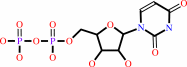 UDP
UDP
|
+
|
H(+)
|
|
|
|
|
|
|
[1,4-alpha-D-glucosyl](n)-L-tyrosyl-[glycogenin]
|
+
|
UDP-alpha-D- glucose
Bound ligand (Het Group name = )
corresponds exactly
|
=
|
[1,4-alpha-D-glucosyl](n+1)-L-tyrosyl-[glycogenin]
|
+
|
UDP
|
+
|
H(+)
|
|
|
|
|
|
|
|
|
|
Cofactor:
|
|
Mn(2+)
|
|
|
|
|
|
|
|
|
Molecule diagrams generated from .mol files obtained from the
KEGG ftp site
|
|
|
|
|
|
|
|
|
|
|
|
|
|
 |
|
|
|
|
|
|
| |
|
|
| |
|
DOI no:
|
J Biol Chem
280:23892-23899
(2005)
|
|
PubMed id:
|
|
|
|
|
|
| |
|
Requirements for catalysis in mammalian glycogenin.
|
|
T.D.Hurley,
S.Stout,
E.Miner,
J.Zhou,
P.J.Roach.
|
|
|
|
|
| |
ABSTRACT
|
|
|
|
| |
|
|
Glycogenin is a glycosyltransferase that functions as the autocatalytic
initiator for the synthesis of glycogen in eukaryotic organisms. Prior
structural work identified the determinants responsible for the recognition and
binding of UDP-glucose and the catalytic manganese ion and implicated two
aspartic acid residues in the reaction mechanism for self-glucosylation. We
examined the effects of substituting asparagine and serine for the aspartic acid
residues at positions 159 and 162. We also examined whether the truncation of
the protein at residue 270 (delta270) was compatible with its structural
integrity and its functional role as the initiator for glycogen synthesis. The
truncated form of the enzyme was indistinguishable from the wild-type enzyme by
all measures of activity and could support glycogen accumulation in a
glycogenin-deficient yeast strain. Substitution of aspartate 159 by either
serine or asparagine eliminated self-glucosylation and reduced
trans-glucosylation activity by at least 260-fold but only reduced UDP-glucose
hydrolytic activity by 4-14-fold. Substitution of aspartate 162 by either serine
or asparagine eliminated self-glucosylation activity and reduced UDP-glucose
hydrolytic activity by at least 190-fold. The trans-glucosylation of maltose was
reduced to undetectable levels in the asparagine 162 mutant, whereas the serine
162 enzyme showed only an 18-30-fold reduction in its ability to
trans-glucosylate maltose. These data support a role for aspartate 162 in the
chemical step for the glucosyltransferase reaction and a role for aspartate 159
in binding and activating the acceptor molecule.
|
|
|
|
|
|
| |
Selected figure(s)
|
|
|
|
| |
|
|

|
|

|
|
Figure 1.
FIG. 1. JZ4-a cells stained for glycogen accumulation using
iodine vapor. A, JZ4-a cells transformed only with wild-type
glycogenin-1. B, JZ4-a cells transformed only with 194F
glycogenin-1. C, JZ4-a cells transformed with both
194F-glycogenin-1 and  271-103A glycogenin-1. 271-103A glycogenin-1.
|
|
Figure 2.
FIG. 2. Subunit relationships among glycogenin crystal
forms. A, tetrameric association formed by crystallographic
contacts between the dimers that comprise the asymmetric unit in
the 270 crystals. Each
subunit is colored differently, and the position of Tyr-194 in
each subunit is highlighted using purple space-filling atoms,
and the position of the bound UDP molecules is highlighted using
blue space-filling atoms. B, alignment of the dimer formed by
one of the crystallographic axes in the I222 space group (red)
with the dimer of the 270 enzyme that
comprises the asymmetric unit of the P6[4] space group (yellow).
For this figure only the respective "A" subunits were aligned.
The red arrow indicates the amount of additional rotation
required to align the "B" subunits using the molecules oriented
in this manner. Figure was prepared using the programs MOLSCRIPT
(38) and Raster3D (39, 40).
|
|
|
|
|
|
| |
The above figures are
reprinted
from an Open Access publication published by the ASBMB:
J Biol Chem
(2005,
280,
23892-23899)
copyright 2005.
|
|
| |
Figures were
selected
by an automated process.
|
|
|
|
|
|
|
|
|
|
|
|
|
|
|
|
 |
 |
 |
|
Literature references that cite this PDB file's key reference
|
|
|
| |
PubMed id
|
|
Reference
|
|
|
|
|
|
V.S.Tagliabracci,
C.Heiss,
C.Karthik,
C.J.Contreras,
J.Glushka,
M.Ishihara,
P.Azadi,
T.D.Hurley,
A.A.DePaoli-Roach,
and
P.J.Roach
(2011).
Phosphate incorporation during glycogen synthesis and Lafora disease.
|
| |
Cell Metab,
13,
274-282.
|
|
|
|
|
|
|
A.V.Skurat,
A.D.Dietrich,
and
P.J.Roach
(2006).
Interaction between glycogenin and glycogen synthase.
|
| |
Arch Biochem Biophys,
456,
93-97.
|
|
|
|
|
|
|
T.D.Hurley,
C.Walls,
J.R.Bennett,
P.J.Roach,
and
M.Wang
(2006).
Direct detection of glycogenin reaction products during glycogen initiation.
|
| |
Biochem Biophys Res Commun,
348,
374-378.
|
|
|
|
|
|
The most recent references are shown first.
Citation data come partly from CiteXplore and partly
from an automated harvesting procedure. Note that this is likely to be
only a partial list as not all journals are covered by
either method. However, we are continually building up the citation data
so more and more references will be included with time.
|
|


 Links
Links





