 |
PDBsum entry 1r7c

|
|
|
|
|
|

|

|

|

|
|

|
|

|
|
|
 |

|

|
|
|
|
|
|
|
|
|
|
|
|
|
|
|
|
|
|
|
|
|
|
|
|
|
|
|
|
|
|
|
Membrane protein
|
PDB id
|
|
|
|
1r7c
|
|
|
|
|
|
|
|
|
|
|
|
|
|
|

|

|

|
|
|
|
|
|
|
PDB id:
|
|
|
|
| Name: |
|
Membrane protein
|
|
|
Title:
|
|
Nmr structure of the membrane anchor domain (1-31) of the nonstructural protein 5a (ns5a) of hepatitis c virus (minimized average structure, sample in 50% tfe)
|
|
Structure:
|
|
Genome polyprotein. Chain: a. Fragment: nonstructural protein ns5a (p56)(residues 1973-2003 of swiss-prot sequence p27958). Engineered: yes
|
|
Source:
|
|
Synthetic: yes. Other_details: the peptide was chemically synthesized. The sequence is naturally found in hepatitis c virus.
|
|
NMR struc:
|
|
1 models
|
|
|
Authors:
|
|
F.Penin,V.Brass,N.Appel,S.Ramboarina,R.Montserret,D.Ficheux,H.E.Blum, R.Bartenschlager,D.Moradpour
|
Key ref:

|
|
F.Penin
et al.
(2004).
Structure and function of the membrane anchor domain of hepatitis C virus nonstructural protein 5A.
J Biol Chem,
279,
40835-40843.
PubMed id:
DOI:

|
|
|
Date:
|
|
|
21-Oct-03
|
Release date:
|
10-Aug-04
|
|
|
|
|
|
|
PROCHECK
|

|
|
|
|
|
Headers
|
|
|
|
References
|
|
|
|
|
|

|
|
P27958
(POLG_HCVH) -
Genome polyprotein from Hepatitis C virus genotype 1a (isolate H77)
|
|
|
|
Seq:
Struc:
|
|
|
|
3011 a.a.
31 a.a.
|
|

|

|

|
|
|
|
|
|
|
|
|
|
|
Key: |
 |
PfamA domain |
|
|
 |
Secondary structure |
|
|
|
|
|
|
|
|
|
|
|
|
|
Enzyme class 1:
|
|
E.C.2.7.7.48
- RNA-directed Rna polymerase.
|
|
|
|
|
|
|
Reaction:
|
|
RNA(n) + a ribonucleoside 5'-triphosphate = RNA(n+1) + diphosphate
|
|
|
|
|
|
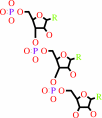 RNA(n)
|
+
|
ribonucleoside 5'-triphosphate
|
=
|
RNA(n+1)
|
+
|
 diphosphate
|
|
|
|
|
|
|
|
|
|
Enzyme class 2:
|
|
E.C.3.4.21.98
- hepacivirin.
|
|
|
|
|
|
|
Reaction:
|
|
Hydrolysis of four peptide bonds in the viral precursor polyprotein, commonly with Asp or Glu in the P6 position, Cys or Thr in P1 and Ser or Ala in P1'.
|
|
|
|
|
|
Enzyme class 3:
|
|
E.C.3.4.22.-
- ?????
|
|
|
|
|
|
|
Enzyme class 4:
|
|
E.C.3.6.1.15
- nucleoside-triphosphate phosphatase.
|
|
|
|
|
|
|
Reaction:
|
|
a ribonucleoside 5'-triphosphate + H2O = a ribonucleoside 5'-diphosphate + phosphate + H+
|
|
|
|
|
|
ribonucleoside 5'-triphosphate
|
+
|
H2O
|
=
|
ribonucleoside 5'-diphosphate
|
+
|
 phosphate
|
+
|
H(+)
|
|
|
|
|
|
|
|
|
|
Enzyme class 5:
|
|
E.C.3.6.4.13
- Rna helicase.
|
|
|
|
|
|
|
Reaction:
|
|
ATP + H2O = ADP + phosphate + H+
|
|
|
|
|
|
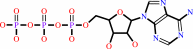 ATP
ATP
|
+
|
H2O
|
=
|
 ADP
ADP
|
+
|
phosphate
|
+
|
H(+)
|
|
|
|
|
|
|
|
|
|
|
|
|
Note, where more than one E.C. class is given (as above), each may
correspond to a different protein domain or, in the case of polyprotein
precursors, to a different mature protein.
|
|
|
|
Molecule diagrams generated from .mol files obtained from the
KEGG ftp site
|
|
|
|
|
|
|
|
|
|
|
|
|
|
 |
|
|
|
|
|
|
| |
|
|
| |
|
DOI no:
|
J Biol Chem
279:40835-40843
(2004)
|
|
PubMed id:
|
|
|
|
|
|
| |
|
Structure and function of the membrane anchor domain of hepatitis C virus nonstructural protein 5A.
|
|
F.Penin,
V.Brass,
N.Appel,
S.Ramboarina,
R.Montserret,
D.Ficheux,
H.E.Blum,
R.Bartenschlager,
D.Moradpour.
|
|
|
|
|
| |
ABSTRACT
|
|
|
|
| |
|
|
Hepatitis C virus (HCV) nonstructural protein 5A (NS5A) is a
membrane-associated, essential component of the viral replication complex. Here,
we report the three-dimensional structure of the membrane anchor domain of NS5A
as determined by NMR spectroscopy. An alpha-helix extending from amino acid
residue 5 to 25 was observed in the presence of different membrane mimetic
media. This helix exhibited a hydrophobic, Trprich side embedded in detergent
micelles, while the polar, charged side was exposed to the solvent. Thus, the
NS5A membrane anchor domain forms an in-plane amphipathic alpha-helix embedded
in the cytosolic leaflet of the membrane bilayer. Interestingly, mutations
affecting the positioning of fully conserved residues located at the cytosolic
surface of the helix impaired HCV RNA replication without interfering with the
membrane association of NS5A. In conclusion, the NS5A membrane anchor domain
constitutes a unique platform that is likely involved in specific interactions
essential for the assembly of the HCV replication complex and that may represent
a novel target for antiviral intervention.
|
|
|
|
|
|
| |
Selected figure(s)
|
|
|
|
| |
|
|

|
|

|
|
Figure 5.
FIG. 5. NS5A membrane anchor mutants. A, amino acid
sequences of NS5A membrane anchor mutants. The amino acid
conservation among different HCV isolates (20) is indicated by
an asterisk (*), a colon (:), and a dot (.) for fully conserved,
conserved, and similar residues, respectively. B and C,
space-filling representation of theoretical helices for mutants
8+A and 11+A. An Ala insertion (shown in magenta) twists the
helix by 110°. The C-terminal side of the helix is shown in
the same orientation as in Fig. 3B to highlight the distortion
of charged residues on the N-terminal side. Residues are colored
as in Fig. 3B. These models were constructed by using the NMR
average structure of NS5A[1-31] observed in 100 mM SDS as
template and SwissPdb Viewer program (www.expasy.ch/swissmod/).
|
|
Figure 8.
FIG. 8. Membrane association of NS5A mutants. Hypotonic
lysates of U-2 OS cells transiently transfected with
pCMVNS5Acon, -8+A, -11+A, and -  5-11 were analyzed by
centrifugation through Nycodenz gradients as described under
"Experimental Procedures." Fractions were collected from the top
and analyzed by immunoblot using mAbs 11H against NS5A and
G1/296 against p63. 5-11 were analyzed by
centrifugation through Nycodenz gradients as described under
"Experimental Procedures." Fractions were collected from the top
and analyzed by immunoblot using mAbs 11H against NS5A and
G1/296 against p63.
|
|
|
|
|
|
| |
The above figures are
reprinted
by permission from the ASBMB:
J Biol Chem
(2004,
279,
40835-40843)
copyright 2004.
|
|
| |
Figures were
selected
by an automated process.
|
|
|
|
|
|
|
|
|
|
|
|
|
|
|
|
 |
 |
 |
|
Literature references that cite this PDB file's key reference
|
|
|
| |
PubMed id
|
|
Reference
|
|
|
|
|
|
D.S.Vieira,
M.V.Alvarado-Mora,
L.Botelho,
F.J.Carrilho,
J.R.Pinho,
and
J.M.Salcedo
(2011).
Distribution of hepatitis c virus (hcv) genotypes in patients with chronic infection from Rondônia, Brazil.
|
| |
Virol J,
8,
165.
|
|
|
|
|
|
|
R.Bartenschlager,
F.Penin,
V.Lohmann,
and
P.André
(2011).
Assembly of infectious hepatitis C virus particles.
|
| |
Trends Microbiol,
19,
95.
|
|
|
|
|
|
|
U.A.Ashfaq,
T.Javed,
S.Rehman,
Z.Nawaz,
and
S.Riazuddin
(2011).
An overview of HCV molecular biology, replication and immune responses.
|
| |
Virol J,
8,
161.
|
|
|
|
|
|
|
H.Zhou,
D.Ferraro,
J.Zhao,
S.Hussain,
J.Shao,
J.Trujillo,
J.Netland,
T.Gallagher,
and
S.Perlman
(2010).
The N-terminal region of severe acute respiratory syndrome coronavirus protein 6 induces membrane rearrangement and enhances virus replication.
|
| |
J Virol,
84,
3542-3551.
|
|
|
|
|
|
|
R.A.Fridell,
D.Qiu,
C.Wang,
L.Valera,
and
M.Gao
(2010).
Resistance analysis of the hepatitis C virus NS5A inhibitor BMS-790052 in an in vitro replicon system.
|
| |
Antimicrob Agents Chemother,
54,
3641-3650.
|
|
|
|
|
|
|
D.Vardanega,
F.Picaud,
and
C.Girardet
(2009).
Enantioselectivity of amino acids using chiral sensors based on nanotubes.
|
| |
J Chem Phys,
130,
114709.
|
|
|
|
|
|
|
G.Brien,
A.L.Debaud,
X.Robert,
L.Oliver,
M.C.Trescol-Biemont,
N.Cauquil,
O.Geneste,
N.Aghajari,
F.M.Vallette,
R.Haser,
and
N.Bonnefoy-Berard
(2009).
C-terminal residues regulate localization and function of the antiapoptotic protein Bfl-1.
|
| |
J Biol Chem,
284,
30257-30263.
|
|
|
|
|
|
|
H.Tang,
and
H.Grisé
(2009).
Cellular and molecular biology of HCV infection and hepatitis.
|
| |
Clin Sci (Lond),
117,
49-65.
|
|
|
|
|
|
|
J.Gouttenoire,
R.Montserret,
A.Kennel,
F.Penin,
and
D.Moradpour
(2009).
An amphipathic alpha-helix at the C terminus of hepatitis C virus nonstructural protein 4B mediates membrane association.
|
| |
J Virol,
83,
11378-11384.
|
|
|
PDB code:
|
|
|
|
|
|
|
|
J.Gouttenoire,
V.Castet,
R.Montserret,
N.Arora,
V.Raussens,
J.M.Ruysschaert,
E.Diesis,
H.E.Blum,
F.Penin,
and
D.Moradpour
(2009).
Identification of a novel determinant for membrane association in hepatitis C virus nonstructural protein 4B.
|
| |
J Virol,
83,
6257-6268.
|
|
|
PDB code:
|
|
|
|
|
|
|
|
M.Kriegs,
T.Bürckstümmer,
K.Himmelsbach,
M.Bruns,
L.Frelin,
G.Ahlén,
M.Sällberg,
and
E.Hildt
(2009).
The hepatitis C virus non-structural NS5A protein impairs both the innate and adaptive hepatic immune response in vivo.
|
| |
J Biol Chem,
284,
28343-28351.
|
|
|
|
|
|
|
M.M.El Hefnawi,
W.H.El Behaidy,
A.A.Youssif,
A.Z.Ghalwash,
L.A.El Housseiny,
and
S.Zada
(2009).
Natural genetic engineering of hepatitis C virus NS5A for immune system counterattack.
|
| |
Ann N Y Acad Sci,
1178,
173-185.
|
|
|
|
|
|
|
R.A.Love,
O.Brodsky,
M.J.Hickey,
P.A.Wells,
and
C.N.Cronin
(2009).
Crystal structure of a novel dimeric form of NS5A domain I protein from hepatitis C virus.
|
| |
J Virol,
83,
4395-4403.
|
|
|
PDB codes:
|
|
|
|
|
|
|
|
V.Meier,
and
G.Ramadori
(2009).
Hepatitis C virus virology and new treatment targets.
|
| |
Expert Rev Anti Infect Ther,
7,
329-350.
|
|
|
|
|
|
|
X.Hanoulle,
A.Badillo,
J.M.Wieruszeski,
D.Verdegem,
I.Landrieu,
R.Bartenschlager,
F.Penin,
and
G.Lippens
(2009).
Hepatitis C virus NS5A protein is a substrate for the peptidyl-prolyl cis/trans isomerase activity of cyclophilins A and B.
|
| |
J Biol Chem,
284,
13589-13601.
|
|
|
|
|
|
|
Y.Bungyoku,
I.Shoji,
T.Makine,
T.Adachi,
K.Hayashida,
M.Nagano-Fujii,
Y.H.Ide,
L.Deng,
and
H.Hotta
(2009).
Efficient production of infectious hepatitis C virus with adaptive mutations in cultured hepatoma cells.
|
| |
J Gen Virol,
90,
1681-1691.
|
|
|
|
|
|
|
A.Kasprzak,
and
A.Adamek
(2008).
Role of hepatitis C virus proteins (C, NS3, NS5A) in hepatic oncogenesis.
|
| |
Hepatol Res,
38,
1.
|
|
|
|
|
|
|
A.M.Paredes,
and
K.J.Blight
(2008).
A genetic interaction between hepatitis C virus NS4B and NS3 is important for RNA replication.
|
| |
J Virol,
82,
10671-10683.
|
|
|
|
|
|
|
G.Cheng,
A.Montero,
P.Gastaminza,
C.Whitten-Bauer,
S.F.Wieland,
M.Isogawa,
B.Fredericksen,
S.Selvarajah,
P.A.Gallay,
M.R.Ghadiri,
and
F.V.Chisari
(2008).
A virocidal amphipathic {alpha}-helical peptide that inhibits hepatitis C virus infection in vitro.
|
| |
Proc Natl Acad Sci U S A,
105,
3088-3093.
|
|
|
|
|
|
|
L.Jaffrelo,
S.Chabas,
S.Reigadas,
A.Pflieger,
C.Wychowski,
J.Rumi,
M.Ventura,
J.J.Toulmé,
and
C.Staedel
(2008).
A functional selection of viral genetic elements in cultured cells to identify hepatitis C virus RNA translation inhibitors.
|
| |
Nucleic Acids Res,
36,
e95.
|
|
|
|
|
|
|
N.Appel,
M.Zayas,
S.Miller,
J.Krijnse-Locker,
T.Schaller,
P.Friebe,
S.Kallis,
U.Engel,
and
R.Bartenschlager
(2008).
Essential role of domain III of nonstructural protein 5A for hepatitis C virus infectious particle assembly.
|
| |
PLoS Pathog,
4,
e1000035.
|
|
|
|
|
|
|
T.L.Tellinghuisen,
K.L.Foss,
J.C.Treadaway,
and
C.M.Rice
(2008).
Identification of residues required for RNA replication in domains II and III of the hepatitis C virus NS5A protein.
|
| |
J Virol,
82,
1073-1083.
|
|
|
|
|
|
|
T.L.Tellinghuisen,
K.L.Foss,
and
J.Treadaway
(2008).
Regulation of hepatitis C virion production via phosphorylation of the NS5A protein.
|
| |
PLoS Pathog,
4,
e1000032.
|
|
|
|
|
|
|
V.Brass,
J.M.Berke,
R.Montserret,
H.E.Blum,
F.Penin,
and
D.Moradpour
(2008).
Structural determinants for membrane association and dynamic organization of the hepatitis C virus NS3-4A complex.
|
| |
Proc Natl Acad Sci U S A,
105,
14545-14550.
|
|
|
|
|
|
|
D.Moradpour,
F.Penin,
and
C.M.Rice
(2007).
Replication of hepatitis C virus.
|
| |
Nat Rev Microbiol,
5,
453-463.
|
|
|
|
|
|
|
J.B.Marq,
A.Brini,
D.Kolakofsky,
and
D.Garcin
(2007).
Targeting of the Sendai virus C protein to the plasma membrane via a peptide-only membrane anchor.
|
| |
J Virol,
81,
3187-3197.
|
|
|
|
|
|
|
J.M.Pawlotsky,
S.Chevaliez,
and
J.G.McHutchison
(2007).
The hepatitis C virus life cycle as a target for new antiviral therapies.
|
| |
Gastroenterology,
132,
1979-1998.
|
|
|
|
|
|
|
N.J.Cho,
K.H.Cheong,
C.Lee,
C.W.Frank,
and
J.S.Glenn
(2007).
Binding dynamics of hepatitis C virus' NS5A amphipathic peptide to cell and model membranes.
|
| |
J Virol,
81,
6682-6689.
|
|
|
|
|
|
|
T.L.Tellinghuisen,
M.J.Evans,
T.von Hahn,
S.You,
and
C.M.Rice
(2007).
Studying hepatitis C virus: making the best of a bad virus.
|
| |
J Virol,
81,
8853-8867.
|
|
|
|
|
|
|
T.Schaller,
N.Appel,
G.Koutsoudakis,
S.Kallis,
V.Lohmann,
T.Pietschmann,
and
R.Bartenschlager
(2007).
Analysis of hepatitis C virus superinfection exclusion by using novel fluorochrome gene-tagged viral genomes.
|
| |
J Virol,
81,
4591-4603.
|
|
|
|
|
|
|
V.Brass,
Z.Pal,
N.Sapay,
G.Deléage,
H.E.Blum,
F.Penin,
and
D.Moradpour
(2007).
Conserved determinants for membrane association of nonstructural protein 5A from hepatitis C virus and related viruses.
|
| |
J Virol,
81,
2745-2757.
|
|
|
|
|
|
|
C.Kuiken,
M.Mizokami,
G.Deleage,
K.Yusim,
F.Penin,
T.Shin-I,
C.Charavay,
N.Tao,
D.Crisan,
D.Grando,
A.Dalwani,
C.Geourjon,
A.Agrawal,
and
C.Combet
(2006).
Hepatitis C databases, principles and utility to researchers.
|
| |
Hepatology,
43,
1157-1165.
|
|
|
|
|
|
|
J.K.Rainey,
L.Fliegel,
and
B.D.Sykes
(2006).
Strategies for dealing with conformational sampling in structural calculations of flexible or kinked transmembrane peptides.
|
| |
Biochem Cell Biol,
84,
918-929.
|
|
|
|
|
|
|
N.Sapay,
Y.Guermeur,
and
G.Deléage
(2006).
Prediction of amphipathic in-plane membrane anchors in monotopic proteins using a SVM classifier.
|
| |
BMC Bioinformatics,
7,
255.
|
|
|
|
|
|
|
T.L.Tellinghuisen,
M.S.Paulson,
and
C.M.Rice
(2006).
The NS5A protein of bovine viral diarrhea virus contains an essential zinc-binding site similar to that of the hepatitis C virus NS5A protein.
|
| |
J Virol,
80,
7450-7458.
|
|
|
|
|
|
|
V.Brass,
D.Moradpour,
and
H.E.Blum
(2006).
Molecular virology of hepatitis C virus (HCV): 2006 update.
|
| |
Int J Med Sci,
3,
29-34.
|
|
|
|
|
|
|
Y.S.Boriskin,
E.I.Pécheur,
and
S.J.Polyak
(2006).
Arbidol: a broad-spectrum antiviral that inhibits acute and chronic HCV infection.
|
| |
Virol J,
3,
56.
|
|
|
|
|
|
|
C.Fetzer,
B.A.Tews,
and
G.Meyers
(2005).
The carboxy-terminal sequence of the pestivirus glycoprotein E(rns) represents an unusual type of membrane anchor.
|
| |
J Virol,
79,
11901-11913.
|
|
|
|
|
|
|
D.Moradpour,
V.Brass,
and
F.Penin
(2005).
Function follows form: the structure of the N-terminal domain of HCV NS5A.
|
| |
Hepatology,
42,
732-735.
|
|
|
|
|
|
|
G.Marceau,
P.Lapierre,
K.Béland,
H.Soudeyns,
and
F.Alvarez
(2005).
LKM1 autoantibodies in chronic hepatitis C infection: a case of molecular mimicry?
|
| |
Hepatology,
42,
675-682.
|
|
|
|
|
|
|
N.Appel,
T.Pietschmann,
and
R.Bartenschlager
(2005).
Mutational analysis of hepatitis C virus nonstructural protein 5A: potential role of differential phosphorylation in RNA replication and identification of a genetically flexible domain.
|
| |
J Virol,
79,
3187-3194.
|
|
|
|
|
|
|
R.Gosert,
W.Jendrsczok,
J.M.Berke,
V.Brass,
H.E.Blum,
and
D.Moradpour
(2005).
Characterization of nonstructural protein membrane anchor deletion mutants expressed in the context of the hepatitis C virus polyprotein.
|
| |
J Virol,
79,
7911-7917.
|
|
|
|
|
|
|
S.Boulant,
C.Vanbelle,
C.Ebel,
F.Penin,
and
J.P.Lavergne
(2005).
Hepatitis C virus core protein is a dimeric alpha-helical protein exhibiting membrane protein features.
|
| |
J Virol,
79,
11353-11365.
|
|
|
|
|
|
|
T.L.Tellinghuisen,
J.Marcotrigiano,
and
C.M.Rice
(2005).
Structure of the zinc-binding domain of an essential component of the hepatitis C virus replicase.
|
| |
Nature,
435,
374-379.
|
|
|
PDB code:
|
|
|
|
|
|
|
The most recent references are shown first.
Citation data come partly from CiteXplore and partly
from an automated harvesting procedure. Note that this is likely to be
only a partial list as not all journals are covered by
either method. However, we are continually building up the citation data
so more and more references will be included with time.
Where a reference describes a PDB structure, the PDB
code is
shown on the right.
|
|


 Links
Links


