 |
PDBsum entry 1kqp

|
|
|
|
|
 |
Contents |
 |
|
|
|
|
|
|
|
|
|
|
|
|
|
|
* Residue conservation analysis
|
|
|
|
|
|
|
|
|
|
|
Enzyme class:
|
|
E.C.6.3.1.5
- NAD(+) synthase.
|
|
|
|
|
|
|
Reaction:
|
|
deamido-NAD+ + NH4+ + ATP = AMP + diphosphate + NAD+ + H+
|
|
|
|
|
|
deamido-NAD(+)
|
+
|
NH4(+)
|
+
|
 ATP
ATP
|
=
|
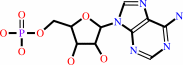 AMP
AMP
|
+
|
diphosphate
Bound ligand (Het Group name = )
corresponds exactly
|
+
|
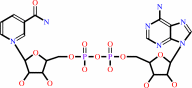 NAD(+)
|
+
|
H(+)
Bound ligand (Het Group name = )
matches with 64.18% similarity
|
|
|
|
|
|
|
|
|
|
|
|
|
Molecule diagrams generated from .mol files obtained from the
KEGG ftp site
|
|
|
|
|
|
|
|
|
|
|
|
|
|
 |
|
|
|
|
|
|
| |
|
|
| |
|
DOI no:
|
Acta Crystallogr D Biol Crystallogr
58:1138-1146
(2002)
|
|
PubMed id:
|
|
|
|
|
|
| |
|
NH3-dependent NAD+ synthetase from Bacillus subtilis at 1 A resolution.
|
|
J.Symersky,
Y.Devedjiev,
K.Moore,
C.Brouillette,
L.DeLucas.
|
|
|
|
|
| |
ABSTRACT
|
|
|
|
| |
|
|
The final step of NAD+ biosynthesis includes an amide transfer to nicotinic acid
adenine dinucleotide (NaAD) catalyzed by NAD+ synthetase. This enzyme was
co-crystallized in microgravity with natural substrates NaAD and ATP at pH 8.5.
The crystal was exposed to ammonium ions, synchrotron diffraction data were
collected and the atomic model was refined anisotropically at 1 A resolution to
R = 11.63%. Both binding sites are occupied by the NAD-adenylate intermediate,
pyrophosphate and two magnesium ions. The atomic resolution of the structure
allows better definition of non-planar peptide groups, reveals a low mean
anisotropy of protein and substrate atoms and indicates the H-atom positions of
the phosphoester group of the reaction intermediate. The phosphoester group is
protonated at the carbonyl O atom O7N, suggesting a carbenium-ion structure
stabilized by interactions with two solvent sites presumably occupied by ammonia
and a water molecule. A mechanism is proposed for the second catalytic step,
which includes a nucleophilic attack by the ammonia molecule on the intermediate.
|
|
|
|
|
|
| |
Selected figure(s)
|
|
|
|
| |
|
|

|
|

|
|
Figure 5.
Figure 5 Spatial relationship between the intermediate
protonated at O7N and cation-binding sites M+(I) and M+(II).
Distances are shown in Å for subunit A. C atoms are in green, N
atoms in blue, O atoms in red, P atoms in magenta and H atoms in
cyan. Hydrophobic residues are all in gray, magnesium ions in
black and the monovalent cation-binding sites M+(I) and M+(II)
are shown as golden spheres. Rendered using RIBBONS (Carson,
1997[Carson, M. (1997). Methods Enzymol. 277, 493-505.]).
|
|
Figure 6.
Figure 6 (a) Stabilization of the protonated intermediate by the
hydrogen bond with ammonia positioned in the cation-binding site
M+(I) and a hypothetical hydrogen bond with water molecule in
the cation-binding site M+(II) releasing the ammonia molecule
for nucleophilic attack. (b) Reaction scheme for the second
catalytic step of NAD^+ synthetase. The NAD-adenylate
intermediate reacts with ammonia to form NAD^+ and AMP and two
protons are released. R[1] represents the ADP-nicotinosyl moiety
and R[2] represents the AMP moiety.
|
|
|
|
|
|
| |
The above figures are
reprinted
by permission from the IUCr:
Acta Crystallogr D Biol Crystallogr
(2002,
58,
1138-1146)
copyright 2002.
|
|
| |
Figures were
selected
by an automated process.
|
|
|
|
|
|
|
|
|
|
|
|
|
|
|
|
 |
 |
 |
|
Literature references that cite this PDB file's key reference
|
|
|
| |
PubMed id
|
|
Reference
|
|
|
|
|
|
D.E.Almonacid,
E.R.Yera,
J.B.Mitchell,
and
P.C.Babbitt
(2010).
Quantitative comparison of catalytic mechanisms and overall reactions in convergently evolved enzymes: implications for classification of enzyme function.
|
| |
PLoS Comput Biol,
6,
e1000700.
|
|
|
|
|
|
|
J.A.Mobley,
and
A.Poliakov
(2009).
Detection of early unfolding events in a dimeric protein by amide proton exchange and native electrospray mass spectrometry.
|
| |
Protein Sci,
18,
1620-1627.
|
|
|
|
|
|
|
N.LaRonde-LeBlanc,
M.Resto,
and
B.Gerratana
(2009).
Regulation of active site coupling in glutamine-dependent NAD(+) synthetase.
|
| |
Nat Struct Mol Biol,
16,
421-429.
|
|
|
PDB code:
|
|
|
|
|
|
|
|
W.B.Moro,
Z.Yang,
T.A.Kane,
C.G.Brouillette,
and
W.J.Brouillette
(2009).
Virtual screening to identify lead inhibitors for bacterial NAD synthetase (NADs).
|
| |
Bioorg Med Chem Lett,
19,
2001-2005.
|
|
|
|
|
|
|
R.Jauch,
A.Humm,
R.Huber,
and
M.C.Wahl
(2005).
Structures of Escherichia coli NAD synthetase with substrates and products reveal mechanistic rearrangements.
|
| |
J Biol Chem,
280,
15131-15140.
|
|
|
PDB codes:
|
|
|
|
|
|
|
|
Z.W.Yang,
S.W.Tendian,
W.M.Carson,
W.J.Brouillette,
L.J.Delucas,
and
C.G.Brouillette
(2004).
Dimethyl sulfoxide at 2.5% (v/v) alters the structural cooperativity and unfolding mechanism of dimeric bacterial NAD+ synthetase.
|
| |
Protein Sci,
13,
830-841.
|
|
|
|
|
|
The most recent references are shown first.
Citation data come partly from CiteXplore and partly
from an automated harvesting procedure. Note that this is likely to be
only a partial list as not all journals are covered by
either method. However, we are continually building up the citation data
so more and more references will be included with time.
Where a reference describes a PDB structure, the PDB
code is
shown on the right.
|
|


 Links
Links


