
|
|
|
|
|
 |
Contents |
 |
|
|
|
|
|
|
|
|
* Residue conservation analysis
|
|
|
|
|
|
|
|
|
|
Enzyme class 1:
|
|
Chains A, B:
E.C.2.3.1.48
- histone acetyltransferase.
|
|
|
|
|
|
|
Reaction:
|
|
L-lysyl-[protein] + acetyl-CoA = N6-acetyl-L-lysyl-[protein] + CoA + H+
|
|
|
|
|
|
L-lysyl-[protein]
|
+
|
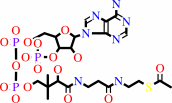 acetyl-CoA
|
=
|
N(6)-acetyl-L-lysyl-[protein]
|
+
|
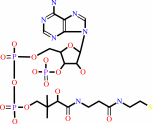 CoA
CoA
|
+
|
H(+)
|
|
|
|
|
|
|
|
|
|
Enzyme class 2:
|
|
Chain B:
E.C.2.3.1.-
- ?????
|
|
|
|
|
|
|
|
|
|
Note, where more than one E.C. class is given (as above), each may
correspond to a different protein domain or, in the case of polyprotein
precursors, to a different mature protein.
|
|
|
|
Molecule diagrams generated from .mol files obtained from the
KEGG ftp site
|
|
|
|
|
|
|
|
|
|
|
|
|
|
 |
|
|
|
|
|
|
| |
|
|
| |
|
DOI no:
|
Nature
415:549-553
(2002)
|
|
PubMed id:
|
|
|
|
|
|
| |
|
Mutual synergistic folding in recruitment of CBP/p300 by p160 nuclear receptor coactivators.
|
|
S.J.Demarest,
M.Martinez-Yamout,
J.Chung,
H.Chen,
W.Xu,
H.J.Dyson,
R.M.Evans,
P.E.Wright.
|
|
|
|
|
| |
ABSTRACT
|
|
|
|
| |
|
|
Nuclear hormone receptors are ligand-activated transcription factors that
regulate the expression of genes that are essential for development,
reproduction and homeostasis. The hormone response is mediated through
recruitment of p160 receptor coactivators and the general transcriptional
coactivator CBP/p300, which function synergistically to activate transcription.
These coactivators exhibit intrinsic histone acetyltransferase activity,
function in the remodelling of chromatin, and facilitate the recruitment of RNA
polymerase II and the basal transcription machinery. The activities of the p160
coactivators are dependent on CBP. Both coactivators are essential for proper
cell-cycle control, differentiation and apoptosis, and are implicated in cancer
and other diseases. To elucidate the molecular basis of assembling the
multiprotein activation complex, we undertook a structural and thermodynamic
analysis of the interaction domains of CBP and the activator for thyroid hormone
and retinoid receptors. Here we show that although the isolated domains are
intrinsically disordered, they combine with high affinity to form a
cooperatively folded helical heterodimer. Our study uncovers a unique mechanism,
called 'synergistic folding', through which p160 coactivators recruit CBP/p300
to allow transmission of the hormonal signal to the transcriptional machinery.
|
|
|
|
|
|
| |
Selected figure(s)
|
|
|
|
| |
|
|

|
|

|
|
Figure 2.
Figure 2: Solution structure of the ACTR -CBP complex. ACTR
is pink and CBP blue in all figures. a, Stereo view showing
best-fit superposition of backbone heavy atoms within the
structured region. Residues at the boundaries of the structured
region are numbered. b, Ribbon representation, in the same
orientation as a. Helices A  1
-3 and C 1
-3, and the polyglutamine (polyQ) stretch in CBP are labelled.
c, Surface representation of CBP domain, showing the hydrophobic
groove formed by C 1
and C 3
that accommodates helix A 1
of ACTR. The orientation is the same as in a and b. Bulky
hydrophobic residues from A 1
embedded within the groove are labelled. d, Surface
representation of CBP domain, rotated to show the hydrophobic
cleft that binds helix A 2
of ACTR. The interactions between A 3
and C 3
are also shown. Bulky hydrophobic residues of ACTR that form the
molecular interface are labelled, as is Asp 1068, which
participates in the buried salt bridge. 1
-3 and C 1
-3, and the polyglutamine (polyQ) stretch in CBP are labelled.
c, Surface representation of CBP domain, showing the hydrophobic
groove formed by C 1
and C 3
that accommodates helix A 1
of ACTR. The orientation is the same as in a and b. Bulky
hydrophobic residues from A 1
embedded within the groove are labelled. d, Surface
representation of CBP domain, rotated to show the hydrophobic
cleft that binds helix A 2
of ACTR. The interactions between A 3
and C 3
are also shown. Bulky hydrophobic residues of ACTR that form the
molecular interface are labelled, as is Asp 1068, which
participates in the buried salt bridge.
|
|
Figure 3.
Figure 3: Conserved interactions in the ACTR -CBP complex. a,
Sequence alignment of the CBP binding domain of human ACTR(1018
-1088) and a representative set of p160 coactivators. b,
Sequence alignment of the ACTR binding domain of murine CBP with
other members of the CBP/p300 family. Conserved hydrophobic
residues (green), conserved acidic residues (red), conserved
basic residues (blue), and other conserved residues (orange) are
indicated (h, human; m, murine, x, Xenopus laevis; d,
Drosophila; dr, Danio rerio; c, Caenorhabditis elegans). c,  -X-X-
-
and
-
-X-X-
hydrophobic
contact map defining the interface between ACTR and CBP ( denotes
hydrophobic residue). The four -X-X-
-
motifs
that comprise the hydrophobic core are enclosed by a green box.
The buried intermolecular salt bridge is indicated. d, Close-up
of the salt bridge between Arg 2105 and Asp 1068 salt bridge.
The solvent-accessible surface of ACTR is shown. -X-X-
-
and
-
-X-X-
hydrophobic
contact map defining the interface between ACTR and CBP ( denotes
hydrophobic residue). The four -X-X-
-
motifs
that comprise the hydrophobic core are enclosed by a green box.
The buried intermolecular salt bridge is indicated. d, Close-up
of the salt bridge between Arg 2105 and Asp 1068 salt bridge.
The solvent-accessible surface of ACTR is shown.
|
|
|
|
|
|
| |
The above figures are
reprinted
by permission from Macmillan Publishers Ltd:
Nature
(2002,
415,
549-553)
copyright 2002.
|
|
| |
Figures were
selected
by the author.
|
|
|
|
|
|
|
|
|
|
|
|
|
|
|
|
 |
 |
 |
|
Literature references that cite this PDB file's key reference
|
|
|
| |
PubMed id
|
|
Reference
|
|
|
|
|
|
D.Ruggiero,
C.Dalmasso,
T.Nutile,
R.Sorice,
L.Dionisi,
M.Aversano,
P.Bröet,
A.L.Leutenegger,
C.Bourgain,
and
M.Ciullo
(2011).
Genetics of VEGF serum variation in human isolated populations of cilento: importance of VEGF polymorphisms.
|
| |
PLoS One,
6,
e16982.
|
|
|
|
|
|
|
M.Kjaergaard,
S.Brander,
and
F.M.Poulsen
(2011).
Random coil chemical shift for intrinsically disordered proteins: effects of temperature and pH.
|
| |
J Biomol NMR,
49,
139-149.
|
|
|
|
|
|
|
A.B.Sigalov
(2010).
Protein intrinsic disorder and oligomericity in cell signaling.
|
| |
Mol Biosyst,
6,
451-461.
|
|
|
|
|
|
|
E.Herbig,
L.Warfield,
L.Fish,
J.Fishburn,
B.A.Knutson,
B.Moorefield,
D.Pacheco,
and
S.Hahn
(2010).
Mechanism of Mediator recruitment by tandem Gcn4 activation domains and three Gal11 activator-binding domains.
|
| |
Mol Cell Biol,
30,
2376-2390.
|
|
|
|
|
|
|
M.Kjaergaard,
A.B.Nørholm,
R.Hendus-Altenburger,
S.F.Pedersen,
F.M.Poulsen,
and
B.B.Kragelund
(2010).
Temperature-dependent structural changes in intrinsically disordered proteins: formation of alpha-helices or loss of polyproline II?
|
| |
Protein Sci,
19,
1555-1564.
|
|
|
|
|
|
|
M.Kjaergaard,
K.Teilum,
and
F.M.Poulsen
(2010).
Conformational selection in the molten globule state of the nuclear coactivator binding domain of CBP.
|
| |
Proc Natl Acad Sci U S A,
107,
12535-12540.
|
|
|
PDB code:
|
|
|
|
|
|
|
|
Z.Dosztányi,
B.Mészáros,
and
I.Simon
(2010).
Bioinformatical approaches to characterize intrinsically disordered/unstructured proteins.
|
| |
Brief Bioinform,
11,
225-243.
|
|
|
|
|
|
|
A.del Sol,
C.J.Tsai,
B.Ma,
and
R.Nussinov
(2009).
The origin of allosteric functional modulation: multiple pre-existing pathways.
|
| |
Structure,
17,
1042-1050.
|
|
|
|
|
|
|
B.Mészáros,
I.Simon,
and
Z.Dosztányi
(2009).
Prediction of protein binding regions in disordered proteins.
|
| |
PLoS Comput Biol,
5,
e1000376.
|
|
|
|
|
|
|
D.S.Libich,
M.Schwalbe,
S.Kate,
H.Venugopal,
J.K.Claridge,
P.J.Edwards,
K.Dutta,
and
S.M.Pascal
(2009).
Intrinsic disorder and coiled-coil formation in prostate apoptosis response factor 4.
|
| |
FEBS J,
276,
3710-3728.
|
|
|
|
|
|
|
J.C.Ferreon,
C.W.Lee,
M.Arai,
M.A.Martinez-Yamout,
H.J.Dyson,
and
P.E.Wright
(2009).
Cooperative regulation of p53 by modulation of ternary complex formation with CBP/p300 and HDM2.
|
| |
Proc Natl Acad Sci U S A,
106,
6591-6596.
|
|
|
|
|
|
|
J.M.Wojciak,
M.A.Martinez-Yamout,
H.J.Dyson,
and
P.E.Wright
(2009).
Structural basis for recruitment of CBP/p300 coactivators by STAT1 and STAT2 transactivation domains.
|
| |
EMBO J,
28,
948-958.
|
|
|
PDB codes:
|
|
|
|
|
|
|
|
P.E.Wright,
and
H.J.Dyson
(2009).
Linking folding and binding.
|
| |
Curr Opin Struct Biol,
19,
31-38.
|
|
|
|
|
|
|
P.Tompa,
M.Fuxreiter,
C.J.Oldfield,
I.Simon,
A.K.Dunker,
and
V.N.Uversky
(2009).
Close encounters of the third kind: disordered domains and the interactions of proteins.
|
| |
Bioessays,
31,
328-335.
|
|
|
|
|
|
|
S.Garapaty,
C.F.Xu,
P.Trojer,
M.A.Mahajan,
T.A.Neubert,
and
H.H.Samuels
(2009).
Identification and Characterization of a Novel Nuclear Protein Complex Involved in Nuclear Hormone Receptor-mediated Gene Regulation.
|
| |
J Biol Chem,
284,
7542-7552.
|
|
|
|
|
|
|
S.H.Bae,
H.J.Dyson,
and
P.E.Wright
(2009).
Prediction of the rotational tumbling time for proteins with disordered segments.
|
| |
J Am Chem Soc,
131,
6814-6821.
|
|
|
|
|
|
|
Y.B.Shi
(2009).
Dual functions of thyroid hormone receptors in vertebrate development: the roles of histone-modifying cofactor complexes.
|
| |
Thyroid,
19,
987-999.
|
|
|
|
|
|
|
Y.Sato,
A.Ding,
R.A.Heimeier,
A.F.Yousef,
J.S.Mymryk,
P.G.Walfish,
and
Y.B.Shi
(2009).
The adenoviral E1A protein displaces corepressors and relieves gene repression by unliganded thyroid hormone receptors in vivo.
|
| |
Cell Res,
19,
783-792.
|
|
|
|
|
|
|
A.Ishizuya-Oka,
and
Y.B.Shi
(2008).
Thyroid hormone regulation of stem cell development during intestinal remodeling.
|
| |
Mol Cell Endocrinol,
288,
71-78.
|
|
|
|
|
|
|
A.Miyagi,
Y.Tsunaka,
T.Uchihashi,
K.Mayanagi,
S.Hirose,
K.Morikawa,
and
T.Ando
(2008).
Visualization of intrinsically disordered regions of proteins by high-speed atomic force microscopy.
|
| |
Chemphyschem,
9,
1859-1866.
|
|
|
|
|
|
|
C.A.Galea,
Y.Wang,
S.G.Sivakolundu,
and
R.W.Kriwacki
(2008).
Regulation of cell division by intrinsically unstructured proteins: intrinsic flexibility, modularity, and signaling conduits.
|
| |
Biochemistry,
47,
7598-7609.
|
|
|
|
|
|
|
D.Datta,
J.M.Scheer,
M.J.Romanowski,
and
J.A.Wells
(2008).
An allosteric circuit in caspase-1.
|
| |
J Mol Biol,
381,
1157-1167.
|
|
|
PDB codes:
|
|
|
|
|
|
|
|
K.Sugase,
M.A.Landes,
P.E.Wright,
and
M.Martinez-Yamout
(2008).
Overexpression of post-translationally modified peptides in Escherichia coli by co-expression with modifying enzymes.
|
| |
Protein Expr Purif,
57,
108-115.
|
|
|
|
|
|
|
M.Fuxreiter,
P.Tompa,
I.Simon,
V.N.Uversky,
J.C.Hansen,
and
F.J.Asturias
(2008).
Malleable machines take shape in eukaryotic transcriptional regulation.
|
| |
Nat Chem Biol,
4,
728-737.
|
|
|
|
|
|
|
M.Lodrini,
T.Münz,
N.Coudevylle,
C.Griesinger,
S.Becker,
and
E.Pfitzner
(2008).
P160/SRC/NCoA coactivators form complexes via specific interaction of their PAS-B domain with the CID/AD1 domain.
|
| |
Nucleic Acids Res,
36,
1847-1860.
|
|
|
|
|
|
|
P.Yi,
Q.Feng,
L.Amazit,
D.M.Lonard,
S.Y.Tsai,
M.J.Tsai,
and
B.W.O'Malley
(2008).
Atypical protein kinase C regulates dual pathways for degradation of the oncogenic coactivator SRC-3/AIB1.
|
| |
Mol Cell,
29,
465-476.
|
|
|
|
|
|
|
S.M.Truhlar,
E.Mathes,
C.F.Cervantes,
G.Ghosh,
and
E.A.Komives
(2008).
Pre-folding IkappaBalpha alters control of NF-kappaB signaling.
|
| |
J Mol Biol,
380,
67-82.
|
|
|
|
|
|
|
B.D.Paul,
D.R.Buchholz,
L.Fu,
and
Y.B.Shi
(2007).
SRC-p300 coactivator complex is required for thyroid hormone-induced amphibian metamorphosis.
|
| |
J Biol Chem,
282,
7472-7481.
|
|
|
|
|
|
|
D.L.Bain,
A.F.Heneghan,
K.D.Connaghan-Jones,
and
M.T.Miura
(2007).
Nuclear receptor structure: implications for function.
|
| |
Annu Rev Physiol,
69,
201-220.
|
|
|
|
|
|
|
K.A.Green,
and
J.S.Carroll
(2007).
Oestrogen-receptor-mediated transcription and the influence of co-factors and chromatin state.
|
| |
Nat Rev Cancer,
7,
713-722.
|
|
|
|
|
|
|
M.V.Karamouzis,
P.A.Konstantinopoulos,
and
A.G.Papavassiliou
(2007).
Roles of CREB-binding protein (CBP)/p300 in respiratory epithelium tumorigenesis.
|
| |
Cell Res,
17,
324-332.
|
|
|
|
|
|
|
N.C.Geething,
and
J.A.Spudich
(2007).
Identification of a minimal myosin Va binding site within an intrinsically unstructured domain of melanophilin.
|
| |
J Biol Chem,
282,
21518-21528.
|
|
|
|
|
|
|
A.E.Kelly,
H.Kranitz,
V.Dötsch,
and
R.D.Mullins
(2006).
Actin binding to the central domain of WASP/Scar proteins plays a critical role in the activation of the Arp2/3 complex.
|
| |
J Biol Chem,
281,
10589-10597.
|
|
|
|
|
|
|
L.Waters,
B.Yue,
V.Veverka,
P.Renshaw,
J.Bramham,
S.Matsuda,
T.Frenkiel,
G.Kelly,
F.Muskett,
M.Carr,
and
D.M.Heery
(2006).
Structural diversity in p160/CREB-binding protein coactivator complexes.
|
| |
J Biol Chem,
281,
14787-14795.
|
|
|
PDB code:
|
|
|
|
|
|
|
|
P.Y.Liu,
T.Y.Hsieh,
W.Y.Chou,
and
S.M.Huang
(2006).
Modulation of glucocorticoid receptor-interacting protein 1 (GRIP1) transactivation and co-activation activities through its C-terminal repression and self-association domains.
|
| |
FEBS J,
273,
2172-2183.
|
|
|
|
|
|
|
Q.Feng,
P.Yi,
J.Wong,
and
B.W.O'Malley
(2006).
Signaling within a coactivator complex: methylation of SRC-3/AIB1 is a molecular switch for complex disassembly.
|
| |
Mol Cell Biol,
26,
7846-7857.
|
|
|
|
|
|
|
R.Métivier,
G.Reid,
and
F.Gannon
(2006).
Transcription in four dimensions: nuclear receptor-directed initiation of gene expression.
|
| |
EMBO Rep,
7,
161-167.
|
|
|
|
|
|
|
S.R.Loftus,
D.Walker,
M.J.Maté,
D.A.Bonsor,
R.James,
G.R.Moore,
and
C.Kleanthous
(2006).
Competitive recruitment of the periplasmic translocation portal TolB by a natively disordered domain of colicin E9.
|
| |
Proc Natl Acad Sci U S A,
103,
12353-12358.
|
|
|
PDB code:
|
|
|
|
|
|
|
|
V.Receveur-Bréchot,
J.M.Bourhis,
V.N.Uversky,
B.Canard,
and
S.Longhi
(2006).
Assessing protein disorder and induced folding.
|
| |
Proteins,
62,
24-45.
|
|
|
|
|
|
|
Y.Nominé,
M.Masson,
S.Charbonnier,
K.Zanier,
T.Ristriani,
F.Deryckère,
A.P.Sibler,
D.Desplancq,
R.A.Atkinson,
E.Weiss,
G.Orfanoudakis,
B.Kieffer,
and
G.Travé
(2006).
Structural and functional analysis of E6 oncoprotein: insights in the molecular pathways of human papillomavirus-mediated pathogenesis.
|
| |
Mol Cell,
21,
665-678.
|
|
|
PDB code:
|
|
|
|
|
|
|
|
B.D.Paul,
D.R.Buchholz,
L.Fu,
and
Y.B.Shi
(2005).
Tissue- and gene-specific recruitment of steroid receptor coactivator-3 by thyroid hormone receptor during development.
|
| |
J Biol Chem,
280,
27165-27172.
|
|
|
|
|
|
|
B.Y.Qin,
C.Liu,
H.Srinath,
S.S.Lam,
J.J.Correia,
R.Derynck,
and
K.Lin
(2005).
Crystal structure of IRF-3 in complex with CBP.
|
| |
Structure,
13,
1269-1277.
|
|
|
|
|
|
|
C.Rochette-Egly
(2005).
Dynamic combinatorial networks in nuclear receptor-mediated transcription.
|
| |
J Biol Chem,
280,
32565-32568.
|
|
|
|
|
|
|
H.J.Dyson,
and
P.E.Wright
(2005).
Intrinsically unstructured proteins and their functions.
|
| |
Nat Rev Mol Cell Biol,
6,
197-208.
|
|
|
|
|
|
|
K.B.Kindle,
P.J.Troke,
H.M.Collins,
S.Matsuda,
D.Bossi,
C.Bellodi,
E.Kalkhoven,
P.Salomoni,
P.G.Pelicci,
S.Minucci,
and
D.M.Heery
(2005).
MOZ-TIF2 inhibits transcription by nuclear receptors and p53 by impairment of CBP function.
|
| |
Mol Cell Biol,
25,
988.
|
|
|
|
|
|
|
W.Xu
(2005).
Nuclear receptor coactivators: the key to unlock chromatin.
|
| |
Biochem Cell Biol,
83,
418-428.
|
|
|
|
|
|
|
Y.H.Lee,
S.A.Coonrod,
W.L.Kraus,
M.A.Jelinek,
and
M.R.Stallcup
(2005).
Regulation of coactivator complex assembly and function by protein arginine methylation and demethylimination.
|
| |
Proc Natl Acad Sci U S A,
102,
3611-3616.
|
|
|
|
|
|
|
H.Hong,
C.Kao,
M.H.Jeng,
J.N.Eble,
M.O.Koch,
T.A.Gardner,
S.Zhang,
L.Li,
C.X.Pan,
Z.Hu,
G.T.MacLennan,
and
L.Cheng
(2004).
Aberrant expression of CARM1, a transcriptional coactivator of androgen receptor, in the development of prostate carcinoma and androgen-independent status.
|
| |
Cancer,
101,
83-89.
|
|
|
|
|
|
|
J.F.Mouillet,
C.Sonnenberg-Hirche,
X.Yan,
and
Y.Sadovsky
(2004).
p300 regulates the synergy of steroidogenic factor-1 and early growth response-1 in activating luteinizing hormone-beta subunit gene.
|
| |
J Biol Chem,
279,
7832-7839.
|
|
|
|
|
|
|
M.J.Wood,
G.Storz,
and
N.Tjandra
(2004).
Structural basis for redox regulation of Yap1 transcription factor localization.
|
| |
Nature,
430,
917-921.
|
|
|
PDB code:
|
|
|
|
|
|
|
|
R.N.De Guzman,
M.A.Martinez-Yamout,
H.J.Dyson,
and
P.E.Wright
(2004).
Interaction of the TAZ1 domain of the CREB-binding protein with the activation domain of CITED2: regulation by competition between intrinsically unstructured ligands for non-identical binding sites.
|
| |
J Biol Chem,
279,
3042-3049.
|
|
|
PDB code:
|
|
|
|
|
|
|
|
S.J.Demarest,
S.Deechongkit,
H.J.Dyson,
R.M.Evans,
and
P.E.Wright
(2004).
Packing, specificity, and mutability at the binding interface between the p160 coactivator and CREB-binding protein.
|
| |
Protein Sci,
13,
203-210.
|
|
|
|
|
|
|
S.Matsuda,
J.C.Harries,
M.Viskaduraki,
P.J.Troke,
K.B.Kindle,
C.Ryan,
and
D.M.Heery
(2004).
A Conserved alpha-helical motif mediates the binding of diverse nuclear proteins to the SRC1 interaction domain of CBP.
|
| |
J Biol Chem,
279,
14055-14064.
|
|
|
|
|
|
|
B.D.Nguyen,
K.L.Abbott,
K.Potempa,
M.S.Kobor,
J.Archambault,
J.Greenblatt,
P.Legault,
and
J.G.Omichinski
(2003).
NMR structure of a complex containing the TFIIF subunit RAP74 and the RNA polymerase II carboxyl-terminal domain phosphatase FCP1.
|
| |
Proc Natl Acad Sci U S A,
100,
5688-5693.
|
|
|
PDB code:
|
|
|
|
|
|
|
|
B.Zagrovic,
and
V.S.Pande
(2003).
Structural correspondence between the alpha-helix and the random-flight chain resolves how unfolded proteins can have native-like properties.
|
| |
Nat Struct Biol,
10,
955-961.
|
|
|
|
|
|
|
H.Wang,
and
S.Chong
(2003).
Visualization of coupled protein folding and binding in bacteria and purification of the heterodimeric complex.
|
| |
Proc Natl Acad Sci U S A,
100,
478-483.
|
|
|
|
|
|
|
K.Brown,
Y.Chen,
T.M.Underhill,
J.S.Mymryk,
and
J.Torchia
(2003).
The coactivator p/CIP/SRC-3 facilitates retinoic acid receptor signaling via recruitment of GCN5.
|
| |
J Biol Chem,
278,
39402-39412.
|
|
|
|
|
|
|
K.Deguchi,
P.M.Ayton,
M.Carapeti,
J.L.Kutok,
C.S.Snyder,
I.R.Williams,
N.C.Cross,
C.K.Glass,
M.L.Cleary,
and
D.G.Gilliland
(2003).
MOZ-TIF2-induced acute myeloid leukemia requires the MOZ nucleosome binding motif and TIF2-mediated recruitment of CBP.
|
| |
Cancer Cell,
3,
259-271.
|
|
|
|
|
|
|
K.Takahasi,
N.N.Suzuki,
M.Horiuchi,
M.Mori,
W.Suhara,
Y.Okabe,
Y.Fukuhara,
H.Terasawa,
S.Akira,
T.Fujita,
and
F.Inagaki
(2003).
X-ray crystal structure of IRF-3 and its functional implications.
|
| |
Nat Struct Biol,
10,
922-927.
|
|
|
PDB code:
|
|
|
|
|
|
|
|
M.Albrecht,
D.Hoffmann,
B.O.Evert,
I.Schmitt,
U.Wüllner,
and
T.Lengauer
(2003).
Structural modeling of ataxin-3 reveals distant homology to adaptins.
|
| |
Proteins,
50,
355-370.
|
|
|
|
|
|
|
R.J.Simpson,
E.D.Cram,
R.Czolij,
J.M.Matthews,
M.Crossley,
and
J.P.Mackay
(2003).
CCHX zinc finger derivatives retain the ability to bind Zn(II) and mediate protein-DNA interactions.
|
| |
J Biol Chem,
278,
28011-28018.
|
|
|
PDB code:
|
|
|
|
|
|
|
|
R.Linding,
L.J.Jensen,
F.Diella,
P.Bork,
T.J.Gibson,
and
R.B.Russell
(2003).
Protein disorder prediction: implications for structural proteomics.
|
| |
Structure,
11,
1453-1459.
|
|
|
|
|
|
|
R.Linding,
R.B.Russell,
V.Neduva,
and
T.J.Gibson
(2003).
GlobPlot: Exploring protein sequences for globularity and disorder.
|
| |
Nucleic Acids Res,
31,
3701-3708.
|
|
|
|
|
|
|
R.Métivier,
G.Penot,
M.R.Hübner,
G.Reid,
H.Brand,
M.Kos,
and
F.Gannon
(2003).
Estrogen receptor-alpha directs ordered, cyclical, and combinatorial recruitment of cofactors on a natural target promoter.
|
| |
Cell,
115,
751-763.
|
|
|
|
|
|
|
S.Bhattacharya,
and
P.J.Ratcliffe
(2003).
ExCITED about HIF.
|
| |
Nat Struct Biol,
10,
501-503.
|
|
|
|
|
|
|
Y.Liang,
F.Du,
S.Sanglier,
B.R.Zhou,
Y.Xia,
A.Van Dorsselaer,
C.Maechling,
M.C.Kilhoffer,
and
J.Haiech
(2003).
Unfolding of rabbit muscle creatine kinase induced by acid. A study using electrospray ionization mass spectrometry, isothermal titration calorimetry, and fluorescence spectroscopy.
|
| |
J Biol Chem,
278,
30098-30105.
|
|
|
|
|
|
|
Z.Q.Huang,
J.Li,
L.M.Sachs,
P.A.Cole,
and
J.Wong
(2003).
A role for cofactor-cofactor and cofactor-histone interactions in targeting p300, SWI/SNF and Mediator for transcription.
|
| |
EMBO J,
22,
2146-2155.
|
|
|
|
|
|
|
D.Burakov,
L.A.Crofts,
C.P.Chang,
and
L.P.Freedman
(2002).
Reciprocal recruitment of DRIP/mediator and p160 coactivator complexes in vivo by estrogen receptor.
|
| |
J Biol Chem,
277,
14359-14362.
|
|
|
|
|
|
|
F.Picard,
M.Géhin,
J.Annicotte,
S.Rocchi,
M.F.Champy,
B.W.O'Malley,
P.Chambon,
and
J.Auwerx
(2002).
SRC-1 and TIF2 control energy balance between white and brown adipose tissues.
|
| |
Cell,
111,
931-941.
|
|
|
|
|
|
|
J.R.Tata
(2002).
Signalling through nuclear receptors.
|
| |
Nat Rev Mol Cell Biol,
3,
702-710.
|
|
|
|
|
|
|
K.P.Hoeflich,
and
M.Ikura
(2002).
Calmodulin in action: diversity in target recognition and activation mechanisms.
|
| |
Cell,
108,
739-742.
|
|
|
|
|
|
|
M.M.Dedmon,
C.N.Patel,
G.B.Young,
and
G.J.Pielak
(2002).
FlgM gains structure in living cells.
|
| |
Proc Natl Acad Sci U S A,
99,
12681-12684.
|
|
|
|
|
|
|
M.S.Qutob,
R.N.Bhattacharjee,
E.Pollari,
S.P.Yee,
and
J.Torchia
(2002).
Microtubule-dependent subcellular redistribution of the transcriptional coactivator p/CIP.
|
| |
Mol Cell Biol,
22,
6611-6626.
|
|
|
|
|
|
|
N.K.Goto,
T.Zor,
M.Martinez-Yamout,
H.J.Dyson,
and
P.E.Wright
(2002).
Cooperativity in transcription factor binding to the coactivator CREB-binding protein (CBP). The mixed lineage leukemia protein (MLL) activation domain binds to an allosteric site on the KIX domain.
|
| |
J Biol Chem,
277,
43168-43174.
|
|
|
|
|
|
|
P.Tompa
(2002).
Intrinsically unstructured proteins.
|
| |
Trends Biochem Sci,
27,
527-533.
|
|
|
|
|
|
|
S.A.Dames,
M.Martinez-Yamout,
R.N.De Guzman,
H.J.Dyson,
and
P.E.Wright
(2002).
Structural basis for Hif-1 alpha /CBP recognition in the cellular hypoxic response.
|
| |
Proc Natl Acad Sci U S A,
99,
5271-5276.
|
|
|
PDB code:
|
|
|
|
|
|
|
|
S.J.Freedman,
Z.Y.Sun,
F.Poy,
A.L.Kung,
D.M.Livingston,
G.Wagner,
and
M.J.Eck
(2002).
Structural basis for recruitment of CBP/p300 by hypoxia-inducible factor-1 alpha.
|
| |
Proc Natl Acad Sci U S A,
99,
5367-5372.
|
|
|
PDB code:
|
|
|
|
|
|
|
|
T.Kino,
A.Gragerov,
O.Slobodskaya,
M.Tsopanomichalou,
G.P.Chrousos,
and
G.N.Pavlakis
(2002).
Human immunodeficiency virus type 1 (HIV-1) accessory protein Vpr induces transcription of the HIV-1 and glucocorticoid-responsive promoters by binding directly to p300/CBP coactivators.
|
| |
J Virol,
76,
9724-9734.
|
|
|
|
|
|
The most recent references are shown first.
Citation data come partly from CiteXplore and partly
from an automated harvesting procedure. Note that this is likely to be
only a partial list as not all journals are covered by
either method. However, we are continually building up the citation data
so more and more references will be included with time.
Where a reference describes a PDB structure, the PDB
code is
shown on the right.
|
 |


 Links
Links


