
|
|
|
|
|
 |
Contents |
 |
|
|
|
|
|
|
|
|
|
|
* Residue conservation analysis
|
|
|
|
|
|
PDB id:
|
|
|
|
| Name: |
|
Gene regulation
|
|
|
Title:
|
|
Structural basis for hif-1alpha/cbp recognition in the cellular hypoxic response
|
|
Structure:
|
|
Creb-binding protein. Chain: a. Fragment: taz1 (transcription activation zinc finger) domain, residues 345-439. Engineered: yes. Hypoxia-inducible factor 1 alpha. Chain: b. Fragment: ctad (c-terminal activation) domain, residues 776-826. Synonym: hif-1 alpha, arnt interacting protein, member of pas protein
|
|
Source:
|
|
Mus musculus. House mouse. Organism_taxid: 10090. Expressed in: escherichia coli. Expression_system_taxid: 562. Homo sapiens. Human. Organism_taxid: 9606. Expression_system_taxid: 562
|
|
NMR struc:
|
|
20 models
|
|
|
Authors:
|
|
S.A.Dames,M.Martinez-Yamout,R.N.De Guzman,H.J.Dyson,P.E.Wright
|
Key ref:

|
|
S.A.Dames
et al.
(2002).
Structural basis for Hif-1 alpha /CBP recognition in the cellular hypoxic response.
Proc Natl Acad Sci U S A,
99,
5271-5276.
PubMed id:
DOI:

|
|
|
Date:
|
|
|
19-Mar-02
|
Release date:
|
10-Apr-02
|
|
|
|
|
|
|
PROCHECK
|

|
|
|
|
|
Headers
|
|
|
|
References
|
|
|
|
|
|
|
|
|
|
|
|
Enzyme class 1:
|
|
Chain A:
E.C.2.3.1.-
- ?????
|
|
|
|
|
|
|
Enzyme class 2:
|
|
Chain A:
E.C.2.3.1.48
- histone acetyltransferase.
|
|
|
|
|
|
|
Reaction:
|
|
L-lysyl-[protein] + acetyl-CoA = N6-acetyl-L-lysyl-[protein] + CoA + H+
|
|
|
|
|
|
L-lysyl-[protein]
|
+
|
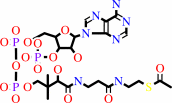 acetyl-CoA
|
=
|
N(6)-acetyl-L-lysyl-[protein]
|
+
|
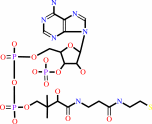 CoA
CoA
|
+
|
H(+)
|
|
|
|
|
|
|
|
|
|
Enzyme class 3:
|
|
Chain B:
E.C.?
|
|
|
|
|
|
|
|
|
|
Note, where more than one E.C. class is given (as above), each may
correspond to a different protein domain or, in the case of polyprotein
precursors, to a different mature protein.
|
|
|
|
Molecule diagrams generated from .mol files obtained from the
KEGG ftp site
|
|
|
|
|
|
|
|
|
|
|
|
|
|
 |
|
|
|
|
|
|
| |
|
|
| |
|
DOI no:
|
Proc Natl Acad Sci U S A
99:5271-5276
(2002)
|
|
PubMed id:
|
|
|
|
|
|
| |
|
Structural basis for Hif-1 alpha /CBP recognition in the cellular hypoxic response.
|
|
S.A.Dames,
M.Martinez-Yamout,
R.N.De Guzman,
H.J.Dyson,
P.E.Wright.
|
|
|
|
|
| |
ABSTRACT
|
|
|
|
| |
|
|
The cellular response to low tissue oxygen concentrations is mediated by the
hypoxia-inducible transcription factor HIF-1. Under hypoxic conditions, HIF-1
activates transcription of critical adaptive genes by recruitment of the general
coactivators CBP/p300 through interactions with its alpha-subunit (Hif-1 alpha).
Disruption of the Hif-1 alpha/p300 interaction has been linked to attenuation of
tumor growth. To delineate the structural basis for this interaction, we have
determined the solution structure of the complex between the carboxy-terminal
activation domain (CAD) of Hif-1 alpha and the zinc-binding TAZ1 (CH1) motif of
cyclic-AMP response element binding protein (CREB) binding protein (CBP).
Despite the overall similarity of the TAZ1 structure to that of the TAZ2 (part
of the CH3) domain of CBP, differences occur in the packing of helices that can
account for differences in specificity. The unbound CAD is intrinsically
disordered and remains relatively extended upon binding, wrapping almost
entirely around the TAZ1 domain in a groove through much of its surface. Three
short helices are formed upon binding, stabilized by intermolecular
interactions. The Asn-803 side chain, which functions as a hypoxic switch, is
located on the second of these helices and is buried in the molecular interface.
The third helix of the Hif-1 alpha CAD docks in a deep hydrophobic groove in
TAZ1, providing extensive intermolecular hydrophobic interactions that
contribute to the stability of the complex. The structure of this complex
provides new insights into the mechanism through which Hif-1 alpha recruits
CBP/p300 in response to hypoxia.
|
|
|
|
|
|
| |
Selected figure(s)
|
|
|
|
| |
|
|

|
|

|
|
Figure 1.
Fig. 1. 1H-15N heteronuclear single quantum coherence
spectra (600 MHz) of Hif-1  (776-826)
free (red) and bound to unlabeled TAZ1 (black). (776-826)
free (red) and bound to unlabeled TAZ1 (black).
|
|
Figure 2.
Fig. 2. NMR structure of the Hif-1 :TAZ1
complex. (A) Stereo view of the best 20 structures superposed on
backbone heavy atoms in ordered regions. The TAZ1 backbone is
shown in blue, Hif-1 in pink,
and the N and C termini of each chain are labeled in the
corresponding colors. Bound zinc ions are shown as yellow
spheres. (B) Ribbon representation of a single structure in a
similar orientation to A. Helices [1]- [4] of TAZ1
and [A]- [C] of the
Hif-1 CAD are
labeled. The zinc ions are represented as white spheres, and the
side chains of the cysteine and histidine ligands are shown in
yellow and blue, respectively.
|
|
|
|
| |
Figures were
selected
by an automated process.
|
|
|
|
|
|
|
|
|
|
|
|
|
|
|
|
 |
 |
 |
|
Literature references that cite this PDB file's key reference
|
|
|
| |
PubMed id
|
|
Reference
|
|
|
|
|
|
S.Kushal,
H.Wang,
C.F.László,
L.Z.Szábo,
and
B.Z.Olenyuk
(2011).
Inhibition of hypoxia-inducible transcription factor complex with designed epipolythiodiketopiperazine.
|
| |
Biopolymers,
95,
8.
|
|
|
|
|
|
|
Y.M.Tian,
K.K.Yeoh,
M.K.Lee,
T.Eriksson,
B.M.Kessler,
H.B.Kramer,
M.J.Edelmann,
C.Willam,
C.W.Pugh,
C.J.Schofield,
and
P.J.Ratcliffe
(2011).
Differential sensitivity of hypoxia inducible factor hydroxylation sites to hypoxia and hydroxylase inhibitors.
|
| |
J Biol Chem,
286,
13041-13051.
|
|
|
|
|
|
|
B.Xue,
R.L.Dunbrack,
R.W.Williams,
A.K.Dunker,
and
V.N.Uversky
(2010).
PONDR-FIT: a meta-predictor of intrinsically disordered amino acids.
|
| |
Biochim Biophys Acta,
1804,
996.
|
|
|
|
|
|
|
J.L.Ruas,
U.Berchner-Pfannschmidt,
S.Malik,
K.Gradin,
J.Fandrey,
R.G.Roeder,
T.Pereira,
and
L.Poellinger
(2010).
Complex regulation of the transactivation function of hypoxia-inducible factor-1 alpha by direct interaction with two distinct domains of the CREB-binding protein/p300.
|
| |
J Biol Chem,
285,
2601-2609.
|
|
|
|
|
|
|
K.G.Pringle,
K.L.Kind,
A.N.Sferruzzi-Perri,
J.G.Thompson,
and
C.T.Roberts
(2010).
Beyond oxygen: complex regulation and activity of hypoxia inducible factors in pregnancy.
|
| |
Hum Reprod Update,
16,
415-431.
|
|
|
|
|
|
|
L.K.Henchey,
J.R.Porter,
I.Ghosh,
and
P.S.Arora
(2010).
High specificity in protein recognition by hydrogen-bond-surrogate α-helices: selective inhibition of the p53/MDM2 complex.
|
| |
Chembiochem,
11,
2104-2107.
|
|
|
|
|
|
|
L.K.Henchey,
S.Kushal,
R.Dubey,
R.N.Chapman,
B.Z.Olenyuk,
and
P.S.Arora
(2010).
Inhibition of hypoxia inducible factor 1-transcription coactivator interaction by a hydrogen bond surrogate alpha-helix.
|
| |
J Am Chem Soc,
132,
941-943.
|
|
|
|
|
|
|
M.Kjaergaard,
K.Teilum,
and
F.M.Poulsen
(2010).
Conformational selection in the molten globule state of the nuclear coactivator binding domain of CBP.
|
| |
Proc Natl Acad Sci U S A,
107,
12535-12540.
|
|
|
PDB code:
|
|
|
|
|
|
|
|
M.L.Nelson,
H.S.Kang,
G.M.Lee,
A.G.Blaszczak,
D.K.Lau,
L.P.McIntosh,
and
B.J.Graves
(2010).
Ras signaling requires dynamic properties of Ets1 for phosphorylation-enhanced binding to coactivator CBP.
|
| |
Proc Natl Acad Sci U S A,
107,
10026-10031.
|
|
|
PDB code:
|
|
|
|
|
|
|
|
Y.Guan,
K.R.Reddy,
Q.Zhu,
Y.Li,
K.Lee,
P.Weerasinghe,
J.Prchal,
G.L.Semenza,
and
N.Jing
(2010).
G-rich oligonucleotides inhibit HIF-1alpha and HIF-2alpha and block tumor growth.
|
| |
Mol Ther,
18,
188-197.
|
|
|
|
|
|
|
D.Eliezer
(2009).
Biophysical characterization of intrinsically disordered proteins.
|
| |
Curr Opin Struct Biol,
19,
23-30.
|
|
|
|
|
|
|
D.F.Estrada,
D.M.Boudreaux,
D.Zhong,
S.C.St Jeor,
and
R.N.De Guzman
(2009).
The Hantavirus Glycoprotein G1 Tail Contains Dual CCHC-type Classical Zinc Fingers.
|
| |
J Biol Chem,
284,
8654-8660.
|
|
|
PDB code:
|
|
|
|
|
|
|
|
J.C.Ferreon,
C.W.Lee,
M.Arai,
M.A.Martinez-Yamout,
H.J.Dyson,
and
P.E.Wright
(2009).
Cooperative regulation of p53 by modulation of ternary complex formation with CBP/p300 and HDM2.
|
| |
Proc Natl Acad Sci U S A,
106,
6591-6596.
|
|
|
|
|
|
|
J.M.Wojciak,
M.A.Martinez-Yamout,
H.J.Dyson,
and
P.E.Wright
(2009).
Structural basis for recruitment of CBP/p300 coactivators by STAT1 and STAT2 transactivation domains.
|
| |
EMBO J,
28,
948-958.
|
|
|
PDB codes:
|
|
|
|
|
|
|
|
K.M.Block,
H.Wang,
L.Z.Szabó,
N.W.Polaske,
L.K.Henchey,
R.Dubey,
S.Kushal,
C.F.László,
J.Makhoul,
Z.Song,
E.J.Meuillet,
and
B.Z.Olenyuk
(2009).
Direct inhibition of hypoxia-inducible transcription factor complex with designed dimeric epidithiodiketopiperazine.
|
| |
J Am Chem Soc,
131,
18078-18088.
|
|
|
|
|
|
|
K.M.Cook,
S.T.Hilton,
J.Mecinovic,
W.B.Motherwell,
W.D.Figg,
and
C.J.Schofield
(2009).
Epidithiodiketopiperazines block the interaction between hypoxia-inducible factor-1alpha (HIF-1alpha) and p300 by a zinc ejection mechanism.
|
| |
J Biol Chem,
284,
26831-26838.
|
|
|
|
|
|
|
L.Kelly,
M.A.McDonough,
M.L.Coleman,
P.J.Ratcliffe,
and
C.J.Schofield
(2009).
Asparagine beta-hydroxylation stabilizes the ankyrin repeat domain fold.
|
| |
Mol Biosyst,
5,
52-58.
|
|
|
PDB codes:
|
|
|
|
|
|
|
|
M.E.Cockman,
J.D.Webb,
and
P.J.Ratcliffe
(2009).
FIH-dependent asparaginyl hydroxylation of ankyrin repeat domain-containing proteins.
|
| |
Ann N Y Acad Sci,
1177,
9.
|
|
|
|
|
|
|
S.E.Wilkins,
J.Hyvärinen,
J.Chicher,
J.J.Gorman,
D.J.Peet,
R.L.Bilton,
and
P.Koivunen
(2009).
Differences in hydroxylation and binding of Notch and HIF-1alpha demonstrate substrate selectivity for factor inhibiting HIF-1 (FIH-1).
|
| |
Int J Biochem Cell Biol,
41,
1563-1571.
|
|
|
|
|
|
|
S.Fukuchi,
K.Homma,
Y.Minezaki,
T.Gojobori,
and
K.Nishikawa
(2009).
Development of an accurate classification system of proteins into structured and unstructured regions that uncovers novel structural domains: its application to human transcription factors.
|
| |
BMC Struct Biol,
9,
26.
|
|
|
|
|
|
|
W.Feng,
F.Ye,
W.Xue,
Z.Zhou,
and
Y.J.Kang
(2009).
Copper regulation of hypoxia-inducible factor-1 activity.
|
| |
Mol Pharmacol,
75,
174-182.
|
|
|
|
|
|
|
Z.K.Otrock,
H.A.Hatoum,
A.H.Awada,
R.S.Ishak,
and
A.I.Shamseddine
(2009).
Hypoxia-inducible factor in cancer angiogenesis: structure, regulation and clinical perspectives.
|
| |
Crit Rev Oncol Hematol,
70,
93.
|
|
|
|
|
|
|
A.G.Turjanski,
J.S.Gutkind,
R.B.Best,
and
G.Hummer
(2008).
Binding-induced folding of a natively unstructured transcription factor.
|
| |
PLoS Comput Biol,
4,
e1000060.
|
|
|
|
|
|
|
A.J.Filiano,
C.D.Bailey,
J.Tucholski,
S.Gundemir,
and
G.V.Johnson
(2008).
Transglutaminase 2 protects against ischemic insult, interacts with HIF1beta, and attenuates HIF1 signaling.
|
| |
FASEB J,
22,
2662-2675.
|
|
|
|
|
|
|
H.S.Kang,
M.L.Nelson,
C.D.Mackereth,
M.Schärpf,
B.J.Graves,
and
L.P.McIntosh
(2008).
Identification and structural characterization of a CBP/p300-binding domain from the ETS family transcription factor GABP alpha.
|
| |
J Mol Biol,
377,
636-646.
|
|
|
PDB code:
|
|
|
|
|
|
|
|
K.Lisy,
and
D.J.Peet
(2008).
Turn me on: regulating HIF transcriptional activity.
|
| |
Cell Death Differ,
15,
642-649.
|
|
|
|
|
|
|
K.Sugase,
M.A.Landes,
P.E.Wright,
and
M.Martinez-Yamout
(2008).
Overexpression of post-translationally modified peptides in Escherichia coli by co-expression with modifying enzymes.
|
| |
Protein Expr Purif,
57,
108-115.
|
|
|
|
|
|
|
M.Fuxreiter,
P.Tompa,
I.Simon,
V.N.Uversky,
J.C.Hansen,
and
F.J.Asturias
(2008).
Malleable machines take shape in eukaryotic transcriptional regulation.
|
| |
Nat Chem Biol,
4,
728-737.
|
|
|
|
|
|
|
R.Chowdhury,
A.Hardy,
and
C.J.Schofield
(2008).
The human oxygen sensing machinery and its manipulation.
|
| |
Chem Soc Rev,
37,
1308-1319.
|
|
|
|
|
|
|
T.Klimova,
and
N.S.Chandel
(2008).
Mitochondrial complex III regulates hypoxic activation of HIF.
|
| |
Cell Death Differ,
15,
660-666.
|
|
|
|
|
|
|
Y.H.Chen,
L.M.Comeaux,
S.J.Eyles,
and
M.J.Knapp
(2008).
Auto-hydroxylation of FIH-1: an Fe(ii), alpha-ketoglutarate-dependent human hypoxia sensor.
|
| |
Chem Commun (Camb),
(),
4768-4770.
|
|
|
|
|
|
|
Y.Li,
T.Kimura,
R.W.Huyck,
J.H.Laity,
and
G.K.Andrews
(2008).
Zinc-induced formation of a coactivator complex containing the zinc-sensing transcription factor MTF-1, p300/CBP, and Sp1.
|
| |
Mol Cell Biol,
28,
4275-4284.
|
|
|
|
|
|
|
Y.Wang,
D.M.Boudreaux,
D.F.Estrada,
C.W.Egan,
S.C.St Jeor,
and
R.N.De Guzman
(2008).
NMR structure of the N-terminal coiled coil domain of the Andes hantavirus nucleocapsid protein.
|
| |
J Biol Chem,
283,
28297-28304.
|
|
|
PDB code:
|
|
|
|
|
|
|
|
A.Ozer,
and
R.K.Bruick
(2007).
Non-heme dioxygenases: cellular sensors and regulators jelly rolled into one?
|
| |
Nat Chem Biol,
3,
144-153.
|
|
|
|
|
|
|
D.P.Teufel,
S.M.Freund,
M.Bycroft,
and
A.R.Fersht
(2007).
Four domains of p300 each bind tightly to a sequence spanning both transactivation subdomains of p53.
|
| |
Proc Natl Acad Sci U S A,
104,
7009-7014.
|
|
|
|
|
|
|
E.L.Bell,
T.A.Klimova,
J.Eisenbart,
C.T.Moraes,
M.P.Murphy,
G.R.Budinger,
and
N.S.Chandel
(2007).
The Qo site of the mitochondrial complex III is required for the transduction of hypoxic signaling via reactive oxygen species production.
|
| |
J Cell Biol,
177,
1029-1036.
|
|
|
|
|
|
|
K.Sugase,
J.C.Lansing,
H.J.Dyson,
and
P.E.Wright
(2007).
Tailoring relaxation dispersion experiments for fast-associating protein complexes.
|
| |
J Am Chem Soc,
129,
13406-13407.
|
|
|
|
|
|
|
Q.Yan,
S.Bartz,
M.Mao,
L.Li,
and
W.G.Kaelin
(2007).
The hypoxia-inducible factor 2alpha N-terminal and C-terminal transactivation domains cooperate to promote renal tumorigenesis in vivo.
|
| |
Mol Cell Biol,
27,
2092-2102.
|
|
|
|
|
|
|
A.Huwiler,
and
J.Pfeilschifter
(2006).
Hypoxia and lipid signaling.
|
| |
Biol Chem,
387,
1321-1328.
|
|
|
|
|
|
|
C.Hebert,
K.Norris,
P.Parashar,
R.A.Ord,
N.G.Nikitakis,
and
J.J.Sauk
(2006).
Hypoxia-inducible factor-1alpha polymorphisms and TSC1/2 mutations are complementary in head and neck cancers.
|
| |
Mol Cancer,
5,
3.
|
|
|
|
|
|
|
D.G.Nagle,
and
Y.D.Zhou
(2006).
Natural product-derived small molecule activators of hypoxia-inducible factor-1 (HIF-1).
|
| |
Curr Pharm Des,
12,
2673-2688.
|
|
|
|
|
|
|
D.Jung,
Y.Choi,
and
M.Uesugi
(2006).
Small organic molecules that modulate gene transcription.
|
| |
Drug Discov Today,
11,
452-457.
|
|
|
|
|
|
|
D.M.Fath,
X.Kong,
D.Liang,
Z.Lin,
A.Chou,
Y.Jiang,
J.Fang,
J.Caro,
and
N.Sang
(2006).
Histone deacetylase inhibitors repress the transactivation potential of hypoxia-inducible factors independently of direct acetylation of HIF-alpha.
|
| |
J Biol Chem,
281,
13612-13619.
|
|
|
|
|
|
|
G.L.Semenza
(2006).
Development of novel therapeutic strategies that target HIF-1.
|
| |
Expert Opin Ther Targets,
10,
267-280.
|
|
|
|
|
|
|
J.Lu,
M.Machius,
I.Dulubova,
H.Dai,
T.C.Südhof,
D.R.Tomchick,
and
J.Rizo
(2006).
Structural basis for a Munc13-1 homodimer to Munc13-1/RIM heterodimer switch.
|
| |
PLoS Biol,
4,
e192.
|
|
|
PDB codes:
|
|
|
|
|
|
|
|
M.Ohh
(2006).
Ubiquitin pathway in VHL cancer syndrome.
|
| |
Neoplasia,
8,
623-629.
|
|
|
|
|
|
|
S.Kajimura,
K.Aida,
and
C.Duan
(2006).
Understanding hypoxia-induced gene expression in early development: in vitro and in vivo analysis of hypoxia-inducible factor 1-regulated zebra fish insulin-like growth factor binding protein 1 gene expression.
|
| |
Mol Cell Biol,
26,
1142-1155.
|
|
|
|
|
|
|
S.Kaluz,
M.Kaluzová,
and
E.J.Stanbridge
(2006).
Proteasomal inhibition attenuates transcriptional activity of hypoxia-inducible factor 1 (HIF-1) via specific effect on the HIF-1alpha C-terminal activation domain.
|
| |
Mol Cell Biol,
26,
5895-5907.
|
|
|
|
|
|
|
D.C.Fry,
and
L.T.Vassilev
(2005).
Targeting protein-protein interactions for cancer therapy.
|
| |
J Mol Med,
83,
955-963.
|
|
|
|
|
|
|
D.E.Merry
(2005).
Animal models of Kennedy disease.
|
| |
NeuroRx,
2,
471-479.
|
|
|
|
|
|
|
H.J.Dyson,
and
P.E.Wright
(2005).
Intrinsically unstructured proteins and their functions.
|
| |
Nat Rev Mol Cell Biol,
6,
197-208.
|
|
|
|
|
|
|
J.L.Ruas,
and
L.Poellinger
(2005).
Hypoxia-dependent activation of HIF into a transcriptional regulator.
|
| |
Semin Cell Dev Biol,
16,
514-522.
|
|
|
|
|
|
|
L.H.Kasper,
F.Boussouar,
K.Boyd,
W.Xu,
M.Biesen,
J.Rehg,
T.A.Baudino,
J.L.Cleveland,
and
P.K.Brindle
(2005).
Two transactivation mechanisms cooperate for the bulk of HIF-1-responsive gene expression.
|
| |
EMBO J,
24,
3846-3858.
|
|
|
|
|
|
|
N.Sánchez-Puig,
D.B.Veprintsev,
and
A.R.Fersht
(2005).
Binding of natively unfolded HIF-1alpha ODD domain to p53.
|
| |
Mol Cell,
17,
11-21.
|
|
|
|
|
|
|
T.Gaber,
R.Dziurla,
R.Tripmacher,
G.R.Burmester,
and
F.Buttgereit
(2005).
Hypoxia inducible factor (HIF) in rheumatology: low O2! See what HIF can do!
|
| |
Ann Rheum Dis,
64,
971-980.
|
|
|
|
|
|
|
V.N.Uversky,
C.J.Oldfield,
and
A.K.Dunker
(2005).
Showing your ID: intrinsic disorder as an ID for recognition, regulation and cell signaling.
|
| |
J Mol Recognit,
18,
343-384.
|
|
|
|
|
|
|
W.G.Kaelin
(2005).
Proline hydroxylation and gene expression.
|
| |
Annu Rev Biochem,
74,
115-128.
|
|
|
|
|
|
|
B.L.Sopher,
P.S.Thomas,
M.A.LaFevre-Bernt,
I.E.Holm,
S.A.Wilke,
C.B.Ware,
L.W.Jin,
R.T.Libby,
L.M.Ellerby,
and
A.R.La Spada
(2004).
Androgen receptor YAC transgenic mice recapitulate SBMA motor neuronopathy and implicate VEGF164 in the motor neuron degeneration.
|
| |
Neuron,
41,
687-699.
|
|
|
|
|
|
|
C.J.Schofield,
and
P.J.Ratcliffe
(2004).
Oxygen sensing by HIF hydroxylases.
|
| |
Nat Rev Mol Cell Biol,
5,
343-354.
|
|
|
|
|
|
|
K.S.Hewitson,
and
C.J.Schofield
(2004).
The HIF pathway as a therapeutic target.
|
| |
Drug Discov Today,
9,
704-711.
|
|
|
|
|
|
|
M.Koshiji,
Y.Kageyama,
E.A.Pete,
I.Horikawa,
J.C.Barrett,
and
L.E.Huang
(2004).
HIF-1alpha induces cell cycle arrest by functionally counteracting Myc.
|
| |
EMBO J,
23,
1949-1956.
|
|
|
|
|
|
|
D.Lando,
J.J.Gorman,
M.L.Whitelaw,
and
D.J.Peet
(2003).
Oxygen-dependent regulation of hypoxia-inducible factors by prolyl and asparaginyl hydroxylation.
|
| |
Eur J Biochem,
270,
781-790.
|
|
|
|
|
|
|
G.L.Semenza
(2003).
Targeting HIF-1 for cancer therapy.
|
| |
Nat Rev Cancer,
3,
721-732.
|
|
|
|
|
|
|
M.Safran,
and
W.G.Kaelin
(2003).
HIF hydroxylation and the mammalian oxygen-sensing pathway.
|
| |
J Clin Invest,
111,
779-783.
|
|
|
|
|
|
|
P.J.Erbel,
P.B.Card,
O.Karakuzu,
R.K.Bruick,
and
K.H.Gardner
(2003).
Structural basis for PAS domain heterodimerization in the basic helix--loop--helix-PAS transcription factor hypoxia-inducible factor.
|
| |
Proc Natl Acad Sci U S A,
100,
15504-15509.
|
|
|
PDB code:
|
|
|
|
|
|
|
|
S.Bhattacharya,
and
P.J.Ratcliffe
(2003).
ExCITED about HIF.
|
| |
Nat Struct Biol,
10,
501-503.
|
|
|
|
|
|
|
S.J.Freedman,
Z.Y.Sun,
A.L.Kung,
D.S.France,
G.Wagner,
and
M.J.Eck
(2003).
Structural basis for negative regulation of hypoxia-inducible factor-1alpha by CITED2.
|
| |
Nat Struct Biol,
10,
504-512.
|
|
|
PDB code:
|
|
|
|
|
|
|
|
W.Kim,
and
W.G.Kaelin
(2003).
The von Hippel-Lindau tumor suppressor protein: new insights into oxygen sensing and cancer.
|
| |
Curr Opin Genet Dev,
13,
55-60.
|
|
|
|
|
|
|
C.Z.Song,
K.Keller,
Y.Chen,
K.Murata,
and
G.Stamatoyannopoulos
(2002).
Transcription coactivator CBP has direct DNA binding activity and stimulates transcription factor DNA binding through small domains.
|
| |
Biochem Biophys Res Commun,
296,
118-124.
|
|
|
|
|
|
|
G.L.Semenza
(2002).
Physiology meets biophysics: visualizing the interaction of hypoxia-inducible factor 1 alpha with p300 and CBP.
|
| |
Proc Natl Acad Sci U S A,
99,
11570-11572.
|
|
|
|
|
|
|
W.G.Kaelin
(2002).
Molecular basis of the VHL hereditary cancer syndrome.
|
| |
Nat Rev Cancer,
2,
673-682.
|
|
|
|
|
|
The most recent references are shown first.
Citation data come partly from CiteXplore and partly
from an automated harvesting procedure. Note that this is likely to be
only a partial list as not all journals are covered by
either method. However, we are continually building up the citation data
so more and more references will be included with time.
Where a reference describes a PDB structure, the PDB
code is
shown on the right.
|
 |


 Links
Links


