
|
|
|
|
|
 |
Contents |
 |
|
|
|
|
|
|
|
|
* Residue conservation analysis
|
|
|
|
|
|
PDB id:
|
|
|
|
| Name: |
|
Transferase
|
|
|
Title:
|
|
Structural diversity in cbp p160 complexes
|
|
Structure:
|
|
Creb-binding protein. Chain: a. Fragment: sid, residues 2059-2117. Engineered: yes. Nuclear receptor coactivator 1. Chain: b. Fragment: ad1, residues 920-970. Synonym: steroid receptor coactivator 1, ncoa-1, src-1, rip160, hin-2 protein.
|
|
Source:
|
|
Mus musculus. Mouse. Organism_taxid: 10090. Expressed in: escherichia coli. Expression_system_taxid: 562. Homo sapiens. Human. Organism_taxid: 9606.
|
|
NMR struc:
|
|
37 models
|
|
|
Authors:
|
|
L.C.Waters,B.Yue,V.Veverka,P.S.Renshaw,J.Bramham,S.Matsuda, T.Frenkiel,G.Kelly,F.W.Muskett,M.D.Carr,D.M.Heery
|
Key ref:

|
|
L.Waters
et al.
(2006).
Structural diversity in p160/CREB-binding protein coactivator complexes.
J Biol Chem,
281,
14787-14795.
PubMed id:
DOI:

|
|
|
Date:
|
|
|
25-Oct-05
|
Release date:
|
15-Mar-06
|
|
|
|
|
|
|
PROCHECK
|

|
|
|
|
|
Headers
|
|
|
|
References
|
|
|
|
|
|
|
|
|
|
|
|
Enzyme class 1:
|
|
Chain A:
E.C.2.3.1.-
- ?????
|
|
|
|
|
|
|
Enzyme class 2:
|
|
Chains A, B:
E.C.2.3.1.48
- histone acetyltransferase.
|
|
|
|
|
|
|
Reaction:
|
|
L-lysyl-[protein] + acetyl-CoA = N6-acetyl-L-lysyl-[protein] + CoA + H+
|
|
|
|
|
|
L-lysyl-[protein]
|
+
|
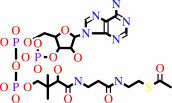 acetyl-CoA
|
=
|
N(6)-acetyl-L-lysyl-[protein]
|
+
|
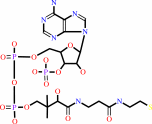 CoA
CoA
|
+
|
H(+)
|
|
|
|
|
|
|
|
|
|
|
|
|
Note, where more than one E.C. class is given (as above), each may
correspond to a different protein domain or, in the case of polyprotein
precursors, to a different mature protein.
|
|
|
|
Molecule diagrams generated from .mol files obtained from the
KEGG ftp site
|
|
|
|
|
|
|
|
|
|
|
|
|
|
 |
|
|
|
|
|
|
| |
|
|
| |
|
DOI no:
|
J Biol Chem
281:14787-14795
(2006)
|
|
PubMed id:
|
|
|
|
|
|
| |
|
Structural diversity in p160/CREB-binding protein coactivator complexes.
|
|
L.Waters,
B.Yue,
V.Veverka,
P.Renshaw,
J.Bramham,
S.Matsuda,
T.Frenkiel,
G.Kelly,
F.Muskett,
M.Carr,
D.M.Heery.
|
|
|
|
|
| |
ABSTRACT
|
|
|
|
| |
|
|
Ligand-induced transcription by nuclear receptors involves the recruitment of
p160 coactivators such as steroid receptor coactivator 1 (SRC1), in complex with
histone acetyltransferases such as CREB-binding protein (CBP) and p300. Here we
describe the solution structure of a complex formed by the SRC1 interaction
domain (SID) of CBP and the activation domain (AD1) of SRC1, both of which
contain four helical regions (Calpha1, Calpha2, Calpha3, and Calpha3' in CBP and
Salpha1, Salpha2', Salpha2, and Salpha3 in SRC1). A tight four-helix bundle is
formed between Salpha1, Calpha1, Calpha2, and Calpha3 that is capped by Salpha3.
In contrast to the structure of the AD1 domain of the related p160 protein ACTR
in complex with CBP SID, the sequences forming Salpha2' and Salpha2 in SRC1 AD1
are not involved in the interface between the two domains but rather serve to
position Salpha3. Thus, although the CBP SID domain adopts a similar fold in
complex with different p160 proteins, the topologies of the AD1 domains are
strikingly different, a feature that is likely to contribute to functional
specificity of these coactivator complexes.
|
|
|
|
|
|
| |
Selected figure(s)
|
|
|
|
| |
|
|

|
|

|
|
Figure 2.
FIGURE 2. Solution structure of the CBP SID-SRC1 AD1
complex. A, best fit superimposition of the family of 37
converged NMR structures obtained for the CBP SID-SRC1 AD1
complex. The CBP SID domain is shown in blue and SRC1 AD1 in
red. B, schematic (ribbon) representation of the backbone
topology of the two polypeptides in the complex, using the same
orientation as in A, and demonstrating the tight 4-helix bundle
conformation. The four helices of CBP SID (C  1, C 2, C
3,
and C 3') and SRC1 AD1 (S
1,
S 2',S 2, and S
3)
are indicated, along with the N and C termini of both domains. 1, C 2, C
3,
and C 3') and SRC1 AD1 (S
1,
S 2',S 2, and S
3)
are indicated, along with the N and C termini of both domains.
|
|
Figure 3.
FIGURE 3. Comparison of CBP SID/SRC1 AD1 and CBP SID-ACTR
AD1 complexes. A and B, equivalent views of the backbone
topology of the CBP SID-SRC1 AD1 and CBP SID-ACTR AD1 complexes,
respectively, which were obtained by superimposing the CBP SID
domain from both complexes (residues Ile^2063,
Pro^2065-Ala^2067, Asp^2070-Ser^2079, and Gln^2085-Lys^2108).
The CBP SID domain is shown in blue; SRC1 AD1 is shown in red
and ACTR AD1 in green. C, comparison of the backbone topologies
of the two CBP SID domains, which were overlaid on the same
residues as in A and B. The CBP SID domains from the SRC1 AD1
and ACTR AD1 complexes are shown in blue and cyan, respectively.
D, comparison of the backbone folds of the AD1 domains of SRC1
(red) and ACTR (yellow), which were overlaid on residues
Ile^2063, Pro^2065-Ala^2067, Asp^2070-Ser^2079,
Gln^2085-Lys^2108 of CBP-SID and residues Asp^928-Ser^941 and
Asp^1044-Ser^1057 of SRC1 and ACTR, respectively.
|
|
|
|
|
|
| |
The above figures are
reprinted
by permission from the ASBMB:
J Biol Chem
(2006,
281,
14787-14795)
copyright 2006.
|
|
| |
Figures were
selected
by the author.
|
|
|
|
|
|
|
|
|
|
|
|
|
|
|
|
 |
 |
 |
|
Literature references that cite this PDB file's key reference
|
|
|
| |
PubMed id
|
|
Reference
|
|
|
|
|
|
E.Herbig,
L.Warfield,
L.Fish,
J.Fishburn,
B.A.Knutson,
B.Moorefield,
D.Pacheco,
and
S.Hahn
(2010).
Mechanism of Mediator recruitment by tandem Gcn4 activation domains and three Gal11 activator-binding domains.
|
| |
Mol Cell Biol,
30,
2376-2390.
|
|
|
|
|
|
|
K.B.Kindle,
H.M.Collins,
and
D.M.Heery
(2010).
MOZ-TIF2-mediated destruction of CBP/p300 is blocked by calpain inhibitor 2.
|
| |
Leukemia,
24,
1359-1361.
|
|
|
|
|
|
|
L.C.Waters,
O.Oka,
F.W.Muskett,
S.L.Strong,
T.Schmedt,
K.H.Klempnauer,
and
M.D.Carr
(2010).
Resonance assignment and secondary structure of the middle MA-3 domain and complete tandem MA-3 region of the tumour suppressor protein Pdcd4.
|
| |
Biomol NMR Assign,
4,
49-53.
|
|
|
|
|
|
|
M.Kjaergaard,
K.Teilum,
and
F.M.Poulsen
(2010).
Conformational selection in the molten globule state of the nuclear coactivator binding domain of CBP.
|
| |
Proc Natl Acad Sci U S A,
107,
12535-12540.
|
|
|
PDB code:
|
|
|
|
|
|
|
|
N.Viswakarma,
Y.Jia,
L.Bai,
A.Vluggens,
J.Borensztajn,
J.Xu,
and
J.K.Reddy
(2010).
Coactivators in PPAR-Regulated Gene Expression.
|
| |
PPAR Res,
2010,
0.
|
|
|
|
|
|
|
M.Lodrini,
T.Münz,
N.Coudevylle,
C.Griesinger,
S.Becker,
and
E.Pfitzner
(2008).
P160/SRC/NCoA coactivators form complexes via specific interaction of their PAS-B domain with the CID/AD1 domain.
|
| |
Nucleic Acids Res,
36,
1847-1860.
|
|
|
|
|
|
|
D.M.Heery,
and
P.M.Fischer
(2007).
Pharmacological targeting of lysine acetyltransferases in human disease: a progress report.
|
| |
Drug Discov Today,
12,
88-99.
|
|
|
|
|
|
|
L.C.Waters,
V.Veverka,
M.Böhm,
T.Schmedt,
P.T.Choong,
F.W.Muskett,
K.H.Klempnauer,
and
M.D.Carr
(2007).
Structure of the C-terminal MA-3 domain of the tumour suppressor protein Pdcd4 and characterization of its interaction with eIF4A.
|
| |
Oncogene,
26,
4941-4950.
|
|
|
PDB code:
|
|
|
|
|
|
|
The most recent references are shown first.
Citation data come partly from CiteXplore and partly
from an automated harvesting procedure. Note that this is likely to be
only a partial list as not all journals are covered by
either method. However, we are continually building up the citation data
so more and more references will be included with time.
Where a reference describes a PDB structure, the PDB
code is
shown on the right.
|
 |


 Links
Links


