 |
PDBsum entry 1gii

|
|
|
|
|
 |
Contents |
 |
|
|
|
|
|
|
|
|
|
|
|
|
* Residue conservation analysis
|
|
|
|
|
|
|
|
|
|
|
Enzyme class:
|
|
E.C.2.7.11.22
- cyclin-dependent kinase.
|
|
|
|
|
|
|
Reaction:
|
|
|
1.
|
L-seryl-[protein] + ATP = O-phospho-L-seryl-[protein] + ADP + H+
|
|
2.
|
L-threonyl-[protein] + ATP = O-phospho-L-threonyl-[protein] + ADP + H+
|
|
|
|
|
|
|
L-seryl-[protein]
|
+
|
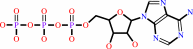 ATP
ATP
|
=
|
O-phospho-L-seryl-[protein]
|
+
|
 ADP
ADP
|
+
|
H(+)
|
|
|
|
|
|
|
L-threonyl-[protein]
|
+
|
ATP
|
=
|
O-phospho-L-threonyl-[protein]
|
+
|
ADP
|
+
|
H(+)
|
|
|
|
|
|
|
|
|
|
|
|
|
Molecule diagrams generated from .mol files obtained from the
KEGG ftp site
|
|
|
|
|
|
|
|
|
|
|
|
|
|
 |
|
|
|
|
|
|
| |
|
|
| |
|
DOI no:
|
J Biol Chem
276:27548-27554
(2001)
|
|
PubMed id:
|
|
|
|
|
|
| |
|
Crystallographic approach to identification of cyclin-dependent kinase 4 (CDK4)-specific inhibitors by using CDK4 mimic CDK2 protein.
|
|
M.Ikuta,
K.Kamata,
K.Fukasawa,
T.Honma,
T.Machida,
H.Hirai,
I.Suzuki-Takahashi,
T.Hayama,
S.Nishimura.
|
|
|
|
|
| |
ABSTRACT
|
|
|
|
| |
|
|
Genetic alteration of one or more components of the p16(INK4A)-CDK4,6/cyclin
D-retinoblastoma pathway is found in more than half of all human cancers.
Therefore, CDK4 is an attractive target for the development of a novel
anticancer agent. However, it is difficult to make CDK4-specific inhibitors that
do not possess activity for other kinases, especially CDK2, because the CDK
family has high structural homology. The three-dimensional structure of CDK2,
particularly that bound with the inhibitor, has provided useful information for
the synthesis of CDK2-specific inhibitors. The same approach used to make
CDK4-specific inhibitors was hindered by the failure to obtain a crystal
structure of CDK4. To overcome this problem, we synthesized a CDK4 mimic CDK2
protein in which the ATP binding pocket of CDK2 was replaced with that of CDK4.
This CDK4 mimic CDK2 was crystallized both in the free and inhibitor-bound form.
The structural information thus obtained was found to be useful for synthesis of
a CDK4-specific inhibitor that does not have substantial CDK2 activity. Namely,
the data suggest that CDK4 has additional space that will accommodate a large
substituent such as the CDK4 selective inhibitor. Inhibitors designed to bind
into this large cavity should be selective for CDK4 without having substantial
CDK2 activity. This design principle was confirmed in the x-ray crystal
structure of the CDK4 mimic CDK2 with a new CDK4 selective inhibitor bound.
|
|
|
|
|
|
| |
Selected figure(s)
|
|
|
|
| |
|
|

|
|

|
|
Figure 2.
Fig. 2. The hydrogen bond and hydrophobic interactions of
compound I bound to wild-type CDK2. Compound I is shown in
magenta. Wild-type CDK2 is shown in green. The figure was
prepared using InsightII (Molecular Simulations, Inc.).
|
|
Figure 5.
Fig. 5. The hydrogen bond and hydrophobic interactions of
compound II bound to CDK4 mimic CDK2. Compound II is shown in
magenta. CDK4 mimic CDK2 is shown in green.
|
|
|
|
|
|
| |
The above figures are
reprinted
by permission from the ASBMB:
J Biol Chem
(2001,
276,
27548-27554)
copyright 2001.
|
|
| |
Figures were
selected
by an automated process.
|
|
|
|
|
|
|
|
|
|
|
|
|
|
|
|
 |
 |
 |
|
Literature references that cite this PDB file's key reference
|
|
|
| |
PubMed id
|
|
Reference
|
|
|
|
|
|
T.Liu,
and
R.B.Altman
(2009).
Prediction of calcium-binding sites by combining loop-modeling with machine learning.
|
| |
BMC Struct Biol,
9,
72.
|
|
|
|
|
|
|
T.Persson,
C.W.Yde,
J.E.Rasmussen,
T.L.Rasmussen,
B.Guerra,
O.G.Issinger,
and
J.Nielsen
(2007).
Pyrazole carboxamides and carboxylic acids as protein kinase inhibitors in aberrant eukaryotic signal transduction: induction of growth arrest in MCF-7 cancer cells.
|
| |
Org Biomol Chem,
5,
3963-3970.
|
|
|
|
|
|
|
J.Sridhar,
N.Akula,
and
N.Pattabiraman
(2006).
Selectivity and potency of cyclin-dependent kinase inhibitors.
|
| |
AAPS J,
8,
E204-E221.
|
|
|
|
|
|
|
K.Terasawa,
K.Yoshimatsu,
S.Iemura,
T.Natsume,
K.Tanaka,
and
Y.Minami
(2006).
Cdc37 interacts with the glycine-rich loop of Hsp90 client kinases.
|
| |
Mol Cell Biol,
26,
3378-3389.
|
|
|
|
|
|
|
L.Martin,
V.Catherinot,
and
G.Labesse
(2006).
kinDOCK: a tool for comparative docking of protein kinase ligands.
|
| |
Nucleic Acids Res,
34,
W325-W329.
|
|
|
|
|
|
|
M.D.Kelly,
and
R.L.Mancera
(2006).
Comparative analysis of the surface interaction properties of the binding sites of CDK2, CDK4, and ERK2.
|
| |
ChemMedChem,
1,
366-375.
|
|
|
|
|
|
|
K.A.Rossi,
J.A.Markwalder,
S.P.Seitz,
C.H.Chang,
S.Cox,
M.D.Boisclair,
L.Brizuela,
S.L.Brenner,
and
P.F.Stouten
(2005).
Understanding and modulating cyclin-dependent kinase inhibitor specificity: molecular modeling and biochemical evaluation of pyrazolopyrimidinones as CDK2/cyclin A and CDK4/cyclin D1 inhibitors.
|
| |
J Comput Aided Mol Des,
19,
111-122.
|
|
|
|
|
|
|
C.McInnes,
S.Wang,
S.Anderson,
J.O'Boyle,
W.Jackson,
G.Kontopidis,
C.Meades,
M.Mezna,
M.Thomas,
G.Wood,
D.P.Lane,
and
P.M.Fischer
(2004).
Structural determinants of CDK4 inhibition and design of selective ATP competitive inhibitors.
|
| |
Chem Biol,
11,
525-534.
|
|
|
|
|
|
|
H.Park,
M.S.Yeom,
and
S.Lee
(2004).
Loop flexibility and solvent dynamics as determinants for the selective inhibition of cyclin-dependent kinase 4: comparative molecular dynamics simulation studies of CDK2 and CDK4.
|
| |
Chembiochem,
5,
1662-1672.
|
|
|
|
|
|
|
M.Koresawa,
and
T.Okabe
(2004).
High-throughput screening with quantitation of ATP consumption: a universal non-radioisotope, homogeneous assay for protein kinase.
|
| |
Assay Drug Dev Technol,
2,
153-160.
|
|
|
|
|
|
|
N.C.Waters,
and
J.A.Geyer
(2003).
Cyclin-dependent protein kinases as therapeutic drug targets for antimalarial drug development.
|
| |
Expert Opin Ther Targets,
7,
7.
|
|
|
|
|
|
|
T.Honma
(2003).
Recent advances in de novo design strategy for practical lead identification.
|
| |
Med Res Rev,
23,
606-632.
|
|
|
|
|
|
|
G.Scapin
(2002).
Structural biology in drug design: selective protein kinase inhibitors.
|
| |
Drug Discov Today,
7,
601-611.
|
|
|
|
|
|
|
M.L.Rodriguez-Puebla,
P.L.Miliani de Marval,
M.LaCava,
D.S.Moons,
H.Kiyokawa,
and
C.J.Conti
(2002).
Cdk4 deficiency inhibits skin tumor development but does not affect normal keratinocyte proliferation.
|
| |
Am J Pathol,
161,
405-411.
|
|
|
|
|
|
The most recent references are shown first.
Citation data come partly from CiteXplore and partly
from an automated harvesting procedure. Note that this is likely to be
only a partial list as not all journals are covered by
either method. However, we are continually building up the citation data
so more and more references will be included with time.
|
|


 Links
Links


