
|
|
|
|
|
 |
Contents |
 |
|
|
|
|
|
|
|
|
|
|
|
|
* Residue conservation analysis
|
|
|
|
|
|
|
|
|
|
Enzyme class:
|
|
Chains A, C:
E.C.2.7.11.22
- cyclin-dependent kinase.
|
|
|
|
|
|
|
Reaction:
|
|
|
1.
|
L-seryl-[protein] + ATP = O-phospho-L-seryl-[protein] + ADP + H+
|
|
2.
|
L-threonyl-[protein] + ATP = O-phospho-L-threonyl-[protein] + ADP + H+
|
|
|
|
|
|
|
L-seryl-[protein]
|
+
|
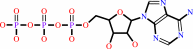 ATP
ATP
|
=
|
O-phospho-L-seryl-[protein]
|
+
|
 ADP
ADP
|
+
|
H(+)
|
|
|
|
|
|
|
L-threonyl-[protein]
|
+
|
ATP
|
=
|
O-phospho-L-threonyl-[protein]
|
+
|
ADP
|
+
|
H(+)
|
|
|
|
|
|
|
|
|
|
|
|
|
Molecule diagrams generated from .mol files obtained from the
KEGG ftp site
|
|
|
|
|
|
|
|
|
|
|
|
|
|
 |
|
|
|
|
|
|
| |
|
|
| |
|
DOI no:
|
Structure
9:389-397
(2001)
|
|
PubMed id:
|
|
|
|
|
|
| |
|
Inhibitor binding to active and inactive CDK2: the crystal structure of CDK2-cyclin A/indirubin-5-sulphonate.
|
|
T.G.Davies,
P.Tunnah,
L.Meijer,
D.Marko,
G.Eisenbrand,
J.A.Endicott,
M.E.Noble.
|
|
|
|
|
| |
ABSTRACT
|
|
|
|
| |
|
|
BACKGROUND: Cyclin-dependent kinase 2 (CDK2) is an important target for
structure-based design of antitumor agents. Monomeric CDK2 is inactive.
Activation requires rearrangements to key structural elements of the enzyme's
active site, which accompany cyclin binding and phosphorylation. To assess the
validity of using monomeric CDK2 as a model for the active kinase in
structure-based drug design, we have solved the structure of the inhibitor
indirubin-5-sulphonate (E226) complexed with phospho-CDK2-cyclin A and compared
it with the structure of E226 bound to inactive, monomeric CDK2. RESULTS:
Activation of monomeric CDK2 leads to a rotation of its N-terminal domain
relative to the C-terminal lobe. The accompanying change in position of E226
follows that of the N-terminal domain, and its interactions with residues
forming part of the adenine binding pocket are conserved. The environment of the
ATP-ribose site, not explored by E226, is significantly different in the binary
complex compared to the monomeric complex due to movement of the glycine loop.
Conformational changes also result in subtle differences in hydrogen bonding and
electrostatic interactions between E226's sulphonate and CDK2's phosphate
binding site. Affinities calculated by LUDI for the interaction of E226 with
active or inactive CDK2 differ by a factor of approximately ten. CONCLUSIONS:
The accuracy of monomeric CDK2 as an inhibitor design template is restricted to
the adenine binding site. The general flexibility observed for the glycine loop
and subtle changes to the phosphate binding site suggest a need to study
interactions between inhibitors and active CDK2 in structure-based drug design
programs.
|
|
|
|
|
|
| |
Selected figure(s)
|
|
|
|
| |
|
|

|
|
Figure 7.
Figure 7. Stereo View Showing Superposition of Monomeric
and Binary Structures, Showing Residues that Form Polar Contacts
with the E226 Sulphonate GroupMonomeric and binary structures
are colored in red and yellow, respectively. Hydrogen bonding
and electrostatic interactions between the sulphonate group and
active CDK2 are denoted by dashed lines

|
|
|
|
|
|
| |
The above figure is
reprinted
by permission from Cell Press:
Structure
(2001,
9,
389-397)
copyright 2001.
|
|
| |
Figure was
selected
by an automated process.
|
|
|
|
|
|
|
|
|
|
|
|
|
|
|
|
 |
 |
 |
|
Literature references that cite this PDB file's key reference
|
|
|
| |
PubMed id
|
|
Reference
|
|
|
|
|
|
G.Karapetyan,
K.Chakrabarty,
M.Hein,
and
P.Langer
(2011).
Synthesis and bioactivity of carbohydrate derivatives of indigo, its isomers and heteroanalogues.
|
| |
ChemMedChem,
6,
25-37.
|
|
|
|
|
|
|
J.M.Hayes,
V.T.Skamnaki,
G.Archontis,
C.Lamprakis,
J.Sarrou,
N.Bischler,
A.L.Skaltsounis,
S.E.Zographos,
and
N.G.Oikonomakos
(2011).
Kinetics, in silico docking, molecular dynamics, and MM-GBSA binding studies on prototype indirubins, KT5720, and staurosporine as phosphorylase kinase ATP-binding site inhibitors: The role of water molecules examined.
|
| |
Proteins,
79,
703-719.
|
|
|
|
|
|
|
O.Sperandio,
L.Mouawad,
E.Pinto,
B.O.Villoutreix,
D.Perahia,
and
M.A.Miteva
(2010).
How to choose relevant multiple receptor conformations for virtual screening: a test case of Cdk2 and normal mode analysis.
|
| |
Eur Biophys J,
39,
1365-1372.
|
|
|
|
|
|
|
I.J.Enyedy,
and
W.J.Egan
(2008).
Can we use docking and scoring for hit-to-lead optimization?
|
| |
J Comput Aided Mol Des,
22,
161-168.
|
|
|
|
|
|
|
K.Vougogiannopoulou,
Y.Ferandin,
K.Bettayeb,
V.Myrianthopoulos,
O.Lozach,
Y.Fan,
C.H.Johnson,
P.Magiatis,
A.L.Skaltsounis,
E.Mikros,
and
L.Meijer
(2008).
Soluble 3',6-substituted indirubins with enhanced selectivity toward glycogen synthase kinase -3 alter circadian period.
|
| |
J Med Chem,
51,
6421-6431.
|
|
|
|
|
|
|
B.Zhang,
V.B.Tan,
K.M.Lim,
T.E.Tay,
and
S.Zhuang
(2007).
Study of the inhibition of cyclin-dependent kinases with roscovitine and indirubin-3'-oxime from molecular dynamics simulations.
|
| |
J Mol Model,
13,
79-89.
|
|
|
|
|
|
|
J.H.Alzate-Morales,
R.Contreras,
A.Soriano,
I.Tuñon,
and
E.Silla
(2007).
A computational study of the protein-ligand interactions in CDK2 inhibitors: using quantum mechanics/molecular mechanics interaction energy as a predictor of the biological activity.
|
| |
Biophys J,
92,
430-439.
|
|
|
|
|
|
|
M.P.Mazanetz,
and
P.M.Fischer
(2007).
Untangling tau hyperphosphorylation in drug design for neurodegenerative diseases.
|
| |
Nat Rev Drug Discov,
6,
464-479.
|
|
|
|
|
|
|
Y.Zhen,
V.Sørensen,
Y.Jin,
Z.Suo,
and
A.Wiedłocha
(2007).
Indirubin-3'-monoxime inhibits autophosphorylation of FGFR1 and stimulates ERK1/2 activity via p38 MAPK.
|
| |
Oncogene,
26,
6372-6385.
|
|
|
|
|
|
|
A.Duensing,
L.Ghanem,
R.A.Steinman,
Y.Liu,
and
S.Duensing
(2006).
p21(Waf1/Cip1) deficiency stimulates centriole overduplication.
|
| |
Cell Cycle,
5,
2899-2902.
|
|
|
|
|
|
|
B.Zhang,
V.B.Tan,
K.M.Lim,
and
T.E.Tay
(2006).
Molecular dynamics simulations on the inhibition of cyclin-dependent kinases 2 and 5 in the presence of activators.
|
| |
J Comput Aided Mol Des,
20,
395-404.
|
|
|
|
|
|
|
G.Sethi,
K.S.Ahn,
S.K.Sandur,
X.Lin,
M.M.Chaturvedi,
and
B.B.Aggarwal
(2006).
Indirubin enhances tumor necrosis factor-induced apoptosis through modulation of nuclear factor-kappa B signaling pathway.
|
| |
J Biol Chem,
281,
23425-23435.
|
|
|
|
|
|
|
J.Ribas,
K.Bettayeb,
Y.Ferandin,
M.Knockaert,
X.Garrofé-Ochoa,
F.Totzke,
C.Schächtele,
J.Mester,
P.Polychronopoulos,
P.Magiatis,
A.L.Skaltsounis,
J.Boix,
and
L.Meijer
(2006).
7-Bromoindirubin-3'-oxime induces caspase-independent cell death.
|
| |
Oncogene,
25,
6304-6318.
|
|
|
|
|
|
|
J.Sridhar,
N.Akula,
and
N.Pattabiraman
(2006).
Selectivity and potency of cyclin-dependent kinase inhibitors.
|
| |
AAPS J,
8,
E204-E221.
|
|
|
|
|
|
|
S.H.Kim,
S.W.Kim,
S.J.Choi,
Y.C.Kim,
and
T.S.Kim
(2006).
Enhancing effect of indirubin derivatives on 1,25-dihydroxyvitamin D3- and all-trans retinoic acid-induced differentiation of HL-60 leukemia cells.
|
| |
Bioorg Med Chem,
14,
6752-6758.
|
|
|
|
|
|
|
K.Suzuki,
R.Adachi,
A.Hirayama,
H.Watanabe,
S.Otani,
Y.Watanabe,
and
T.Kasahara
(2005).
Indirubin, a Chinese anti-leukaemia drug, promotes neutrophilic differentiation of human myelocytic leukaemia HL-60 cells.
|
| |
Br J Haematol,
130,
681-690.
|
|
|
|
|
|
|
R.Jautelat,
T.Brumby,
M.Schäfer,
H.Briem,
G.Eisenbrand,
S.Schwahn,
M.Krüger,
U.Lücking,
O.Prien,
and
G.Siemeister
(2005).
From the insoluble dye indirubin towards highly active, soluble CDK2-inhibitors.
|
| |
Chembiochem,
6,
531-540.
|
|
|
PDB codes:
|
|
|
|
|
|
|
|
H.Park,
M.S.Yeom,
and
S.Lee
(2004).
Loop flexibility and solvent dynamics as determinants for the selective inhibition of cyclin-dependent kinase 4: comparative molecular dynamics simulation studies of CDK2 and CDK4.
|
| |
Chembiochem,
5,
1662-1672.
|
|
|
|
|
|
|
M.N.Kosmopoulou,
D.D.Leonidas,
E.D.Chrysina,
N.Bischler,
G.Eisenbrand,
C.E.Sakarellos,
R.Pauptit,
and
N.G.Oikonomakos
(2004).
Binding of the potential antitumour agent indirubin-5-sulphonate at the inhibitor site of rabbit muscle glycogen phosphorylase b. Comparison with ligand binding to pCDK2-cyclin A complex.
|
| |
Eur J Biochem,
271,
2280-2290.
|
|
|
PDB code:
|
|
|
|
|
|
|
|
Y.Wan,
W.Hur,
C.Y.Cho,
Y.Liu,
F.J.Adrian,
O.Lozach,
S.Bach,
T.Mayer,
D.Fabbro,
L.Meijer,
and
N.S.Gray
(2004).
Synthesis and target identification of hymenialdisine analogs.
|
| |
Chem Biol,
11,
247-259.
|
|
|
|
|
|
|
L.Meijer,
A.L.Skaltsounis,
P.Magiatis,
P.Polychronopoulos,
M.Knockaert,
M.Leost,
X.P.Ryan,
C.A.Vonica,
A.Brivanlou,
R.Dajani,
C.Crovace,
C.Tarricone,
A.Musacchio,
S.M.Roe,
L.Pearl,
and
P.Greengard
(2003).
GSK-3-selective inhibitors derived from Tyrian purple indirubins.
|
| |
Chem Biol,
10,
1255-1266.
|
|
|
PDB code:
|
|
|
|
|
|
|
|
P.M.Fischer
(2003).
CDK versus GSK-3 inhibition: a purple haze no longer?
|
| |
Chem Biol,
10,
1144-1146.
|
|
|
|
|
|
|
P.L.Toogood
(2002).
Progress toward the development of agents to modulate the cell cycle.
|
| |
Curr Opin Chem Biol,
6,
472-478.
|
|
|
|
|
|
|
T.G.Davies,
D.J.Pratt,
J.A.Endicott,
L.N.Johnson,
and
M.E.Noble
(2002).
Structure-based design of cyclin-dependent kinase inhibitors.
|
| |
Pharmacol Ther,
93,
125-133.
|
|
|
|
|
|
|
T.G.Davies,
J.Bentley,
C.E.Arris,
F.T.Boyle,
N.J.Curtin,
J.A.Endicott,
A.E.Gibson,
B.T.Golding,
R.J.Griffin,
I.R.Hardcastle,
P.Jewsbury,
L.N.Johnson,
V.Mesguiche,
D.R.Newell,
M.E.Noble,
J.A.Tucker,
L.Wang,
and
H.J.Whitfield
(2002).
Structure-based design of a potent purine-based cyclin-dependent kinase inhibitor.
|
| |
Nat Struct Biol,
9,
745-749.
|
|
|
PDB codes:
|
|
|
|
|
|
|
|
W.M.Rockey,
and
A.H.Elcock
(2002).
Progress toward virtual screening for drug side effects.
|
| |
Proteins,
48,
664-671.
|
|
|
|
|
|
The most recent references are shown first.
Citation data come partly from CiteXplore and partly
from an automated harvesting procedure. Note that this is likely to be
only a partial list as not all journals are covered by
either method. However, we are continually building up the citation data
so more and more references will be included with time.
Where a reference describes a PDB structure, the PDB
codes are
shown on the right.
|
 |


 Links
Links





