 |
PDBsum entry 1ch4

|
|
|
|
|
|

|

|

|

|
|

|
|

|
|

|
|

|
|

|
|

|
|
|
 |

|

|
|
|
|
|
|
|
|
|
|
|
|
|
|
|
|
|
|
|
|
|
|
|
|
|
|
|
|
|
|
|
|
|
|
|
Oxygen transport
|
PDB id
|
|
|
|
1ch4
|
|
|
|
|
|
|
|
|
|
|
|
|
|
|

|

|

|
|
|
|
|
|
|
|
 |
Contents |
 |
|
|
|
|
|
|
|
|
|
|
|
|
* Residue conservation analysis
|
|
|
|
|
|
PDB id:
|
|
|
|
| Name: |
|
Oxygen transport
|
|
|
Title:
|
|
Module-substituted chimera hemoglobin beta-alpha (f133v)
|
|
Structure:
|
|
Module-substituted chimera hemoglobin beta-alpha. Chain: a, b, c, d. Engineered: yes. Mutation: yes
|
|
Source:
|
|
Homo sapiens. Human. Organism_taxid: 9606. Expressed in: escherichia coli bl21. Expression_system_taxid: 511693.
|
|
Biol. unit:
|
|
Tetramer (from PDB file)
|
|
Resolution:
|
|
|
2.50Å
|
R-factor:
|
0.188
|
R-free:
|
0.244
|
|
|
Authors:
|
|
T.Shirai,M.Fujikake,T.Yamane,K.Inaba,K.Ishimori,I.Morishima
|
Key ref:

|
|
T.Shirai
et al.
(1999).
Crystal structure of a protein with an artificial exon-shuffling, module M4-substituted chimera hemoglobin beta alpha, at 2.5 A resolution.
J Mol Biol,
287,
369-382.
PubMed id:
DOI:

|
|
|
Date:
|
|
|
11-Jun-98
|
Release date:
|
27-Apr-99
|
|
|
|
|
|
|
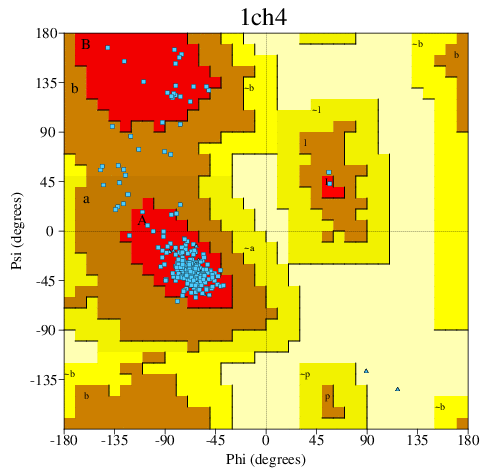
PROCHECK
|
|
|
|
|
|
Headers
|
|
|
|
References
|
|
|
|
|
|

|
|
P68871
(HBB_HUMAN) -
Hemoglobin subunit beta from Homo sapiens
|
|
|
|
Seq:
Struc:
|
|
|
|
147 a.a.
146 a.a.*
|
|

|

|
|
|
|
|
|
|
|
|
|
|
|
Key: |
 |
PfamA domain |
|
|
 |
Secondary structure |
|
 |
CATH domain |
|
|
*
PDB and UniProt seqs differ
at 26 residue positions (black
crosses)
|
|
|
|
|
|
|
|
|
|
|
|
|
|
|
|
|
 |
|
|
|
|
|
|
| |
|
DOI no:
|
J Mol Biol
287:369-382
(1999)
|
|
PubMed id:
|
|
|
|
|
|
| |
|
Crystal structure of a protein with an artificial exon-shuffling, module M4-substituted chimera hemoglobin beta alpha, at 2.5 A resolution.
|
|
T.Shirai,
M.Fujikake,
T.Yamane,
K.Inaba,
K.Ishimori,
I.Morishima.
|
|
|
|
|
| |
ABSTRACT
|
|
|
|
| |
|
|
The crystal structure of the homotetramer of a chimera beta alpha-subunit of
human hemoglobin was refined at 2.5 A resolution. The chimera subunit was
constructed by replacing an exon-encoded module M4 of the beta-subunit with that
of the alpha-subunit, simulating an exon-shuffling event. The implanted module
M4 retained the native alpha-subunit structure, while module M3 was disturbed
around the site where a new type of intron was recently found. Some of the
residues were found in alternative conformations that avoid steric hindrance at
the subunit interface. The modules are modestly rigid in their backbone
structures by using side-chains to compensate for interface incompatibility.
|
|
|
|
|
|
| |
Selected figure(s)
|
|
|
|
| |
|
|

|
|

|
|
Figure 4.
Figure 4. A stereo view of the side-chain and heme group
packing around fine tuning site Val133 (H11). The structures of
α-subunit (gray), β-subunit (blue) and chimera subunit
(yellow) are superimposed.
|
|
Figure 6.
|
|
|
|
|
|
| |
The above figures are
reprinted
by permission from Elsevier:
J Mol Biol
(1999,
287,
369-382)
copyright 1999.
|
|
| |
Figures were
selected
by an automated process.
|
|
|
|
|
|
|
|
|
|
|
|
|
|
|
|
 |
 |
 |
|
Literature references that cite this PDB file's key reference
|
|
|
| |
PubMed id
|
|
Reference
|
|
|
|
|
|
B.C.Lee,
K.Park,
and
D.Kim
(2008).
Analysis of the residue-residue coevolution network and the functionally important residues in proteins.
|
| |
Proteins,
72,
863-872.
|
|
|
|
|
|
|
C.Schalk-Hihi,
H.C.Ma,
G.T.Struble,
S.Bayoumy,
R.Williams,
E.Devine,
I.P.Petrounia,
T.Mezzasalma,
L.Zeng,
C.Schubert,
B.Grasberger,
B.A.Springer,
and
I.C.Deckman
(2007).
Protein engineering of the colony-stimulating factor-1 receptor kinase domain for structural studies.
|
| |
J Biol Chem,
282,
4085-4093.
|
|
|
|
|
|
|
X.Liu,
and
E.C.Theil
(2004).
Ferritin reactions: direct identification of the site for the diferric peroxide reaction intermediate.
|
| |
Proc Natl Acad Sci U S A,
101,
8557-8562.
|
|
|
|
|
|
|
Y.Watanabe
(2002).
Construction of heme enzymes: four approaches.
|
| |
Curr Opin Chem Biol,
6,
208-216.
|
|
|
|
|
|
The most recent references are shown first.
Citation data come partly from CiteXplore and partly
from an automated harvesting procedure. Note that this is likely to be
only a partial list as not all journals are covered by
either method. However, we are continually building up the citation data
so more and more references will be included with time.
|
|


 Links
Links


