 |
PDBsum entry 1bvg

|
|
|
|
|
|

|

|

|

|
|

|
|

|
|

|
|

|
|

|
|
|
 |

|

|
|
|
|
|
|
|
|
|
|
|
|
|
|
|
|
|
|
|
|
|
|
|
|
|
|
|
|
|
|
|
|
|
|
Aspartyl protease
|
PDB id
|
|
|
|
1bvg
|
|
|
|
|
|
|
|
|
|
|
|
|
|
|

|

|

|
|
|
|
|
|
|
|
 |
Contents |
 |
|
|
|
|
|
|
|
|
|
|
* Residue conservation analysis
|
|
|
|
|
|
PDB id:
|
|
|
|
| Name: |
|
Aspartyl protease
|
|
|
Title:
|
|
HIV-1 protease-dmp323 complex in solution, nmr minimized average structure
|
|
Structure:
|
|
HIV-1 protease. Chain: a, b. Engineered: yes. Mutation: yes
|
|
Source:
|
|
Human immunodeficiency virus 1. Organism_taxid: 11676. Strain: hxb2. Expressed in: escherichia coli. Expression_system_taxid: 562.
|
|
NMR struc:
|
|
1 models
|
|
|
Authors:
|
|
T.Yamazaki,A.P.Hinck,Y.-X.Wang,L.K.Nicholson,D.A.Torchia,P.Wingfield, S.J.Stahl,J.D.Kaufman,C.Chang,P.J.Domaille,P.Y.S.Lam
|
|
Key ref:
|
|
T.Yamazaki
et al.
(1996).
Three-dimensional solution structure of the HIV-1 protease complexed with DMP323, a novel cyclic urea-type inhibitor, determined by nuclear magnetic resonance spectroscopy.
Protein Sci,
5,
495-506.
PubMed id:
DOI:
|
|
|
Date:
|
|
|
16-Jan-96
|
Release date:
|
17-Aug-96
|
|
|
|
|
|
|
PROCHECK
|

|
|
|
|
|
Headers
|
|
|
|
References
|
|
|
|
|
|

|
|
P04585
(POL_HV1H2) -
Gag-Pol polyprotein from Human immunodeficiency virus type 1 group M subtype B (isolate HXB2)
|
|
|
|
Seq:
Struc:
|
|
|
|
1435 a.a.
99 a.a.*
|
|

|

|

|
|
|
|
|
|
|
|
|
|
|
Key: |
|
 |
Secondary structure |
|
 |
CATH domain |
|
|
*
PDB and UniProt seqs differ
at 1 residue position (black
cross)
|
|
|
|
|
|
|
|
|
|
|
|
|
Enzyme class 1:
|
|
E.C.2.7.7.-
- ?????
|
|
|
|
|
|
|
Enzyme class 2:
|
|
E.C.2.7.7.49
- RNA-directed Dna polymerase.
|
|
|
|
|
|
|
Reaction:
|
|
DNA(n) + a 2'-deoxyribonucleoside 5'-triphosphate = DNA(n+1) + diphosphate
|
|
|
|
|
|
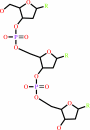 DNA(n)
|
+
|
2'-deoxyribonucleoside 5'-triphosphate
|
=
|
DNA(n+1)
|
+
|
 diphosphate
|
|
|
|
|
|
|
|
|
|
Enzyme class 3:
|
|
E.C.2.7.7.7
- DNA-directed Dna polymerase.
|
|
|
|
|
|
|
Reaction:
|
|
DNA(n) + a 2'-deoxyribonucleoside 5'-triphosphate = DNA(n+1) + diphosphate
|
|
|
|
|
|
DNA(n)
|
+
|
2'-deoxyribonucleoside 5'-triphosphate
|
=
|
DNA(n+1)
|
+
|
diphosphate
|
|
|
|
|
|
|
|
|
|
Enzyme class 4:
|
|
E.C.3.1.-.-
|
|
|
|
|
|
|
Enzyme class 5:
|
|
E.C.3.1.13.2
- exoribonuclease H.
|
|
|
|
|
|
|
Reaction:
|
|
Exonucleolytic cleavage to 5'-phosphomonoester oligonucleotides in both 5'- to 3'- and 3'- to 5'-directions.
|
|
|
|
|
|
Enzyme class 6:
|
|
E.C.3.1.26.13
- retroviral ribonuclease H.
|
|
|
|
|
|
|
Enzyme class 7:
|
|
E.C.3.4.23.16
- HIV-1 retropepsin.
|
|
|
|
|
|
|
Reaction:
|
|
Specific for a P1 residue that is hydrophobic, and P1' variable, but often Pro.
|
|
|
|
|
|
|
|
|
Note, where more than one E.C. class is given (as above), each may
correspond to a different protein domain or, in the case of polyprotein
precursors, to a different mature protein.
|
|
|
|
Molecule diagrams generated from .mol files obtained from the
KEGG ftp site
|
|
|
|
|
|
|
|
|
|
|
|
|
|
 |
|
|
|
|
|
|
| |
|
|
| |
|
DOI no:
|
Protein Sci
5:495-506
(1996)
|
|
PubMed id:
|
|
|
|
|
|
| |
|
Three-dimensional solution structure of the HIV-1 protease complexed with DMP323, a novel cyclic urea-type inhibitor, determined by nuclear magnetic resonance spectroscopy.
|
|
T.Yamazaki,
A.P.Hinck,
Y.X.Wang,
L.K.Nicholson,
D.A.Torchia,
P.Wingfield,
S.J.Stahl,
J.D.Kaufman,
C.H.Chang,
P.J.Domaille,
P.Y.Lam.
|
|
|
|
|
| |
ABSTRACT
|
|
|
|
| |
|
|
The three-dimensional solution structure of the HIV-1 protease homodimer, MW
22.2 kDa, complexed to a potent, cyclic urea-based inhibitor, DMP323, is
reported. This is the first solution structure of an HIV protease/inhibitor
complex that has been elucidated. Multidimensional heteronuclear NMR spectra
were used to assemble more than 4,200 distance and angle constraints. Using the
constraints, together with a hybrid distance geometry/simulated annealing
protocol, an ensemble of 28 NMR structures was calculated having no distance or
angle violations greater than 0.3 A or 5 degrees, respectively. Neglecting
residues in disordered loops, the RMS deviation (RMSD) for backbone atoms in the
family of structures was 0.60 A relative to the average structure. The
individual NMR structures had excellent covalent geometry and stereochemistry,
as did the restrained minimized average structure. The latter structure is
similar to the 1.8-A X-ray structure of the protease/DMP323 complex (Chang CH et
al., 1995, Protein Science, submitted); the pairwise backbone RMSD calculated
for the two structures is 1.22 A. As expected, the mismatch between the
structures is greatest in the loops that are disordered and/or flexible. The
flexibility of residues 37-42 and 50-51 may be important in facilitating
substrate binding and product release, because these residues make up the
respective hinges and tips of the protease flaps. Flexibility of residues 4-8
may play a role in protease regulation by facilitating autolysis.
|
|
|
|
|
|
|
|
|
|
|
|
|
|
|
|
|
|
 |
 |
 |
|
Literature references that cite this PDB file's key reference
|
|
|
| |
PubMed id
|
|
Reference
|
|
|
|
|
|
I.Jedidi,
F.Zhang,
H.Qiu,
S.J.Stahl,
I.Palmer,
J.D.Kaufman,
P.S.Nadaud,
S.Mukherjee,
P.T.Wingfield,
C.P.Jaroniec,
and
A.G.Hinnebusch
(2010).
Activator Gcn4 employs multiple segments of Med15/Gal11, including the KIX domain, to recruit mediator to target genes in vivo.
|
| |
J Biol Chem,
285,
2438-2455.
|
|
|
|
|
|
|
R.Ishima,
Q.Gong,
Y.Tie,
I.T.Weber,
and
J.M.Louis
(2010).
Highly conserved glycine 86 and arginine 87 residues contribute differently to the structure and activity of the mature HIV-1 protease.
|
| |
Proteins,
78,
1015-1025.
|
|
|
PDB codes:
|
|
|
|
|
|
|
|
J.Wang,
X.Zuo,
P.Yu,
I.J.Byeon,
J.Jung,
X.Wang,
M.Dyba,
S.Seifert,
C.D.Schwieters,
J.Qin,
A.M.Gronenborn,
and
Y.X.Wang
(2009).
Determination of multicomponent protein structures in solution using global orientation and shape restraints.
|
| |
J Am Chem Soc,
131,
10507-10515.
|
|
|
PDB codes:
|
|
|
|
|
|
|
|
H.E.Klei,
K.Kish,
P.F.Lin,
Q.Guo,
J.Friborg,
R.E.Rose,
Y.Zhang,
V.Goldfarb,
D.R.Langley,
M.Wittekind,
and
S.Sheriff
(2007).
X-ray crystal structures of human immunodeficiency virus type 1 protease mutants complexed with atazanavir.
|
| |
J Virol,
81,
9525-9535.
|
|
|
PDB codes:
|
|
|
|
|
|
|
|
M.Bonomi,
F.L.Gervasio,
G.Tiana,
D.Provasi,
R.A.Broglia,
and
M.Parrinello
(2007).
Insight into the folding inhibition of the HIV-1 protease by a small peptide.
|
| |
Biophys J,
93,
2813-2821.
|
|
|
|
|
|
|
Y.Ryabov,
and
D.Fushman
(2007).
Structural assembly of multidomain proteins and protein complexes guided by the overall rotational diffusion tensor.
|
| |
J Am Chem Soc,
129,
7894-7902.
|
|
|
PDB codes:
|
|
|
|
|
|
|
|
R.A.Broglia,
D.Provasi,
F.Vasile,
G.Ottolina,
R.Longhi,
and
G.Tiana
(2006).
A folding inhibitor of the HIV-1 protease.
|
| |
Proteins,
62,
928-933.
|
|
|
|
|
|
|
G.R.Thuduppathy,
and
R.B.Hill
(2004).
Applications of NMR spin relaxation methods for measuring biological motions.
|
| |
Methods Enzymol,
384,
243-264.
|
|
|
|
|
|
|
M.Kumar,
and
M.V.Hosur
(2003).
Adaptability and flexibility of HIV-1 protease.
|
| |
Eur J Biochem,
270,
1231-1239.
|
|
|
|
|
|
|
D.I.Freedberg,
R.Ishima,
J.Jacob,
Y.X.Wang,
I.Kustanovich,
J.M.Louis,
and
D.A.Torchia
(2002).
Rapid structural fluctuations of the free HIV protease flaps in solution: relationship to crystal structures and comparison with predictions of dynamics calculations.
|
| |
Protein Sci,
11,
221-232.
|
|
|
|
|
|
|
A.Wlodawer,
and
J.Vondrasek
(1998).
Inhibitors of HIV-1 protease: a major success of structure-assisted drug design.
|
| |
Annu Rev Biophys Biomol Struct,
27,
249-284.
|
|
|
|
|
|
|
P.T.Wingfield,
S.J.Stahl,
J.Kaufman,
A.Zlotnick,
C.C.Hyde,
A.M.Gronenborn,
and
G.M.Clore
(1997).
The extracellular domain of immunodeficiency virus gp41 protein: expression in Escherichia coli, purification, and crystallization.
|
| |
Protein Sci,
6,
1653-1660.
|
|
|
|
|
|
|
Y.X.Wang,
D.I.Freedberg,
S.Grzesiek,
D.A.Torchia,
P.T.Wingfield,
J.D.Kaufman,
S.J.Stahl,
C.H.Chang,
and
C.N.Hodge
(1996).
Mapping hydration water molecules in the HIV-1 protease/DMP323 complex in solution by NMR spectroscopy.
|
| |
Biochemistry,
35,
12694-12704.
|
|
|
|
|
|
|
Y.X.Wang,
D.I.Freedberg,
T.Yamazaki,
P.T.Wingfield,
S.J.Stahl,
J.D.Kaufman,
Y.Kiso,
and
D.A.Torchia
(1996).
Solution NMR evidence that the HIV-1 protease catalytic aspartyl groups have different ionization states in the complex formed with the asymmetric drug KNI-272.
|
| |
Biochemistry,
35,
9945-9950.
|
|
|
|
|
|
The most recent references are shown first.
Citation data come partly from CiteXplore and partly
from an automated harvesting procedure. Note that this is likely to be
only a partial list as not all journals are covered by
either method. However, we are continually building up the citation data
so more and more references will be included with time.
Where a reference describes a PDB structure, the PDB
codes are
shown on the right.
|
|


 Links
Links


