 |
PDBsum entry 1qw4

|
|
|
|
|
|

|

|

|

|
|

|
|

|
|

|
|

|
|

|
|

|
|

|
|
|
 |

|

|
|
|
|
|
|
|
|
|
|
|
|
|
|
|
|
|
|
|
|
|
|
|
|
|
|
|
|
|
|
|
|
|
|
|
|
Oxidoreductase
|
PDB id
|
|
|
|
1qw4
|
|
|
|
|
|
|
|
|
|
|
|
|
|
|

|

|

|
|
|
|
|
|
|
|
 |
Contents |
 |
|
|
|
|
|
|
|
|
|
|
|
|
|
|
* Residue conservation analysis
|
|
|
|
|
|
PDB id:
|
|
|
|
| Name: |
|
Oxidoreductase
|
|
|
Title:
|
|
Crystal structure of murine inducible nitric oxide synthase oxygenase domain in complex with n-omega-propyl-l-arginine.
|
|
Structure:
|
|
Nitric oxide synthase, inducible. Chain: a, b. Fragment: inducible nitric oxide synthase oxygenase domain (residues 77-495). Synonym: nos, type ii, inducible nos, inos, macrophage nos, mac-nos. Engineered: yes
|
|
Source:
|
|
Mus musculus. House mouse. Organism_taxid: 10090. Gene: nos2 or inosl. Expressed in: escherichia coli. Expression_system_taxid: 562.
|
|
Biol. unit:
|
|
Dimer (from PDB file)
|
|
Resolution:
|
|
|
2.40Å
|
R-factor:
|
0.213
|
R-free:
|
0.251
|
|
|
Authors:
|
|
R.Fedorov,E.Hartmann,D.K.Ghosh,I.Schlichting
|
Key ref:

|
|
R.Fedorov
et al.
(2003).
Structural basis for the specificity of the nitric-oxide synthase inhibitors W1400 and Nomega-propyl-L-Arg for the inducible and neuronal isoforms.
J Biol Chem,
278,
45818-45825.
PubMed id:
DOI:

|
|
|
Date:
|
|
|
31-Aug-03
|
Release date:
|
09-Dec-03
|
|
|
|
|
|
|
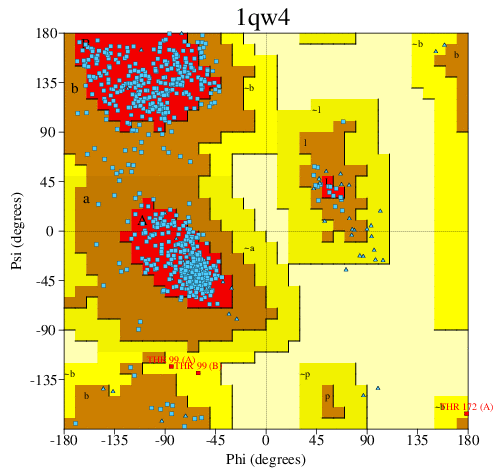
PROCHECK
|
|
|
|
|
|
Headers
|
|
|
|
References
|
|
|
|
|
|

|
|
P29477
(NOS2_MOUSE) -
Nitric oxide synthase, inducible from Mus musculus
|
|
|
|
Seq:
Struc:
|
|
|
|
1144 a.a.
419 a.a.
|
|

|

|
|
|
|
|
|
|
|
|
|
|
|
Key: |
 |
PfamA domain |
|
|
 |
Secondary structure |
|
 |
CATH domain |
|
|
|
|
|
|
|
|
|
|
|
|
|
Enzyme class:
|
|
E.C.1.14.13.39
- nitric-oxide synthase (NADPH).
|
|
|
|
|
|
|
Reaction:
|
|
2 L-arginine + 3 NADPH + 4 O2 + H+ = 2 L-citrulline + 2 nitric oxide + 3 NADP+ + 4 H2O
|
|
|
|
|
|
 2
×
L-arginine
2
×
L-arginine
|
+
|
3
×
NADPH
Bound ligand (Het Group name = )
matches with 80.00% similarity
|
+
|
 4
×
O2
4
×
O2
|
+
|
H(+)
|
=
|
 2
×
L-citrulline
2
×
L-citrulline
|
+
|
 2
×
nitric oxide
2
×
nitric oxide
|
+
|
 3
×
NADP(+)
3
×
NADP(+)
|
+
|
4
×
H2O
|
|
|
|
|
|
|
|
|
|
|
|
|
Molecule diagrams generated from .mol files obtained from the
KEGG ftp site
|
|
|
|
|
|
|
|
|
|
|
|
|
|
 |
|
|
|
|
|
|
| |
|
|
| |
|
DOI no:
|
J Biol Chem
278:45818-45825
(2003)
|
|
PubMed id:
|
|
|
|
|
|
| |
|
Structural basis for the specificity of the nitric-oxide synthase inhibitors W1400 and Nomega-propyl-L-Arg for the inducible and neuronal isoforms.
|
|
R.Fedorov,
E.Hartmann,
D.K.Ghosh,
I.Schlichting.
|
|
|
|
|
| |
ABSTRACT
|
|
|
|
| |
|
|
The high level of amino acid conservation and structural similarity in the
immediate vicinity of the substrate binding sites of the oxygenase domains of
the nitric-oxide synthase (NOS) isoforms (eNOSoxy, iNOSoxy, and nNOSoxy) make
the interpretation of the structural basis of inhibitor isoform specificity a
challenge and provide few clues for the design of new selective compounds.
Crystal structures of iNOSoxy and nNOSoxy complexed with the inhibitors W1400
and Nomega-propyl-l-arginine provide a rationale for their isoform specificity.
It involves differences outside the immediate active site as well as a
conformational flexibility in the active site that allows the adoption of
distinct conformations in response to interactions with the inhibitors. This
flexibility is determined by isoform-specific residues outside the active site.
|
|
|
|
|
|
| |
Selected figure(s)
|
|
|
|
| |
|
|

|
|

|
|
Figure 1.
FIG. 1. F[obs] - F[calc] difference electron density omit
maps contoured at 3  showing the inhibitors
N showing the inhibitors
N  -propyl-L-Arg (top) and
W1400 (bottom) bound to nNOSoxy (left) and the two
crystallographically independent molecules in the iNOSoxy
crystal form (molecule 1 (middle); molecule 2 (right)). -propyl-L-Arg (top) and
W1400 (bottom) bound to nNOSoxy (left) and the two
crystallographically independent molecules in the iNOSoxy
crystal form (molecule 1 (middle); molecule 2 (right)).
|
|
Figure 2.
FIG. 2. A, comparison of the structures of the iNOSoxy
(green) and nNOSoxy (gray) NPA complexes. There is one
qualitatively different interaction in the nNOSoxy complex that
originates ultimately from Asn-498 located in the substrate
access channel. iNOSoxy has a threonine (T277) at this position.
B, the view onto the heme plane shows the difference in the
positioning of  -strand S15 (F363 to
W366, iNOS numbering) that makes up the back wall of the heme
cavity. Asn-364 limits the space available for the propyl chain
of NPA in iNOSoxy. C-E, for illustration, the cavity between the
backwall and N of the bound L-Arg is
shown (green mesh) and the NPA coordinates are superimposed on
the corresponding L-Arg complexes. For eNOSoxy (Protein Data
Bank code 4NSE [PDB]
), the coordinates of NPA of the nNOSoxy-NPA complex were used.
In contrast to iNOSoxy (E), the cavity is rather large in
nNOSoxy (C) and eNOSoxy (D), explaining the latter's good
acceptance of inhibitors with bulky groups at the N position. F, -strand
S15 in murine iNOSoxy (green), human iNOSoxy (gray), bovine
eNOSoxy (violet), and human eNOSoxy (red) structures. -strand S15 (F363 to
W366, iNOS numbering) that makes up the back wall of the heme
cavity. Asn-364 limits the space available for the propyl chain
of NPA in iNOSoxy. C-E, for illustration, the cavity between the
backwall and N of the bound L-Arg is
shown (green mesh) and the NPA coordinates are superimposed on
the corresponding L-Arg complexes. For eNOSoxy (Protein Data
Bank code 4NSE [PDB]
), the coordinates of NPA of the nNOSoxy-NPA complex were used.
In contrast to iNOSoxy (E), the cavity is rather large in
nNOSoxy (C) and eNOSoxy (D), explaining the latter's good
acceptance of inhibitors with bulky groups at the N position. F, -strand
S15 in murine iNOSoxy (green), human iNOSoxy (gray), bovine
eNOSoxy (violet), and human eNOSoxy (red) structures.
|
|
|
|
|
|
| |
The above figures are
reprinted
by permission from the ASBMB:
J Biol Chem
(2003,
278,
45818-45825)
copyright 2003.
|
|
| |
Figures were
selected
by an automated process.
|
|
|
|
|
|
|
|
|
|
|
|
|
|
|
|
 |
 |
 |
|
Literature references that cite this PDB file's key reference
|
|
|
| |
PubMed id
|
|
Reference
|
|
|
|
|
|
R.B.Silverman
(2009).
Design of selective neuronal nitric oxide synthase inhibitors for the prevention and treatment of neurodegenerative diseases.
|
| |
Acc Chem Res,
42,
439-451.
|
|
|
|
|
|
|
E.D.Garcin,
A.S.Arvai,
R.J.Rosenfeld,
M.D.Kroeger,
B.R.Crane,
G.Andersson,
G.Andrews,
P.J.Hamley,
P.R.Mallinder,
D.J.Nicholls,
S.A.St-Gallay,
A.C.Tinker,
N.P.Gensmantel,
A.Mete,
D.R.Cheshire,
S.Connolly,
D.J.Stuehr,
A.Aberg,
A.V.Wallace,
J.A.Tainer,
and
E.D.Getzoff
(2008).
Anchored plasticity opens doors for selective inhibitor design in nitric oxide synthase.
|
| |
Nat Chem Biol,
4,
700-707.
|
|
|
PDB codes:
|
|
|
|
|
|
|
|
L.Jia,
V.Shafirovich,
R.Shapiro,
N.E.Geacintov,
and
S.Broyde
(2006).
Flexible 5-guanidino-4-nitroimidazole DNA lesions: structures and thermodynamics.
|
| |
Biochemistry,
45,
6644-6655.
|
|
|
|
|
|
|
R.Fedorov,
R.Vasan,
D.K.Ghosh,
and
I.Schlichting
(2004).
Structures of nitric oxide synthase isoforms complexed with the inhibitor AR-R17477 suggest a rational basis for specificity and inhibitor design.
|
| |
Proc Natl Acad Sci U S A,
101,
5892-5897.
|
|
|
PDB codes:
|
|
|
|
|
|
|
The most recent references are shown first.
Citation data come partly from CiteXplore and partly
from an automated harvesting procedure. Note that this is likely to be
only a partial list as not all journals are covered by
either method. However, we are continually building up the citation data
so more and more references will be included with time.
Where a reference describes a PDB structure, the PDB
codes are
shown on the right.
|
|


 Links
Links


