 |
PDBsum entry 1vaf

|
|
|
|
|
|

|

|

|

|
|

|
|

|
|

|
|

|
|

|
|

|
|

|
|
|
 |

|

|
|
|
|
|
|
|
|
|
|
|
|
|
|
|
|
|
|
|
|
|
|
|
|
|
|
|
|
|
|
|
|
|
|
|
|
Oxidoreductase
|
PDB id
|
|
|
|
1vaf
|
|
|
|
|
|
|
|
|
|
|
|
|
|
|

|

|

|
|
|
|
|
|
|
|
 |
Contents |
 |
|
|
|
|
|
|
|
|
|
|
|
|
|
|
* Residue conservation analysis
|
|
|
|
|
|
PDB id:
|
|
|
|
| Name: |
|
Oxidoreductase
|
|
|
Title:
|
|
Inducible nitric oxide synthase oxygenase domain complexed with the inhibitor ar-r17477
|
|
Structure:
|
|
Nitric oxide synthase, inducible. Chain: a, b. Fragment: inducible nitric oxide synthase oxygenase domain (residues 77-495). Synonym: nos, type ii, inducible nos, inos, macrophage nos, mac-nos. Engineered: yes
|
|
Source:
|
|
Mus musculus. House mouse. Organism_taxid: 10090. Gene: nos2, inosl. Expressed in: escherichia coli. Expression_system_taxid: 562.
|
|
Biol. unit:
|
|
Dimer (from PDB file)
|
|
Resolution:
|
|
|
2.90Å
|
R-factor:
|
0.207
|
R-free:
|
0.262
|
|
|
Authors:
|
|
R.Fedorov,R.Vasan,D.K.Ghosh,I.Schlichting
|
Key ref:

|
|
R.Fedorov
et al.
(2004).
Structures of nitric oxide synthase isoforms complexed with the inhibitor AR-R17477 suggest a rational basis for specificity and inhibitor design.
Proc Natl Acad Sci U S A,
101,
5892-5897.
PubMed id:
DOI:

|
|
|
Date:
|
|
|
16-Feb-04
|
Release date:
|
01-Jun-04
|
|
|
|
|
|
|
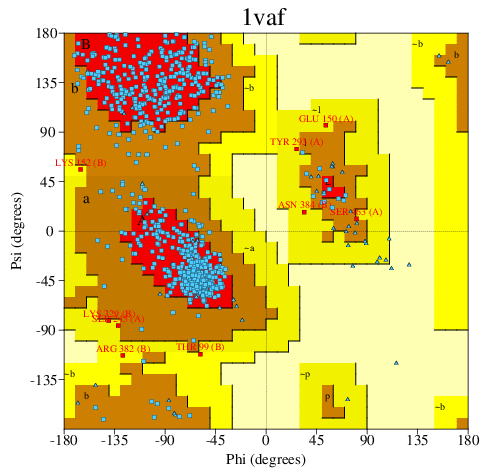
PROCHECK
|
|
|
|
|
|
Headers
|
|
|
|
References
|
|
|
|
|
|

|
|
P29477
(NOS2_MOUSE) -
Nitric oxide synthase, inducible from Mus musculus
|
|
|
|
Seq:
Struc:
|
|
|
|
1144 a.a.
419 a.a.
|
|

|

|
|
|
|
|
|
|
|
|
|
|
|
Key: |
 |
PfamA domain |
|
|
 |
Secondary structure |
|
 |
CATH domain |
|
|
|
|
|
|
|
|
|
|
|
|
|
Enzyme class:
|
|
E.C.1.14.13.39
- nitric-oxide synthase (NADPH).
|
|
|
|
|
|
|
Reaction:
|
|
2 L-arginine + 3 NADPH + 4 O2 + H+ = 2 L-citrulline + 2 nitric oxide + 3 NADP+ + 4 H2O
|
|
|
|
|
|
 2
×
L-arginine
2
×
L-arginine
|
+
|
 3
×
NADPH
3
×
NADPH
|
+
|
 4
×
O2
4
×
O2
|
+
|
H(+)
|
=
|
 2
×
L-citrulline
2
×
L-citrulline
|
+
|
 2
×
nitric oxide
2
×
nitric oxide
|
+
|
 3
×
NADP(+)
3
×
NADP(+)
|
+
|
4
×
H2O
|
|
|
|
|
|
|
|
|
|
|
|
|
Molecule diagrams generated from .mol files obtained from the
KEGG ftp site
|
|
|
|
|
|
|
|
|
|
|
|
|
|
 |
|
|
|
|
|
|
| |
|
|
| |
|
DOI no:
|
Proc Natl Acad Sci U S A
101:5892-5897
(2004)
|
|
PubMed id:
|
|
|
|
|
|
| |
|
Structures of nitric oxide synthase isoforms complexed with the inhibitor AR-R17477 suggest a rational basis for specificity and inhibitor design.
|
|
R.Fedorov,
R.Vasan,
D.K.Ghosh,
I.Schlichting.
|
|
|
|
|
| |
ABSTRACT
|
|
|
|
| |
|
|
The high level of amino acid conservation and structural similarity of the
substrate-binding sites of the oxygenase domains of the nitric oxide synthase
(NOS) isoforms (eNOSoxy, iNOSoxy, nNOSoxy) make the interpretation of the
structural basis of inhibitor isoform specificity a challenge, and provide few
clues for the design of new selective compounds. Crystal structures of iNOSoxy
and nNOSoxy complexed with the neuronal NOS-specific inhibitor AR-R17447 suggest
that specificity is provided by the interaction of the chlorophenyl group with
an isoform-unique substrate access channel residue (L337 in rat neuronal NOS,
N115 in mouse inducible NOS). This is confirmed by biochemical analysis of
site-directed mutants. Inhibitors combining guanidinium-like structural motifs
with long chains specifically targeting this residue are good candidates for
rational isoform-specific drug design. Based on this finding, modifications of
AR-R17447 to improve the specificity for the human isoforms are suggested.
|
|
|
|
|
|
| |
Selected figure(s)
|
|
|
|
| |
|
|

|
|

|
|
Figure 1.
Fig. 1. F[obs] - F[calc] electron density omit maps
contoured at 3  superimposed with the
final model of the inhibitor AR-R17477 bound to nNOSoxy and the
two crystallographically independent molecules in the asymmetric
unit of iNOSoxy crystals (mol.1 and mol.2). superimposed with the
final model of the inhibitor AR-R17477 bound to nNOSoxy and the
two crystallographically independent molecules in the asymmetric
unit of iNOSoxy crystals (mol.1 and mol.2).
|
|
Figure 2.
Fig. 2. Schematic representation of the interactions of
AR-R17477 and nNOSoxy and iNOSoxy (two molecules in asymmetric
unit, two conformations each). Dashed lines correspond to
hydrogen bonds, dotted lines correspond to van der Waals
interactions.
|
|
|
|
| |
Figures were
selected
by an automated process.
|
|
|
|
|
|
|
|
|
|
|
|
|
|
|
|
 |
 |
 |
|
Literature references that cite this PDB file's key reference
|
|
|
| |
PubMed id
|
|
Reference
|
|
|
|
|
|
A.Pavelka,
E.Chovancova,
and
J.Damborsky
(2009).
HotSpot Wizard: a web server for identification of hot spots in protein engineering.
|
| |
Nucleic Acids Res,
37,
W376-W383.
|
|
|
|
|
|
|
J.Fang,
H.Ji,
G.R.Lawton,
F.Xue,
L.J.Roman,
and
R.B.Silverman
(2009).
L337H mutant of rat neuronal nitric oxide synthase resembles human neuronal nitric oxide synthase toward inhibitors.
|
| |
J Med Chem,
52,
4533-4537.
|
|
|
|
|
|
|
J.Fang,
and
R.B.Silverman
(2009).
A cellular model for screening neuronal nitric oxide synthase inhibitors.
|
| |
Anal Biochem,
390,
74-78.
|
|
|
|
|
|
|
M.Pavlova,
M.Klvana,
Z.Prokop,
R.Chaloupkova,
P.Banas,
M.Otyepka,
R.C.Wade,
M.Tsuda,
Y.Nagata,
and
J.Damborsky
(2009).
Redesigning dehalogenase access tunnels as a strategy for degrading an anthropogenic substrate.
|
| |
Nat Chem Biol,
5,
727-733.
|
|
|
|
|
|
|
S.M.Francis,
A.Mittal,
M.Sharma,
and
P.V.Bharatam
(2008).
Design of benzene-1,2-diamines as selective inducible nitric oxide synthase inhibitors: a combined de novo design and docking analysis.
|
| |
J Mol Model,
14,
215-224.
|
|
|
|
|
|
|
W.Li,
N.T.Lee,
H.Fu,
K.K.Kan,
Y.Pang,
M.Li,
K.W.Tsim,
X.Li,
and
Y.Han
(2006).
Neuroprotection via inhibition of nitric oxide synthase by bis(7)-tacrine.
|
| |
Neuroreport,
17,
471-474.
|
|
|
|
|
|
|
T.L.Arakaki,
J.A.Pezza,
M.A.Cronin,
C.E.Hopkins,
D.B.Zimmer,
D.R.Tolan,
and
K.N.Allen
(2004).
Structure of human brain fructose 1,6-(bis)phosphate aldolase: linking isozyme structure with function.
|
| |
Protein Sci,
13,
3077-3084.
|
|
|
PDB code:
|
|
|
|
|
|
|
The most recent references are shown first.
Citation data come partly from CiteXplore and partly
from an automated harvesting procedure. Note that this is likely to be
only a partial list as not all journals are covered by
either method. However, we are continually building up the citation data
so more and more references will be included with time.
Where a reference describes a PDB structure, the PDB
code is
shown on the right.
|
|


 Links
Links




