
Briony Jackson
Head of Science Education and Public Engagement
bjackson [at] ebi.ac.uk
EditDeepti Gupta and David Armstrong of PDBe share how they engage young people with art and science through the PDB Art project.
Head of Science Education and Public Engagement
bjackson [at] ebi.ac.uk
Edit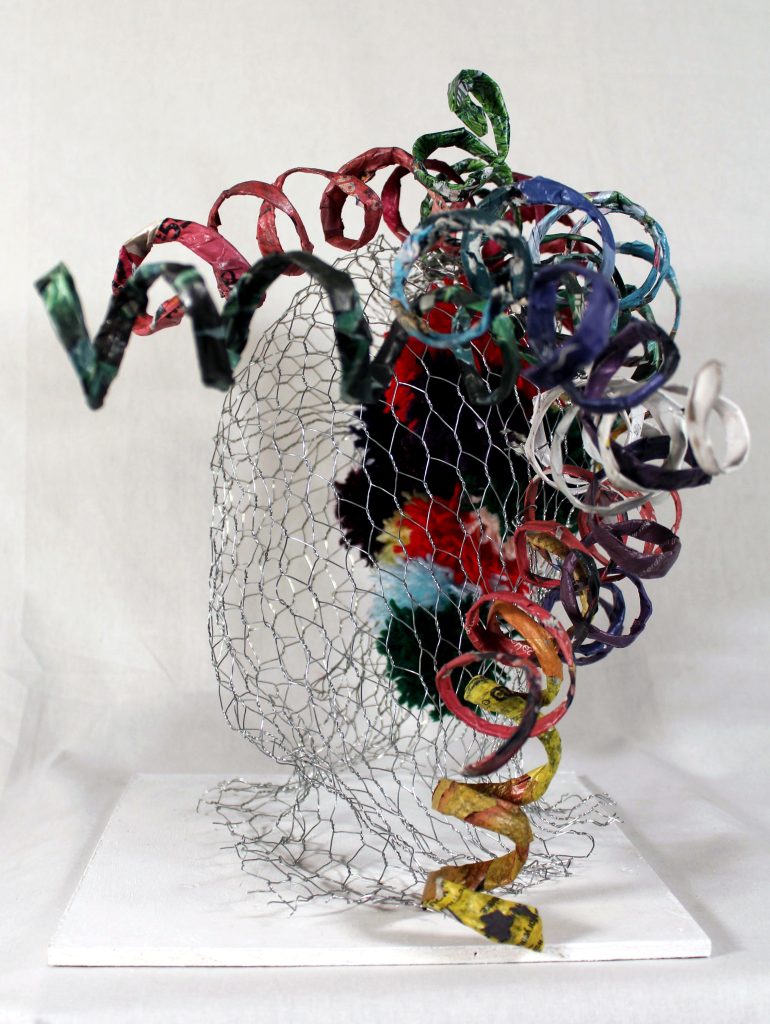
Deepti: I’m a curator for the Protein Databank in Europe (PDBe), which is jointly responsible for managing the Protein Data Bank (PDB) archive – a database containing 3D atomic structures for more than 175 000 biomolecules. These structures are crucial for scientists looking for answers to important biological and biomedical questions relating to disease, metabolism and drug development. I check the protein structures, submitted by scientists in Europe and Africa, to ensure the data is as accurate and complete as possible before inclusion in the PDBe archive where it’s freely available for researchers around the world.
David: I have a dual role, I’m partly a curator like Deepti, and my other role is Outreach and Training Coordinator for the PDBe team. I oversee all our outreach and training to user communities and support our public engagement projects.
Deepti: PDB Art started in 2015 working with a single student and an ambition to bring the two traditionally distinct disciplines of art and science together to make science more accessible, inspiring young people to explore the beauty of proteins through art. The project expanded over time and we now work with eight schools in the UK and Australia.
It’s a collaborative project bringing together art societies, school students, school art and science departments and scientists. Through this cross-curricular approach, students create artworks inspired by proteins, simultaneously gaining insight into the world of structural biology. The project concludes in an exhibition, usually in Cambridge and at the Wellcome Genome Campus so friends, family, scientists and the general public can view the artwork.
David: Partly it’s to share our science with a wider audience because structural biology and protein science are of huge importance in biological research especially human health and drug design. We know that most of the general public aren’t aware of this area of science so finding new ways to engage the public was one of the big goals.
Personally, I’m motivated to do more public engagement because it’s so rewarding to talk to people about our work and see their spark of interest.
We hold the keys to the fascinating world of proteins that we can open to others, so I’m keen to do more large-scale engagement to reach even more people.
Deepti: I didn’t know about protein structures until my undergraduate studies, and I fell in love with protein crystals and the amazing protein structures that can reveal so much about the protein function and importance. I want to provide an opportunity to younger audiences to see and explore protein structures. It’s a wonderful way to connect with the school students and talk about the science behind the structure.
Deepti: We aim to engage three different audiences: the students involved in the project, their teachers and the general public, including friends and family, who visit the exhibition. In the last couple of years we reached an even wider audience through virtual exhibitions, which made the artwork accessible to a worldwide audience.
David: We initially worked with 16 to 18-year-olds because there was natural crossover with their areas of study. However, we wanted to reach a younger audience too and so we’ve developed a programme that is accessible to students as young as 12. We would like to reach an even younger age group, introducing them to the concepts of DNA and proteins. The creative and visual nature of the PDB Art project lends itself well to this but the current structure of project would need adapting for a younger audience. In February 2022 we took part in a community event Joy at the Jobcentre and collaborated with families to create a large-scale protein polygon art work.
David: One of the biggest benefits is the opportunity to engage the public in science that underpins human health, disease and pharmaceutical drug development. Also, to build trust in, and familiarity with, science so that when topics come up in the news, for example, they are confident the information is grounded in science. I think this has been shown clearly during the coronavirus pandemic. It was helpful to see the virus images represented so often because it demonstrated there was understanding of the structure of the virus, it wasn’t a completely abstract thing.
Deepti: For the scientists it can provide a fresh perspective to their work.
It’s a great way to reconnect the scientific community to the public audiences and inspire them to do more engagement.
Joy Choi from Impington Village College in Cambridge talks about her experience of being involved in the PDB Art project in 2020 and what she learnt in the process.
It’s a great way to reconnect the scientific community to the public audiences and inspire them to do more engagement.
David: The students often feed back that they’ve not really considered the crossover between art and science before. This project can open their eyes to the fact that subjects that are often considered distinct from each other do work together. In structural biology we’re less focused on one protein and more on the broader outlook – where the protein fits in the wider world.
Deepti: Students appreciate the self-directed nature of the project; they choose their own protein to study and research before creating their artwork. They learn new skills as they explore protein depiction. By working on a cross-curricular project the students became more aware of career options and roles that straddle art and science, like graphic design or scientific illustration. It’s wonderful that the students are thinking beyond the current project to their career opportunities.
The project adds value to the student’s studies – by forging greater connections between Art and Science they strengthen the knowledge in both subjects.
David: The first thing that surprised us was just how impressive and creative the artworks were. We were expecting artistic replicas of scientific protein structures, but the students created brilliant, abstract depictions of the protein structure within their context.
There are some significant themes running through the works and the students show great depth of knowledge and comprehension through their artworks.
Another pleasant surprise is how well the teachers have taken to this project. Seeing them keen to have a go at something outside of their usual comfort zone, both in terms of topic and working across departments, is so encouraging.
Deepti: So that our capacity doesn’t become a limiting factor to participation, we are increasing the supporting teaching resources that we host on the PDB Art website. Our aim is to make the project programme accessible to schools to run with little or no guidance from us. We’ll include suggested ways to contact local scientists and scientific organisations so that the in-person engagement with science can be maintained and schools can submit artworks for inclusion in the exhibition.
David: We also plan to develop a digital archive to showcase all the project artworks so they can become a resource themselves and have a life beyond the physical exhibition. We want to link this to the PDBe archive pages so that when a scientist is looking at protein structure, they can also access the artistic depiction of the structure, further connecting science and art.