 |
PDBsum entry 6qqh

|
|
|
|
|
|

|

|

|

|
|

|
|

|
|

|
|
|
 |

|

|
|
|
|
|
|
|
|
|
|
|
|
|
|
|
|
|
|
|
|
|
|
|
|
|
|
|
|
|
|
|
|
Plant protein
|
PDB id
|
|
|
|
6qqh
|
|
|
|
|
|
|
|
|
|
|
|
|
|
|

|

|

|
|
|
|
|
|
|
PDB id:
|
|
|
|
| Name: |
|
Plant protein
|
|
|
Title:
|
|
Cryogenic temperature structure of the ground state of atphot2lov2 recorded after an accumulated dose of 2.68 mgy
|
|
Structure:
|
|
Phototropin-2. Chain: a. Synonym: defective in chloroplast avoidance protein 1,non-phototropic hypocotyl 1-like protein 1,nph1-like protein 1. Engineered: yes
|
|
Source:
|
|
Arabidopsis thaliana. Mouse-ear cress. Organism_taxid: 3702. Gene: phot2, cav1, kin7, npl1, at5g58140, k21l19.6. Expressed in: escherichia coli bl21(de3). Expression_system_taxid: 469008
|
|
Resolution:
|
|
|
1.38Å
|
R-factor:
|
0.141
|
R-free:
|
0.170
|
|
|
Authors:
|
|
S.Aumonier,G.Gotthard,A.Royant
|
|
Key ref:
|
|
G.Gotthard
et al.
(2019).
Specific radiation damage is a lesser concern at room temperature.
IUCrJ,
6,
665-680.
PubMed id:
DOI:
|
|
|
Date:
|
|
|
18-Feb-19
|
Release date:
|
19-Jun-19
|
|
|
|
|
|
|
PROCHECK
|

|
|
|
|
|
Headers
|
|
|
|
References
|
|
|
|
|
|

|
|
P93025
(PHOT2_ARATH) -
Phototropin-2 from Arabidopsis thaliana
|
|
|
|
Seq:
Struc:
|
|
|
|
915 a.a.
117 a.a.*
|
|

|

|

|
|
|
|
|
|
|
|
|
|
|
Key: |
 |
PfamA domain |
|
|
 |
Secondary structure |
|
|
*
PDB and UniProt seqs differ
at 10 residue positions (black
crosses)
|
|
|
|
|
|
|
|
|
|
|
|
|
Enzyme class:
|
|
E.C.2.7.11.1
- non-specific serine/threonine protein kinase.
|
|
|
|
|
|
|
Reaction:
|
|
|
1.
|
L-seryl-[protein] + ATP = O-phospho-L-seryl-[protein] + ADP + H+
|
|
2.
|
L-threonyl-[protein] + ATP = O-phospho-L-threonyl-[protein] + ADP + H+
|
|
|
|
|
|
|
L-seryl-[protein]
|
+
|
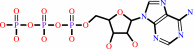 ATP
ATP
|
=
|
O-phospho-L-seryl-[protein]
Bound ligand (Het Group name = )
matches with 61.11% similarity
|
+
|
 ADP
ADP
|
+
|
H(+)
|
|
|
|
|
|
|
L-threonyl-[protein]
|
+
|
ATP
|
=
|
O-phospho-L-threonyl-[protein]
Bound ligand (Het Group name = )
matches with 61.11% similarity
|
+
|
ADP
|
+
|
H(+)
|
|
|
|
|
|
|
|
|
|
|
|
|
Molecule diagrams generated from .mol files obtained from the
KEGG ftp site
|
|
|
|
|
|
|
|
|
|
|
|
|
|
 |
|
|
|
|
|
|
| |
|
|
| |
|
DOI no:
|
IUCrJ
6:665-680
(2019)
|
|
PubMed id:
|
|
|
|
|
|
| |
|
Specific radiation damage is a lesser concern at room temperature.
|
|
G.Gotthard,
S.Aumonier,
D.De Sanctis,
G.Leonard,
D.von Stetten,
A.Royant.
|
|
|
|
|
| |
ABSTRACT
|
|
|
|
| |
|
|
Carrying out macromolecular crystallography (MX) experiments at cryogenic
temperatures significantly slows the rate of global radiation damage, thus
facilitating the solution of high-resolution crystal structures of
macromolecules. However, cryo-MX experiments suffer from the early onset of
so-called specific radiation damage that affects certain amino-acid residues
and, in particular, the active sites of many proteins. Here, a series of MX
experiments are described which suggest that specific and global radiation
damage are much less decoupled at room temperature than they are at cryogenic
temperatures. The results reported here demonstrate the interest in reviving the
practice of collecting MX diffraction data at room temperature and allow
structural biologists to favourably envisage the development of time-resolved MX
experiments at synchrotron sources.
|
|
|
|
|
|
|
|
|
|
|
|
|
|
|
|
|
|
 |
 |
 |
|


 Links
Links


