 |
PDBsum entry 5ju5

|
|
|
|
|
|

|

|

|

|
|

|
|

|
|

|
|
|
 |

|

|
|
|
|
|
|
|
|
|
|
|
|
|
|
|
|
|
|
|
|
|
|
|
|
|
|
|
|
|
|
|
|
Signaling protein
|
PDB id
|
|
|
|
5ju5
|
|
|
|
|
|
|
|
|
|
|
|
|
|
|

|

|

|
|
|
|
|
|
|
PDB id:
|
|
|
|
| Name: |
|
Signaling protein
|
|
|
Title:
|
|
Crystal structure of the human tankyrase 1 (tnks) sam domain (d1055r), crystal form 1
|
|
Structure:
|
|
Tankyrase-1. Chain: a, b, c, d, e, f. Fragment: unp residues 1018-1093. Synonym: tank1,adp-ribosyltransferase diphtheria toxin-like 5,artd5, poly [adp-ribose] polymerase 5a,tnks-1,trf1-interacting ankyrin- related adp-ribose polymerase,tankyrase i. Engineered: yes
|
|
Source:
|
|
Homo sapiens. Human. Organism_taxid: 9606. Gene: tnks, parp5a, parpl, tin1, tinf1, tnks1. Expressed in: escherichia coli. Expression_system_taxid: 562
|
|
Resolution:
|
|
|
2.50Å
|
R-factor:
|
0.192
|
R-free:
|
0.211
|
|
|
Authors:
|
|
S.Guetter,L.Mariotti,N.Cronin
|
|
Key ref:
|
|
L.Mariotti
et al.
(2016).
Tankyrase Requires SAM Domain-Dependent Polymerization to Support Wnt-β-Catenin Signaling.
Mol Cell,
63,
498-513.
PubMed id:
DOI:
|
|
|
Date:
|
|
|
10-May-16
|
Release date:
|
03-Aug-16
|
|
|
|
|
|
|
PROCHECK
|

|
|
|
|
|
Headers
|
|
|
|
References
|
|
|
|
|
|

|
|
O95271
(TNKS1_HUMAN) -
Poly [ADP-ribose] polymerase tankyrase-1 from Homo sapiens
|
|
|
|
Seq:
Struc:
|
|
|
|
1327 a.a.
60 a.a.*
|
|

|

|

|
|
|
|
|
|
|
|
|
|
|
|
|
|
|
|
|
Enzyme class 1:
|
|
Chains A, B, C, D, E, F:
E.C.2.4.2.-
- ?????
|
|
|
|
|
|
|
Enzyme class 2:
|
|
Chains A, B, C, D, E, F:
E.C.2.4.2.30
- NAD(+) ADP-ribosyltransferase.
|
|
|
|
|
|
|
Pathway:
|
|
|
|
|
|
|
|
Reaction:
|
|
NAD+ + (ADP-D-ribosyl)n-acceptor = nicotinamide + (ADP-D- ribosyl)n+1-acceptor + H+
|
|
|
|
|
|
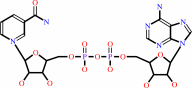 NAD(+)
|
+
|
(ADP-D-ribosyl)n-acceptor
|
=
|
 nicotinamide
|
+
|
(ADP-D- ribosyl)n+1-acceptor
|
+
|
H(+)
|
|
|
|
|
|
|
|
|
|
|
|
|
Note, where more than one E.C. class is given (as above), each may
correspond to a different protein domain or, in the case of polyprotein
precursors, to a different mature protein.
|
|
|
|
Molecule diagrams generated from .mol files obtained from the
KEGG ftp site
|
|
|
|
|
|
|
|
|
|
|
|
|
|
 |
|
|
|
|
|
|
| |
|
|
| |
|
DOI no:
|
Mol Cell
63:498-513
(2016)
|
|
PubMed id:
|
|
|
|
|
|
| |
|
Tankyrase Requires SAM Domain-Dependent Polymerization to Support Wnt-β-Catenin Signaling.
|
|
L.Mariotti,
C.M.Templeton,
M.Ranes,
P.Paracuellos,
N.Cronin,
F.Beuron,
E.Morris,
S.Guettler.
|
|
|
|
|
| |
ABSTRACT
|
|
|
|
| |
|
|
The poly(ADP-ribose) polymerase (PARP) Tankyrase (TNKS and TNKS2) is paramount
to Wnt-β-catenin signaling and a promising therapeutic target in Wnt-dependent
cancers. The pool of active β-catenin is normally limited by destruction
complexes, whose assembly depends on the polymeric master scaffolding protein
AXIN. Tankyrase, which poly(ADP-ribosyl)ates and thereby destabilizes AXIN, also
can polymerize, but the relevance of these polymers has remained unclear. We
report crystal structures of the polymerizing TNKS and TNKS2 sterile alpha motif
(SAM) domains, revealing versatile head-to-tail interactions. Biochemical
studies informed by these structures demonstrate that polymerization is required
for Tankyrase to drive β-catenin-dependent transcription. We show that the
polymeric state supports PARP activity and allows Tankyrase to effectively
access destruction complexes through enabling avidity-dependent AXIN binding.
This study provides an example for regulated signal transduction in
non-membrane-enclosed compartments (signalosomes), and it points to novel
potential strategies to inhibit Tankyrase function in oncogenic Wnt signaling.
|
|
|
|
|
|
|
|
|
|
|
|
|
|
|
|
|
|
 |
 |
 |
|
| |


 Links
Links


