 |
PDBsum entry 5y3e
 |
|
|
|
|
|
|
Enzyme class 1:
|
|
E.C.2.7.7.50
- mRNA guanylyltransferase.
|
|
|
|
|
|
|
Reaction:
|
|
a 5'-end diphospho-ribonucleoside in mRNA + GTP + H+ = a 5'-end (5'-triphosphoguanosine)-ribonucleoside in mRNA + diphosphate
|
|
|
|
|
|
5'-end diphospho-ribonucleoside in mRNA
|
+
|
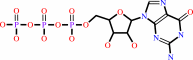 GTP
GTP
|
+
|
H(+)
|
=
|
5'-end (5'-triphosphoguanosine)-ribonucleoside in mRNA
|
+
|
 diphosphate
|
|
|
|
|
|
|
|
|
|
Enzyme class 2:
|
|
E.C.3.4.19.12
- ubiquitinyl hydrolase 1.
|
|
|
|
|
|
|
Reaction:
|
|
Thiol-dependent hydrolysis of ester, thiolester, amide, peptide and isopeptide bonds formed by the C-terminal Gly of ubiquitin (a 76-residue protein attached to proteins as an intracellular targeting signal).
|
|
|
|
|
|
Enzyme class 3:
|
|
E.C.3.4.22.-
- ?????
|
|
|
|
|
|
|
Enzyme class 4:
|
|
E.C.3.4.22.69
- Sars coronavirus main proteinase.
|
|
|
|
|
|
|
|
|
|
Note, where more than one E.C. class is given (as above), each may
correspond to a different protein domain or, in the case of polyprotein
precursors, to a different mature protein.
|
|
|
|
Molecule diagrams generated from .mol files obtained from the
KEGG ftp site
|
|
|
|
|
|
|
|
|
|
|
|
|
|
 |
|
|
|
|
|
|
| |
|
|
| |
|
DOI no:
|
Antiviral Res
150:155-163
(2018)
|
|
PubMed id:
|
|
|
|
|
|
| |
|
Disulfiram can inhibit MERS and SARS coronavirus papain-like proteases via different modes.
|
|
M.H.Lin,
D.C.Moses,
C.H.Hsieh,
S.C.Cheng,
Y.H.Chen,
C.Y.Sun,
C.Y.Chou.
|
|
|
|
|
| |
ABSTRACT
|
|
|
|
| |
|
|
Severe acute respiratory syndrome coronavirus (SARS-CoV) emerged in southern
China in late 2002 and caused a global outbreak with a fatality rate around 10%
in 2003. Ten years later, a second highly pathogenic human CoV, MERS-CoV,
emerged in the Middle East and has spread to other countries in Europe, North
Africa, North America and Asia. As of November 2017, MERS-CoV had infected at
least 2102 people with a fatality rate of about 35% globally, and hence there is
an urgent need to identify antiviral drugs that are active against MERS-CoV.
Here we show that a clinically available alcohol-aversive drug, disulfiram, can
inhibit the papain-like proteases (PLpros) of MERS-CoV and SARS-CoV.
Our findings suggest that disulfiram acts as an allosteric inhibitor of MERS-CoV
PLprobut as a competitive (or mixed) inhibitor of SARS-CoV
PLpro. The phenomenon of slow-binding inhibition and the
irrecoverability of enzyme activity after removing unbound disulfiram indicate
covalent inactivation of SARS-CoV PLproby disulfiram, while
synergistic inhibition of MERS-CoV PLproby disulfiram and
6-thioguanine or mycophenolic acid implies the potential for combination
treatments using these three clinically available drugs.
|
|
|
|
|
|
|
|
|
|
|
|
|
|
|
|
|
|
 |
 |
 |
|


 Links
Links


