 |
PDBsum entry 4lrk
 |
|
|
|
|
|
|
Enzyme class:
|
|
E.C.2.7.11.1
- non-specific serine/threonine protein kinase.
|
|
|
|
|
|
|
Reaction:
|
|
|
1.
|
L-seryl-[protein] + ATP = O-phospho-L-seryl-[protein] + ADP + H+
|
|
2.
|
L-threonyl-[protein] + ATP = O-phospho-L-threonyl-[protein] + ADP + H+
|
|
|
|
|
|
|
L-seryl-[protein]
|
+
|
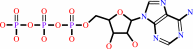 ATP
ATP
|
=
|
O-phospho-L-seryl-[protein]
|
+
|
 ADP
ADP
|
+
|
H(+)
|
|
|
|
|
|
|
L-threonyl-[protein]
|
+
|
ATP
|
=
|
O-phospho-L-threonyl-[protein]
|
+
|
ADP
|
+
|
H(+)
|
|
|
|
|
|
|
|
|
|
|
|
|
Molecule diagrams generated from .mol files obtained from the
KEGG ftp site
|
|
|
|
|
|
|
|
|
|
|
|
|
|
 |
|
|
|
|
|
|
| |
|
|
| |
|
DOI no:
|
Structure
22:250-259
(2014)
|
|
PubMed id:
|
|
|
|
|
|
| |
|
NleH defines a new family of bacterial effector kinases.
|
|
A.M.Grishin,
M.Cherney,
D.H.Anderson,
S.Phanse,
M.Babu,
M.Cygler.
|
|
|
|
|
| |
ABSTRACT
|
|
|
|
| |
|
|
Upon host cell infection, pathogenic Escherichia coli hijacks host cellular
processes with the help of 20-60 secreted effector proteins that subvert
cellular processes to create an environment conducive to bacterial survival. The
NleH effector kinases manipulate the NF-κB pathway and prevent apoptosis. They
show low sequence similarity to human regulatory kinases and contain two
domains, the N-terminal, likely intrinsically unfolded, and a C-terminal
kinase-like domain. We show that these effectors autophosphorylate on sites
located predominantly in the N-terminal segment. The kinase domain displays a
minimal kinase fold, but lacks an activation loop and the GHI subdomain.
Nevertheless, all catalytically important residues are conserved. ATP binding
proceeds with minimal structural rearrangements. The NleH structure is the first
for the bacterial effector kinases family. NleHs and their homologous effector
kinases form a new kinase family within the cluster of eukaryotic-like kinases
that includes also Rio, Bud32, and KdoK families.
|
|
|
|
|
|
|
|
|
|
|
|
|
|
|
|
|
|
 |
 |
 |
|


 Links
Links


