 |
PDBsum entry 4f7n

|
|
|
|
|
|

|

|

|

|
|

|
|

|
|

|
|

|
|

|
|

|
|
|
 |

|

|
|
|
|
|
|
|
|
|
|
|
|
|
|
|
|
|
|
|
|
|
|
|
|
|
|
|
|
|
|
|
|
|
|
|
Transferase/transcription/inhibitor
|
PDB id
|
|
|
|
4f7n
|
|
|
|
|
|
|
|
|
|
|
|
|
|
|

|

|

|
|
|
|
|
|
|
|
|
|
|
Enzyme class 1:
|
|
Chain A:
E.C.2.7.11.22
- cyclin-dependent kinase.
|
|
|
|
|
|
|
Reaction:
|
|
|
1.
|
L-seryl-[protein] + ATP = O-phospho-L-seryl-[protein] + ADP + H+
|
|
2.
|
L-threonyl-[protein] + ATP = O-phospho-L-threonyl-[protein] + ADP + H+
|
|
|
|
|
|
|
L-seryl-[protein]
|
+
|
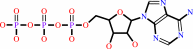 ATP
ATP
|
=
|
O-phospho-L-seryl-[protein]
|
+
|
 ADP
ADP
|
+
|
H(+)
|
|
|
|
|
|
|
L-threonyl-[protein]
|
+
|
ATP
|
=
|
O-phospho-L-threonyl-[protein]
|
+
|
ADP
|
+
|
H(+)
|
|
|
|
|
|
|
|
|
|
Enzyme class 2:
|
|
Chain A:
E.C.2.7.11.23
- [RNA-polymerase]-subunit kinase.
|
|
|
|
|
|
|
Reaction:
|
|
[DNA-directed RNA polymerase] + ATP = phospho-[DNA-directed RNA polymerase] + ADP + H+
|
|
|
|
|
|
[DNA-directed RNA polymerase]
|
+
|
ATP
|
=
|
phospho-[DNA-directed RNA polymerase]
|
+
|
ADP
|
+
|
H(+)
|
|
|
|
|
|
|
|
|
|
Enzyme class 3:
|
|
Chain B:
E.C.?
|
|
|
|
|
|
|
|
|
|
Note, where more than one E.C. class is given (as above), each may
correspond to a different protein domain or, in the case of polyprotein
precursors, to a different mature protein.
|
|
|
|
Molecule diagrams generated from .mol files obtained from the
KEGG ftp site
|
|
|
|
|
|
|
|
|
|
|
|
|
|
 |
|
|
|
|
|
|
| |
|
|
| |
|
DOI no:
|
Proc Natl Acad Sci U S A
110:8081-8086
(2013)
|
|
PubMed id:
|
|
|
|
|
|
| |
|
Structure-kinetic relationship study of CDK8/CycC specific compounds.
|
|
E.V.Schneider,
J.Böttcher,
R.Huber,
K.Maskos,
L.Neumann.
|
|
|
|
|
| |
ABSTRACT
|
|
|
|
| |
|
|
In contrast with the very well explored concept of structure-activity
relationship, similar studies are missing for the dependency between binding
kinetics and compound structure of a protein ligand complex, the
structure-kinetic relationship. Here, we present a structure-kinetic
relationship study of the cyclin-dependent kinase 8 (CDK8)/cyclin C (CycC)
complex. The scaffold moiety of the compounds is anchored in the kinase deep
pocket and extended with diverse functional groups toward the hinge region and
the front pocket. These variations can cause the compounds to change from fast
to slow binding kinetics, resulting in an improved residence time. The flip of
the DFG motif ("DMG" in CDK8) to the inactive DFG-out conformation
appears to have relatively little influence on the velocity of binding. Hydrogen
bonding with the kinase hinge region contributes to the residence time but has
less impact than hydrophobic complementarities within the kinase front pocket.
|
|
|
|
|
|
|
|
|
|
|
|
|
|
|
|
|
|
 |
 |
 |
|
|


 Links
Links


