 |
PDBsum entry 4ow0

|
|
|
|
|
|

|

|

|

|
|

|
|

|
|

|
|

|
|

|
|

|
|
|
 |

|

|
|
|
|
|
|
|
|
|
|
|
|
|
|
|
|
|
|
|
|
|
|
|
|
|
|
|
|
|
|
|
|
|
|
|
Hydrolase/hydrolase inhibitor
|
PDB id
|
|
|
|
4ow0
|
|
|
|
|
|
|
|
|
|
|
|
|
|
|

|

|

|
|
|
|
|
|
|
|
|
|
|
Enzyme class 1:
|
|
Chains A, B:
E.C.2.7.7.50
- mRNA guanylyltransferase.
|
|
|
|
|
|
|
Reaction:
|
|
a 5'-end diphospho-ribonucleoside in mRNA + GTP + H+ = a 5'-end (5'-triphosphoguanosine)-ribonucleoside in mRNA + diphosphate
|
|
|
|
|
|
5'-end diphospho-ribonucleoside in mRNA
|
+
|
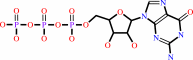 GTP
GTP
|
+
|
H(+)
|
=
|
5'-end (5'-triphosphoguanosine)-ribonucleoside in mRNA
|
+
|
 diphosphate
|
|
|
|
|
|
|
|
|
|
Enzyme class 2:
|
|
Chains A, B:
E.C.3.4.19.12
- ubiquitinyl hydrolase 1.
|
|
|
|
|
|
|
Reaction:
|
|
Thiol-dependent hydrolysis of ester, thiolester, amide, peptide and isopeptide bonds formed by the C-terminal Gly of ubiquitin (a 76-residue protein attached to proteins as an intracellular targeting signal).
|
|
|
|
|
|
Enzyme class 3:
|
|
Chains A, B:
E.C.3.4.22.-
- ?????
|
|
|
|
|
|
|
Enzyme class 4:
|
|
Chains A, B:
E.C.3.4.22.69
- Sars coronavirus main proteinase.
|
|
|
|
|
|
|
|
|
|
Note, where more than one E.C. class is given (as above), each may
correspond to a different protein domain or, in the case of polyprotein
precursors, to a different mature protein.
|
|
|
|
Molecule diagrams generated from .mol files obtained from the
KEGG ftp site
|
|
|
|
|
|
|
|
|
|
|
|
|
|
 |
|
|
|
|
|
|
| |
|
|
| |
|
DOI no:
|
J Med Chem
57:2393-2412
(2014)
|
|
PubMed id:
|
|
|
|
|
|
| |
|
X-ray structural and biological evaluation of a series of potent and highly selective inhibitors of human coronavirus papain-like proteases.
|
|
Y.M.Báez-Santos,
S.J.Barraza,
M.W.Wilson,
M.P.Agius,
A.M.Mielech,
N.M.Davis,
S.C.Baker,
S.D.Larsen,
A.D.Mesecar.
|
|
|
|
|
| |
ABSTRACT
|
|
|
|
| |
|
|
Structure-guided design was used to generate a series of noncovalent inhibitors
with nanomolar potency against the papain-like protease (PLpro) from the SARS
coronavirus (CoV). A number of inhibitors exhibit antiviral activity against
SARS-CoV infected Vero E6 cells and broadened specificity toward the homologous
PLP2 enzyme from the human coronavirus NL63. Selectivity and cytotoxicity
studies established a more than 100-fold preference for the coronaviral enzyme
over homologous human deubiquitinating enzymes (DUBs), and no significant
cytotoxicity in Vero E6 and HEK293 cell lines is observed. X-ray structural
analyses of inhibitor-bound crystal structures revealed subtle differences
between binding modes of the initial benzodioxolane lead (15g) and the most
potent analogues 3k and 3j, featuring a monofluoro substitution at para and meta
positions of the benzyl ring, respectively. Finally, the less lipophilic
bis(amide) 3e and methoxypyridine 5c exhibit significantly improved metabolic
stability and are viable candidates for advancing to in vivo studies.
|
|
|
|
|
|
|
|
|
|
|
|
|
|
|
|
|
|
 |
 |
 |
|
|


 Links
Links


