 |
PDBsum entry 3lqc

|
|
|
|
|
|

|

|

|

|
|

|
|

|
|

|
|

|
|

|
|
|
 |

|

|
|
|
|
|
|
|
|
|
|
|
|
|
|
|
|
|
|
|
|
|
|
|
|
|
|
|
|
|
|
|
|
|
|
DNA binding protein
|
PDB id
|
|
|
|
3lqc
|
|
|
|
|
|
|
|
|
|
|
|
|
|
|

|

|

|
|
|
|
|
|
|
|
 |
Contents |
 |
|
|
|
|
|
|
|
|
|
|
|
|
|
|
* Residue conservation analysis
|
|
|
|
|
|
|
|
|
|
Enzyme class 1:
|
|
Chain B:
E.C.2.7.7.7
- DNA-directed Dna polymerase.
|
|
|
|
|
|
|
Reaction:
|
|
DNA(n) + a 2'-deoxyribonucleoside 5'-triphosphate = DNA(n+1) + diphosphate
|
|
|
|
|
|
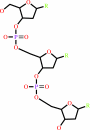 DNA(n)
|
+
|
2'-deoxyribonucleoside 5'-triphosphate
|
=
|
DNA(n+1)
|
+
|
 diphosphate
|
|
|
|
|
|
|
|
|
|
Enzyme class 2:
|
|
Chain B:
E.C.4.2.99.-
- ?????
|
|
|
|
|
|
|
Enzyme class 3:
|
|
Chain B:
E.C.4.2.99.18
- DNA-(apurinic or apyrimidinic site) lyase.
|
|
|
|
|
|
|
Reaction:
|
|
2'-deoxyribonucleotide-(2'-deoxyribose 5'-phosphate)- 2'-deoxyribonucleotide-DNA = a 3'-end 2'-deoxyribonucleotide-(2,3- dehydro-2,3-deoxyribose 5'-phosphate)-DNA + a 5'-end 5'-phospho- 2'-deoxyribonucleoside-DNA + H+
|
|
|
|
|
|
|
|
|
Note, where more than one E.C. class is given (as above), each may
correspond to a different protein domain or, in the case of polyprotein
precursors, to a different mature protein.
|
|
|
|
Molecule diagrams generated from .mol files obtained from the
KEGG ftp site
|
|
|
|
|
|
|
|
|
|
|
|
|
|
 |
|
|
|
|
|
|
| |
|
|
| |
|
|
Proc Natl Acad Sci U S A
107:6805-6810
(2010)
|
|
PubMed id:
|
|
|
|
|
|
| |
|
Oxidation state of the XRCC1 N-terminal domain regulates DNA polymerase beta binding affinity.
|
|
M.J.Cuneo,
R.E.London.
|
|
|
|
|
| |
ABSTRACT
|
|
|
|
| |
|
|
Formation of a complex between the XRCC1 N-terminal domain (NTD) and DNA
polymerase beta (Pol beta) is central to base excision repair of damaged DNA.
Two crystal forms of XRCC1-NTD complexed with Pol beta have been solved,
revealing that the XRCC1-NTD is able to adopt a redox-dependent alternate fold,
characterized by a disulfide bond, and substantial variations of secondary
structure, folding topology, and electrostatic surface. Although most of these
structural changes occur distal to the interface, the oxidized XRCC1-NTD forms
additional interactions with Pol beta, enhancing affinity by an order of
magnitude. Transient disulfide bond formation is increasingly recognized as an
important molecular regulatory mechanism. The results presented here suggest a
paradigm in DNA repair in which the redox state of a scaffolding protein plays
an active role in organizing the repair complex.
|
|
|
|
|
|
|
|
|
|
|
|
|
|
|
|
|
|
 |
 |
 |
|
Literature references that cite this PDB file's key reference
|
|
|
| |
PubMed id
|
|
Reference
|
|
|
|
|
|
R.Morita,
S.Nakane,
A.Shimada,
M.Inoue,
H.Iino,
T.Wakamatsu,
K.Fukui,
N.Nakagawa,
R.Masui,
and
S.Kuramitsu
(2010).
Molecular mechanisms of the whole DNA repair system: a comparison of bacterial and eukaryotic systems.
|
| |
J Nucleic Acids,
2010,
179594.
|
|
|
|
|
|
The most recent references are shown first.
Citation data come partly from CiteXplore and partly
from an automated harvesting procedure. Note that this is likely to be
only a partial list as not all journals are covered by
either method. However, we are continually building up the citation data
so more and more references will be included with time.
|
|
|


 Links
Links


