 |
PDBsum entry 3in5

|
|
|
|
|
|

|

|

|

|
|

|
|

|
|

|
|

|
|

|
|

|
|

|
|

|
|

|
|
|
 |

|

|
|
|
|
|
|
|
|
|
|
|
|
|
|
|
|
|
|
|
|
|
|
|
|
|
|
|
|
|
|
|
|
|
|
|
|
|
|
Transferase/DNA
|
PDB id
|
|
|
|
3in5
|
|
|
|
|
|
|
|
|
|
|
|
|
|
|

|

|

|
|
|
|
|
|
|
|
 |
Contents |
 |
|
|
|
|
|
|
|
|
|
|
|
|
|
|
|
|
* Residue conservation analysis
|
|
|
|
|
|
|
|
|
|
|
Enzyme class:
|
|
E.C.2.7.7.7
- DNA-directed Dna polymerase.
|
|
|
|
|
|
|
Reaction:
|
|
DNA(n) + a 2'-deoxyribonucleoside 5'-triphosphate = DNA(n+1) + diphosphate
|
|
|
|
|
|
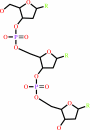 DNA(n)
|
+
|
2'-deoxyribonucleoside 5'-triphosphate
|
=
|
DNA(n+1)
|
+
|
 diphosphate
|
|
|
|
|
|
|
|
|
|
|
|
|
Molecule diagrams generated from .mol files obtained from the
KEGG ftp site
|
|
|
|
|
|
|
|
|
|
|
|
|
|
 |
|
|
|
|
|
|
| |
|
|
| |
|
|
Plos One
4:e5766
(2009)
|
|
PubMed id:
|
|
|
|
|
|
| |
|
Structure of human DNA polymerase kappa inserting dATP opposite an 8-OxoG DNA lesion.
|
|
R.Vasquez-Del Carpio,
T.D.Silverstein,
S.Lone,
M.K.Swan,
J.R.Choudhury,
R.E.Johnson,
S.Prakash,
L.Prakash,
A.K.Aggarwal.
|
|
|
|
|
| |
ABSTRACT
|
|
|
|
| |
|
|
BACKGROUND: Oxygen-free radicals formed during normal aerobic cellular
metabolism attack bases in DNA and 7,8-dihydro-8-oxoguanine (8-oxoG) is one of
the major lesions formed. It is amongst the most mutagenic lesions in cells
because of its dual coding potential, wherein 8-oxoG(syn) can pair with an A in
addition to normal base pairing of 8-oxoG(anti) with a C. Human DNA polymerase
kappa (Polkappa) is a member of the newly discovered Y-family of DNA polymerases
that possess the ability to replicate through DNA lesions. To understand the
basis of Polkappa's preference for insertion of an A opposite 8-oxoG lesion, we
have solved the structure of Polkappa in ternary complex with a template-primer
presenting 8-oxoG in the active site and with dATP as the incoming nucleotide.
METHODOLOGY AND PRINCIPAL FINDINGS: We show that the Polkappa active site is
well-adapted to accommodate 8-oxoG in the syn conformation. That is, the
polymerase and the bound template-primer are almost identical in their
conformations to that in the ternary complex with undamaged DNA. There is no
steric hindrance to accommodating 8-oxoG in the syn conformation for Hoogsteen
base-paring with incoming dATP. CONCLUSIONS AND SIGNIFICANCE: The structure we
present here is the first for a eukaryotic translesion synthesis (TLS) DNA
polymerase with an 8-oxoG:A base pair in the active site. The structure shows
why Polkappa is more efficient at inserting an A opposite the 8-oxoG lesion than
a C. The structure also provides a basis for why Polkappa is more efficient at
inserting an A opposite the lesion than other Y-family DNA polymerases.
|
|
|
|
|
|
|
|
|
|
|
|
|
|
|
|
|
|
 |
 |
 |
|
Literature references that cite this PDB file's key reference
|
|
|
| |
PubMed id
|
|
Reference
|
|
|
|
|
|
K.N.Kirouac,
and
H.Ling
(2011).
Unique active site promotes error-free replication opposite an 8-oxo-guanine lesion by human DNA polymerase iota.
|
| |
Proc Natl Acad Sci U S A,
108,
3210-3215.
|
|
|
PDB codes:
|
|
|
|
|
|
|
|
S.M.Sherrer,
K.A.Fiala,
J.D.Fowler,
S.A.Newmister,
J.M.Pryor,
and
Z.Suo
(2011).
Quantitative analysis of the efficiency and mutagenic spectra of abasic lesion bypass catalyzed by human Y-family DNA polymerases.
|
| |
Nucleic Acids Res,
39,
609-622.
|
|
|
|
|
|
|
S.Oka,
and
Y.Nakabeppu
(2011).
DNA glycosylase encoded by MUTYH functions as a molecular switch for programmed cell death under oxidative stress to suppress tumorigenesis.
|
| |
Cancer Sci,
102,
677-682.
|
|
|
|
|
|
|
J.D.Pata
(2010).
Structural diversity of the Y-family DNA polymerases.
|
| |
Biochim Biophys Acta,
1804,
1124-1135.
|
|
|
|
|
|
|
T.D.Silverstein,
R.Jain,
R.E.Johnson,
L.Prakash,
S.Prakash,
and
A.K.Aggarwal
(2010).
Structural basis for error-free replication of oxidatively damaged DNA by yeast DNA polymerase η.
|
| |
Structure,
18,
1463-1470.
|
|
|
PDB codes:
|
|
|
|
|
|
|
The most recent references are shown first.
Citation data come partly from CiteXplore and partly
from an automated harvesting procedure. Note that this is likely to be
only a partial list as not all journals are covered by
either method. However, we are continually building up the citation data
so more and more references will be included with time.
Where a reference describes a PDB structure, the PDB
codes are
shown on the right.
|
|


 Links
Links


