 |
PDBsum entry 3hyh

|
|
|
|
|
 |
Contents |
 |
|
|
|
|
|
|
|
|
|
|
* Residue conservation analysis
|
|
|
|
|
|
PDB id:
|
|
|
|
| Name: |
|
Transferase
|
|
|
Title:
|
|
Crystal structure of the protein kinase domain of yeast amp-activated protein kinase snf1
|
|
Structure:
|
|
Carbon catabolite-derepressing protein kinase. Chain: a, b. Fragment: kinase domain. Engineered: yes
|
|
Source:
|
|
Saccharomyces cerevisiae. Yeast. Organism_taxid: 4932. Gene: cat1, ccr1, d8035.20, glc2, pas14, snf1, ydr477w. Expressed in: escherichia coli. Expression_system_taxid: 562.
|
|
Resolution:
|
|
|
2.20Å
|
R-factor:
|
0.241
|
R-free:
|
0.280
|
|
|
Authors:
|
|
M.J.Rudolph,G.A.Amodeo,Y.Bai,L.Tong
|
|
Key ref:
|
|
M.J.Rudolph
et al.
(2005).
Crystal structure of the protein kinase domain of yeast AMP-activated protein kinase Snf1.
Biochem Biophys Res Commun,
337,
1224-1228.
PubMed id:
DOI:
|
|
|
Date:
|
|
|
22-Jun-09
|
Release date:
|
30-Jun-09
|
|
|
Supersedes:
|
|
|
|
|
|
|
|
PROCHECK
|

|
|
|
|
|
Headers
|
|
|
|
References
|
|
|
|
|
|

|
|
P06782
(SNF1_YEAST) -
Carbon catabolite-derepressing protein kinase from Saccharomyces cerevisiae (strain ATCC 204508 / S288c)
|
|
|
|
Seq:
Struc:
|
|
|
|
633 a.a.
238 a.a.
|
|

|

|
|
|
|
|
|
|
|
|
|
|
|
Key: |
 |
PfamA domain |
|
|
 |
Secondary structure |
|
 |
CATH domain |
|
|
|
|
|
|
|
|
|
|
|
|
|
Enzyme class:
|
|
E.C.2.7.11.1
- non-specific serine/threonine protein kinase.
|
|
|
|
|
|
|
Reaction:
|
|
|
1.
|
L-seryl-[protein] + ATP = O-phospho-L-seryl-[protein] + ADP + H+
|
|
2.
|
L-threonyl-[protein] + ATP = O-phospho-L-threonyl-[protein] + ADP + H+
|
|
|
|
|
|
|
L-seryl-[protein]
|
+
|
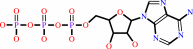 ATP
ATP
|
=
|
O-phospho-L-seryl-[protein]
|
+
|
 ADP
ADP
|
+
|
H(+)
|
|
|
|
|
|
|
L-threonyl-[protein]
|
+
|
ATP
|
=
|
O-phospho-L-threonyl-[protein]
|
+
|
ADP
|
+
|
H(+)
|
|
|
|
|
|
|
|
|
|
|
|
|
Molecule diagrams generated from .mol files obtained from the
KEGG ftp site
|
|
|
|
|
|
|
|
|
|
|
|
|
|
 |
|
|
|
|
|
|
| |
|
|
| |
|
DOI no:
|
Biochem Biophys Res Commun
337:1224-1228
(2005)
|
|
PubMed id:
|
|
|
|
|
|
| |
|
Crystal structure of the protein kinase domain of yeast AMP-activated protein kinase Snf1.
|
|
M.J.Rudolph,
G.A.Amodeo,
Y.Bai,
L.Tong.
|
|
|
|
|
| |
ABSTRACT
|
|
|
|
| |
|
|
AMP-activated protein kinase (AMPK) is a master metabolic regulator, and is an
important target for drug development against diabetes, obesity, and other
diseases. AMPK is a hetero-trimeric enzyme, with a catalytic (alpha) subunit,
and two regulatory (beta and gamma) subunits. Here we report the crystal
structure at 2.2A resolution of the protein kinase domain (KD) of the catalytic
subunit of yeast AMPK (commonly known as SNF1). The Snf1-KD structure shares
strong similarity to other protein kinases, with a small N-terminal lobe and a
large C-terminal lobe. Two negative surface patches in the structure may be
important for the recognition of the substrates of this kinase.
|
|
|
|
|
|
|
|
|
|
|
|
|
|
|
|
|
|
 |
 |
 |
|
Literature references that cite this PDB file's key reference
|
|
|
| |
PubMed id
|
|
Reference
|
|
|
|
|
|
L.Zhu,
L.Chen,
X.M.Zhou,
Y.Y.Zhang,
Y.J.Zhang,
J.Zhao,
S.R.Ji,
J.W.Wu,
and
Y.Wu
(2011).
Structural Insights into the Architecture and Allostery of Full-Length AMP-Activated Protein Kinase.
|
| |
Structure,
19,
515-522.
|
|
|
|
|
|
|
N.Handa,
T.Takagi,
S.Saijo,
S.Kishishita,
D.Takaya,
M.Toyama,
T.Terada,
M.Shirouzu,
A.Suzuki,
S.Lee,
T.Yamauchi,
M.Okada-Iwabu,
M.Iwabu,
T.Kadowaki,
Y.Minokoshi,
and
S.Yokoyama
(2011).
Structural basis for compound C inhibition of the human AMP-activated protein kinase α2 subunit kinase domain.
|
| |
Acta Crystallogr D Biol Crystallogr,
67,
480-487.
|
|
|
PDB codes:
|
|
|
|
|
|
|
|
C.Moffat,
and
M.Ellen Harper
(2010).
Metabolic functions of AMPK: aspects of structure and of natural mutations in the regulatory gamma subunits.
|
| |
IUBMB Life,
62,
739-745.
|
|
|
|
|
|
|
M.J.Rudolph,
G.A.Amodeo,
and
L.Tong
(2010).
An inhibited conformation for the protein kinase domain of the Saccharomyces cerevisiae AMPK homolog Snf1.
|
| |
Acta Crystallogr Sect F Struct Biol Cryst Commun,
66,
999.
|
|
|
PDB code:
|
|
|
|
|
|
|
|
A.A.Santos,
C.M.Carvalho,
L.H.Florentino,
H.J.Ramos,
and
E.P.Fontes
(2009).
Conserved threonine residues within the A-loop of the receptor NIK differentially regulate the kinase function required for antiviral signaling.
|
| |
PLoS One,
4,
e5781.
|
|
|
|
|
|
|
L.Chen,
Z.H.Jiao,
L.S.Zheng,
Y.Y.Zhang,
S.T.Xie,
Z.X.Wang,
and
J.W.Wu
(2009).
Structural insight into the autoinhibition mechanism of AMP-activated protein kinase.
|
| |
Nature,
459,
1146-1149.
|
|
|
PDB codes:
|
|
|
|
|
|
|
|
R.Scholz,
M.Suter,
T.Weimann,
C.Polge,
P.V.Konarev,
R.F.Thali,
R.D.Tuerk,
B.Viollet,
T.Wallimann,
U.Schlattner,
and
D.Neumann
(2009).
Homo-oligomerization and activation of AMP-activated protein kinase are mediated by the kinase domain alphaG-helix.
|
| |
J Biol Chem,
284,
27425-27437.
|
|
|
|
|
|
|
K.Hedbacker,
and
M.Carlson
(2008).
SNF1/AMPK pathways in yeast.
|
| |
Front Biosci,
13,
2408-2420.
|
|
|
|
|
|
|
T.J.Iseli,
J.S.Oakhill,
M.F.Bailey,
S.Wee,
M.Walter,
B.J.van Denderen,
L.A.Castelli,
F.Katsis,
L.A.Witters,
D.Stapleton,
S.L.Macaulay,
B.J.Michell,
and
B.E.Kemp
(2008).
AMP-activated protein kinase subunit interactions: beta1:gamma1 association requires beta1 Thr-263 and Tyr-267.
|
| |
J Biol Chem,
283,
4799-4807.
|
|
|
|
|
|
|
T.Williams,
and
J.E.Brenman
(2008).
LKB1 and AMPK in cell polarity and division.
|
| |
Trends Cell Biol,
18,
193-198.
|
|
|
|
|
|
|
U.Riek,
R.Scholz,
P.Konarev,
A.Rufer,
M.Suter,
A.Nazabal,
P.Ringler,
M.Chami,
S.A.Müller,
D.Neumann,
M.Forstner,
M.Hennig,
R.Zenobi,
A.Engel,
D.Svergun,
U.Schlattner,
and
T.Wallimann
(2008).
Structural properties of AMP-activated protein kinase: dimerization, molecular shape, and changes upon ligand binding.
|
| |
J Biol Chem,
283,
18331-18343.
|
|
|
|
|
|
|
B.E.Kemp,
J.S.Oakhill,
and
J.W.Scott
(2007).
AMPK structure and regulation from three angles.
|
| |
Structure,
15,
1161-1163.
|
|
|
|
|
|
|
B.Xiao,
R.Heath,
P.Saiu,
F.C.Leiper,
P.Leone,
C.Jing,
P.A.Walker,
L.Haire,
J.F.Eccleston,
C.T.Davis,
S.R.Martin,
D.Carling,
and
S.J.Gamblin
(2007).
Structural basis for AMP binding to mammalian AMP-activated protein kinase.
|
| |
Nature,
449,
496-500.
|
|
|
PDB codes:
|
|
|
|
|
|
|
|
G.A.Amodeo,
M.J.Rudolph,
and
L.Tong
(2007).
Crystal structure of the heterotrimer core of Saccharomyces cerevisiae AMPK homologue SNF1.
|
| |
Nature,
449,
492-495.
|
|
|
PDB code:
|
|
|
|
|
|
|
|
J.E.Brenman,
and
B.R.Temple
(2007).
Opinion: alternative views of AMP-activated protein kinase.
|
| |
Cell Biochem Biophys,
47,
321-331.
|
|
|
|
|
|
|
J.W.Scott,
F.A.Ross,
J.K.Liu,
and
D.G.Hardie
(2007).
Regulation of AMP-activated protein kinase by a pseudosubstrate sequence on the gamma subunit.
|
| |
EMBO J,
26,
806-815.
|
|
|
|
|
|
|
P.Day,
A.Sharff,
L.Parra,
A.Cleasby,
M.Williams,
S.Hörer,
H.Nar,
N.Redemann,
I.Tickle,
and
J.Yon
(2007).
Structure of a CBS-domain pair from the regulatory gamma1 subunit of human AMPK in complex with AMP and ZMP.
|
| |
Acta Crystallogr D Biol Crystallogr,
63,
587-596.
|
|
|
PDB codes:
|
|
|
|
|
|
|
|
R.A.Miller,
B.F.Binkowski,
and
P.J.Belshaw
(2007).
Ligand-regulated peptide aptamers that inhibit the 5'-AMP-activated protein kinase.
|
| |
J Mol Biol,
365,
945-957.
|
|
|
|
|
|
|
R.Townley,
and
L.Shapiro
(2007).
Crystal structures of the adenylate sensor from fission yeast AMP-activated protein kinase.
|
| |
Science,
315,
1726-1729.
|
|
|
PDB codes:
|
|
|
|
|
|
|
|
S.Lall
(2007).
Primers on chromatin.
|
| |
Nat Struct Mol Biol,
14,
1110-1115.
|
|
|
|
|
|
|
A.Marx,
C.Nugoor,
J.Müller,
S.Panneerselvam,
T.Timm,
M.Bilang,
E.Mylonas,
D.I.Svergun,
E.M.Mandelkow,
and
E.Mandelkow
(2006).
Structural variations in the catalytic and ubiquitin-associated domains of microtubule-associated protein/microtubule affinity regulating kinase (MARK) 1 and MARK2.
|
| |
J Biol Chem,
281,
27586-27599.
|
|
|
PDB code:
|
|
|
|
|
|
|
|
G.R.Steinberg,
S.L.Macaulay,
M.A.Febbraio,
and
B.E.Kemp
(2006).
AMP-activated protein kinase--the fat controller of the energy railroad.
|
| |
Can J Physiol Pharmacol,
84,
655-665.
|
|
|
|
|
|
|
P.Pellicena,
and
J.Kuriyan
(2006).
Protein-protein interactions in the allosteric regulation of protein kinases.
|
| |
Curr Opin Struct Biol,
16,
702-709.
|
|
|
|
|
|
The most recent references are shown first.
Citation data come partly from CiteXplore and partly
from an automated harvesting procedure. Note that this is likely to be
only a partial list as not all journals are covered by
either method. However, we are continually building up the citation data
so more and more references will be included with time.
Where a reference describes a PDB structure, the PDB
codes are
shown on the right.
|
|


 Links
Links


