 |
PDBsum entry 3fsi

|
|
|
|
|
|

|

|

|

|
|

|
|

|
|

|
|

|
|
|
 |

|

|
|
|
|
|
|
|
|
|
|
|
|
|
|
|
|
|
|
|
|
|
|
|
|
|
|
|
|
|
|
|
|
|
Transferase/DNA
|
PDB id
|
|
|
|
3fsi
|
|
|
|
|
|
|
|
|
|
|
|
|
|
|

|

|

|
|
|
|
|
|
|
|
 |
Contents |
 |
|
|
|
|
|
|
|
|
|
|
|
|
|
|
* Residue conservation analysis
|
|
|
|
|
|
|
|
|
|
|
Enzyme class 2:
|
|
E.C.2.7.7.-
- ?????
|
|
|
|
|
|
|
Enzyme class 3:
|
|
E.C.2.7.7.49
- RNA-directed Dna polymerase.
|
|
|
|
|
|
|
Reaction:
|
|
DNA(n) + a 2'-deoxyribonucleoside 5'-triphosphate = DNA(n+1) + diphosphate
|
|
|
|
|
|
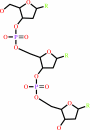 DNA(n)
|
+
|
2'-deoxyribonucleoside 5'-triphosphate
|
=
|
DNA(n+1)
|
+
|
 diphosphate
|
|
|
|
|
|
|
|
|
|
Enzyme class 4:
|
|
E.C.2.7.7.7
- DNA-directed Dna polymerase.
|
|
|
|
|
|
|
Reaction:
|
|
DNA(n) + a 2'-deoxyribonucleoside 5'-triphosphate = DNA(n+1) + diphosphate
|
|
|
|
|
|
DNA(n)
|
+
|
2'-deoxyribonucleoside 5'-triphosphate
|
=
|
DNA(n+1)
|
+
|
diphosphate
|
|
|
|
|
|
|
|
|
|
Enzyme class 5:
|
|
E.C.3.1.-.-
|
|
|
|
|
|
|
Enzyme class 6:
|
|
E.C.3.1.26.4
- ribonuclease H.
|
|
|
|
|
|
|
Reaction:
|
|
Endonucleolytic cleavage to 5'-phosphomonoester.
|
|
|
|
|
|
Enzyme class 7:
|
|
E.C.3.4.23.-
- ?????
|
|
|
|
|
|
|
|
|
|
Note, where more than one E.C. class is given (as above), each may
correspond to a different protein domain or, in the case of polyprotein
precursors, to a different mature protein.
|
|
|
|
Molecule diagrams generated from .mol files obtained from the
KEGG ftp site
|
|
|
|
|
|
|
|
|
|
|
|
|
|
 |
|
|
|
|
|
|
| |
|
|
| |
|
|
Biochemistry
48:5943-5952
(2009)
|
|
PubMed id:
|
|
|
|
|
|
| |
|
Crystal structure of a trypanocidal 4,4'-bis(imidazolinylamino)diphenylamine bound to DNA.
|
|
L.S.Glass,
B.Nguyen,
K.D.Goodwin,
C.Dardonville,
W.D.Wilson,
E.C.Long,
M.M.Georgiadis.
|
|
|
|
|
| |
ABSTRACT
|
|
|
|
| |
|
|
The pursuit of small molecules that bind to DNA has led to the discovery of
selective and potent antitrypanosomal agents, specifically
4,4'-bis(imidazolinylamino)- and 4,4'-bis(guanidino)diphenylamine compounds,
CD27 and CD25, respectively. Although the antitrypanosomal properties of these
compounds have been characterized, further development of this series of
compounds requires assessment of their DNA site selectivities and affinities.
Toward this end, both compounds have been analyzed and found to selectively bind
AT sequences. However, CD27 was found to bind with higher affinity to 5'-AATT
than 5'-ATAT while CD25 bound more weakly but equally well to either sequence.
To detail the nature of its interactions with DNA, the crystal structure of
CD27, bound to its preferred DNA-binding site 5'-AATT within a
self-complementary oligonucleotide, 5'-d(CTTAATTCGAATTAAG), was determined at
1.75 A using a host-guest approach. Although CD27 is predicted to be highly
twisted in its energy-minimized state, it adopts a more planar crescent shape
when bound in the minor groove of the DNA. Interactions of CD27 with 5'-AATT
include bifurcated hydrogen bonds, providing a basis for selectivity of this
site, and favorable van der Waals interactions in a slightly widened minor
groove. Thus, an induced fit results from conformational changes in both the
ligand and the DNA. Our studies suggest a basis for understanding the mechanism
of the antitrypanosomal activity of these symmetric diphenylamine compounds.
|
|
|
|
|
|
|
|
|
|
|
|
|
|
|
|
|
|
 |
 |
 |
|
Literature references that cite this PDB file's key reference
|
|
|
| |
PubMed id
|
|
Reference
|
|
|
|
|
|
L.S.Glass,
A.Bapat,
M.R.Kelley,
M.M.Georgiadis,
and
E.C.Long
(2010).
Semi-automated high-throughput fluorescent intercalator displacement-based discovery of cytotoxic DNA binding agents from a large compound library.
|
| |
Bioorg Med Chem Lett,
20,
1685-1688.
|
|
|
|
|
|
|
P.S.Nagle,
S.J.Quinn,
J.M.Kelly,
D.H.O'Donovan,
A.R.Khan,
F.Rodriguez,
B.Nguyen,
W.D.Wilson,
and
I.Rozas
(2010).
Understanding the DNA binding of novel non-symmetrical guanidinium/2-aminoimidazolinium derivatives.
|
| |
Org Biomol Chem,
8,
5558-5567.
|
|
|
|
|
|
The most recent references are shown first.
Citation data come partly from CiteXplore and partly
from an automated harvesting procedure. Note that this is likely to be
only a partial list as not all journals are covered by
either method. However, we are continually building up the citation data
so more and more references will be included with time.
|
|


 Links
Links


